
Drinking Water Production Equipment Process Flow Explained: Key Stages, Equipment Configuration, and Operational Conside
Introduction
The drinking water production equipment process flow is not a single machine, but a coordinated sequence of water treatment, container preparation, filling, sealing, inspection, and packaging. For procurement managers and operations leads in beverage, food, pharmaceutical, and industrial sectors, understanding each stage's operating logic and boundaries is essential for selecting a stable, maintainable line that matches actual source water conditions, target standards, and facility constraints.
Core Process Stages and Operating Logic
1. Source Water Assessment and Pre-Treatment
The process begins with evaluating raw water quality. Multi-media filtration removes larger suspended solids and reduces turbidity, protecting downstream membranes and valves. Activated carbon adsorption addresses chlorine, organic compounds, and taste/odor issues. The pre-treatment configuration is determined by the source water profile, not by a fixed template.
2. Deep Purification and Disinfection
For purified water lines, a two-stage reverse osmosis (RO) system provides deep deionization, typically followed by ozone and UV (254 nm) dual sterilization to control microbial load without chemical residuals. For spring or mineral water, a dual-membrane NF + UF process is often selected to balance purification efficiency with natural mineral retention. Ozone is effective for finished water and container-related disinfection but requires controlled dosing, contact time, and off-gas management. UV offers physical disinfection without residuals, though its effectiveness depends on water clarity, flow rate, lamp aging, and sleeve fouling.
3. Finished Water Storage and Distribution
Treated water is stored in sanitary tanks with closed-loop circulation to prevent stagnation. Constant-pressure supply pumps and online monitoring instruments maintain stable pressure and quality parameters. Storage and distribution design must account for material compatibility, cleaning access, and environmental control to avoid secondary contamination before filling.
4. Container Preparation and Filling Integration
The container handling sequence varies by packaging format:
- Barrelled water (3–5 gallon reusable containers):*
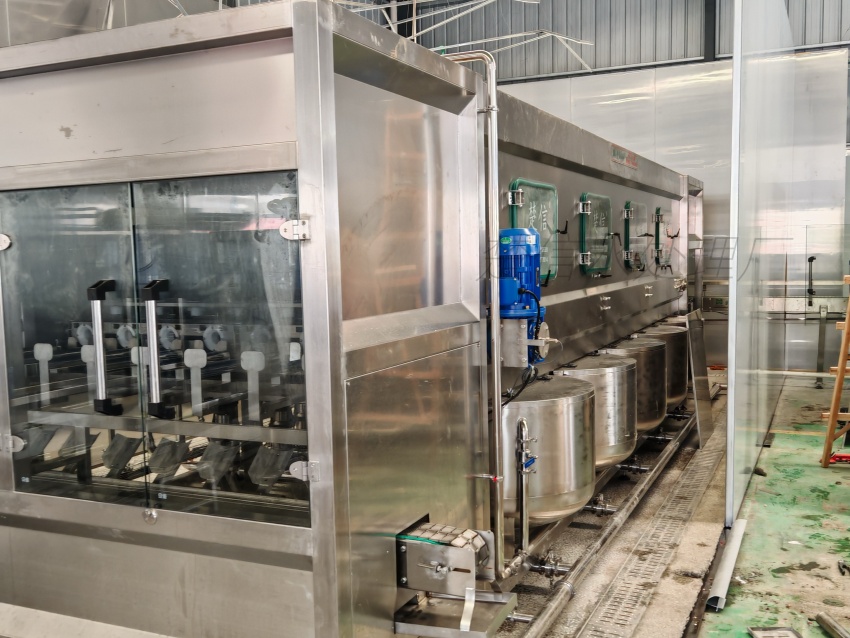
- The standard chain includes empty barrel recovery, inspection and sorting, cap removal, external/internal brushing, multi-stage washing and disinfection, final rinse with finished water, filling, capping, inspection, labeling, shrink-wrapping, coding, bagging, and palletizing. The core challenge is managing contamination from returned barrels, cleaning agent residues, final rinse water quality, cap hygiene, and filling room secondary pollution.
- Bottled water (single-use PET):*
- A three-in-one bottle washing-filling-capping machine integrates rinsing, filling, and sealing into a continuous unit, reducing intermediate handling and exposure. Selection variables include bottle type, neck finish, capacity, rated output, actual efficiency, filling method, changeover time, and upstream/downstream matching.
5. Inspection, Packaging, and Dispatch
Post-filling, lines incorporate liquid level detection, missing cap detection, and visual inspection. Automated labeling, shrink-wrapping, coding, and palletizing systems complete the workflow. Packaging configuration must align with product format, transport requirements, and warehouse logistics.
Equipment Configuration and Selection Criteria
When evaluating a drinking water production equipment process flow, focus on:
- Source water data and target standards:*
- Pre-treatment and membrane selection must reflect actual raw water composition and required output quality.
- Capacity and packaging format:*
- Rated output (e.g., 200–2,500 bottles/hour for 18.9 L containers) should match production schedules, shift patterns, and future expansion plans.
- Integration and automation level:*
- PLC-based control systems with HMI interfaces enable synchronized operation, real-time diagnostics, and reduced manual intervention.
- Facility constraints:*
- Available floor space, cleanroom zoning, utility connections (water, power, drainage), and environmental controls dictate equipment layout and support system design.
- Maintainability and service scope:*
- Long-term stability depends on accessible maintenance points, documented operating procedures, operator training, and clear after-sales support boundaries.
Operational Boundaries and Risk Considerations
- RO is not a standalone solution:*
- Membrane performance degrades without proper pre-treatment, regular monitoring of pressure differentials, flow rates, conductivity, and temperature, and scheduled cleaning protocols.
- Disinfection requires controlled application:*
- Ozone dosing must balance microbial control with off-gas safety and byproduct management. UV effectiveness declines with lamp aging and sleeve fouling, requiring routine inspection and replacement based on operating data, not fixed intervals.
- Container hygiene is as critical as water quality:*
- Reusable barrels introduce variable contamination levels; single-use bottles require controlled storage and handling to prevent pre-filling contamination.
- Cleanroom environment matters:*
- Filling zones should meet appropriate air cleanliness standards (e.g., ISO Class 8 or higher), with controlled airflow, pressure zoning, and HEPA filtration to minimize airborne contamination.
Practical Implementation Steps
- Collect source water analysis and define target standards before selecting purification technology.
- Map container types, capacity requirements, and facility layout to determine equipment configuration and automation level.
- Specify control system requirements (PLC/HMI, remote diagnostics, data logging) to support operational visibility and maintenance planning.
- Define cleanroom and environmental controls based on product type, packaging format, and regulatory expectations.
- Confirm service scope and support boundaries including installation, commissioning, operator training, spare parts availability, and response protocols.
Conclusion
A reliable drinking water production equipment process flow is engineered from actual source water conditions, target quality standards, production capacity, packaging format, and facility constraints. Success depends on matching equipment capabilities to real-world operational contexts, maintaining disciplined pre-treatment and disinfection practices, and ensuring sustained post-installation support. For project teams evaluating line upgrades or new installations, the next step is to align technical specifications with operational requirements and confirm delivery execution capabilities.
Next Steps
To evaluate a customized process flow for your facility, prepare source water test reports, target production capacity, container specifications, and layout constraints. Our engineering team can review your requirements, propose a matched configuration, and outline delivery scope, installation boundaries, and long-term support terms.