
Drinking Water Production Equipment Working Principle: Process Logic, Component Roles, and Scenario-Based Configuration
When evaluating drinking water production equipment, the working principle is not defined by a single machine, but by how each treatment stage prepares water and containers for the next. This article explains the operating logic of integrated water treatment and filling systems, clarifies component roles, and outlines configuration boundaries for real production environments.
How the System Works: Sequential Treatment Logic
Drinking water production follows a sequential workflow where upstream performance directly determines downstream stability. The equipment chain typically begins with raw water intake and moves through pretreatment, membrane purification, disinfection, finished water storage, container cleaning, filling, capping, inspection, and packaging.
For purified water applications, the standard process chain is: raw water → pretreatment → precision filtration → RO deionization → disinfection → finished water storage/circulation → container cleaning → filling and capping → inspection → packaging. For spring or mineral water, the logic shifts to preserving source characteristics while ensuring microbiological safety: source assessment → coarse filtration → fine filtration or ultrafiltration → controlled disinfection → storage/circulation → filling → inspection and packaging.
The system does not operate as isolated units. Pretreatment protects membranes, membrane output determines disinfection load, and finished water quality is only maintained if container hygiene and filling environment are controlled.
Core Components and Operating Functions
Pretreatment and Precision Filtration
Pretreatment removes suspended solids, reduces turbidity, and stabilizes feed conditions for downstream membranes. Multi-media filtration and activated carbon handle particulate matter and organic load, while precision filtration captures finer particles before membrane stages. The configuration depends on raw water quality, seasonal variation, and the required protection level for RO or UF membranes.
Membrane Purification: RO vs. UF/NF
Reverse osmosis (RO) provides deep deionization and is the core of purified water production. Single-stage or dual-stage RO configurations are selected based on target conductivity, recovery rate, and concentrate management. Ultrafiltration (UF) or nanofiltration (NF) retains beneficial minerals while removing microorganisms and colloids, making it suitable for spring water where source character must be preserved. The choice between RO and UF is not about which is universally superior; it depends on operational continuity, maintenance capacity, chemical dosing, footprint, and target water standards.
Disinfection and Finished Water Storage
Ozone and ultraviolet (UV) systems serve complementary roles. Ozone is effective for finished water and container-related disinfection but requires controlled dosage, contact time, off-gas management, and byproduct risk mitigation. UV provides physical disinfection without chemical residuals, but its effectiveness depends on water clarity, flow rate, lamp aging, and sleeve fouling. Neither method replaces the other; they are often combined to address different contamination pathways. Finished water is stored in sterile tanks with circulation loops to prevent stagnation and secondary contamination.
Container Cleaning and Filling Integration
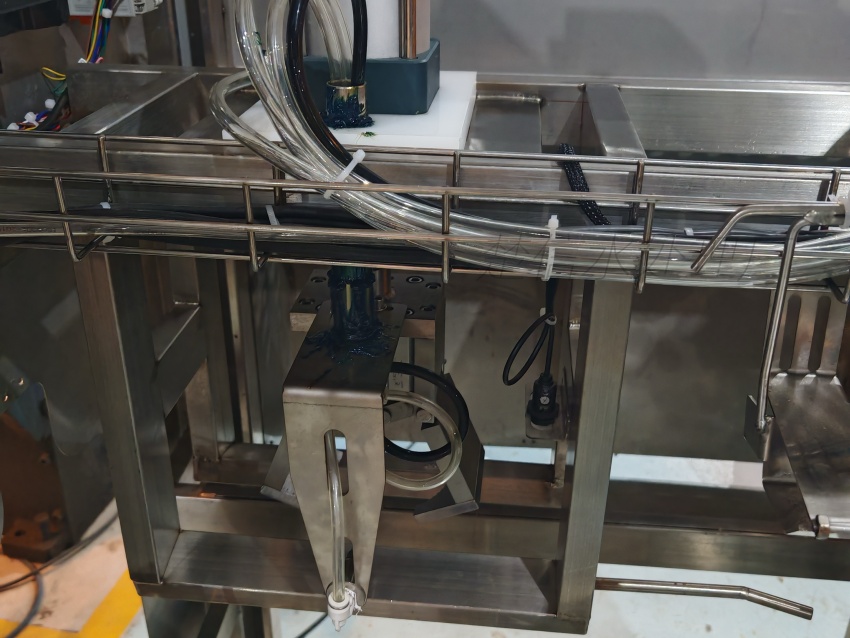
For bottled water, a three-in-one machine integrates bottle rinsing, filling, and capping into a continuous unit, reducing intermediate handling and exposure. For barrelled water (3-gallon, 5-gallon, or 18.9L reusable containers), the process includes cap removal, external and internal brushing, multi-stage washing, disinfection, final rinse, filling, capping, and inspection. The core challenge is not simply filling containers, but managing reusable container contamination, cleaning agent residuals, final rinse water quality, cap hygiene, and cleanroom air control.
Scenario-Based Configuration Guidelines
| Production Scenario | Recommended Core Process | Key Configuration Variables |
|---|---|---|
| Purified drinking water (bottled/barrelled) | Dual-stage RO + ozone/UV + sterile storage | Raw water variability, concentrate disposal, membrane replacement cycle, filling hygiene |
| Spring/mineral water | UF or NF + controlled disinfection | Source stability, mineral retention targets, seasonal quality shifts, packaging format |
| High-capacity lines | Integrated wash-fill-cap + automated packaging | Line balancing, changeover time, utility requirements, maintenance access |
| Facilities with space or layout constraints | Modular pretreatment + compact filling units | Piping routing, pressure zoning, cleanroom classification, future expansion |
Practical Boundaries and Risk Points
- RO depends on consistent pretreatment: Membrane performance degrades rapidly if feed water contains high turbidity, hardness, or organics. Skipping or undersizing pretreatment leads to frequent fouling and reduced membrane lifespan.
- Disinfection requires parameter control: Ozone overdosing can affect taste and material compatibility; UV underperformance occurs when flow exceeds design capacity or sleeves are fouled. Monitoring and scheduled maintenance are essential.
- Container hygiene determines final quality: Even with excellent water treatment, inadequate container cleaning, poor cap sanitation, or uncontrolled filling environment will compromise product safety. Cleanroom classification and air filtration must match production standards.
- Rated capacity assumes optimal conditions: Output ratings depend on container size, changeover frequency, operator skill, and upstream water supply stability. Real-world throughput should be validated during commissioning.
Next Steps for Procurement and Implementation
- Provide source water analysis: Include seasonal variation, turbidity, hardness, TDS, and microbial indicators to determine pretreatment and membrane selection.
- Define target standards and packaging: Specify required water quality, bottle/barrel sizes, and production capacity to align equipment configuration.
- Map facility constraints: Document available space, utility connections, drainage, and cleanroom requirements to ensure proper layout and airflow design.
- Request a process flow diagram and equipment list: Verify how each stage connects, where monitoring points are placed, and what maintenance access is provided.
- Plan for commissioning and training: Ensure the supplier includes installation, system balancing, operator training, and documented maintenance procedures.
Chuxin Mingwei designs and manufactures custom water treatment systems, bottled and barrelled water filling lines, and clean air support solutions based on actual source water quality, target standards, production capacity, and facility constraints. If you are evaluating drinking water production equipment for a new line or upgrade, share your source water report, target output, and packaging format. Our engineering team will provide a process flow diagram, equipment configuration, and implementation timeline tailored to your operational requirements.