
How to choose purified water system working pr: selection, rollout and support checklist
Who Needs a Purified Water System and Why
Procurement managers and operations leads in beverage production, food processing, pharmaceuticals, and electronics manufacturing face a common requirement: water that meets strict conductivity, microbial, and particulate standards. Unlike mineral or spring water applications—where the goal is to preserve natural characteristics—purified water systems are designed to strip dissolved solids, organics, and microorganisms down to defined thresholds. The working principle of these systems is not a single filtration step but a sequenced chain of pretreatment, membrane separation, and post-treatment sterilization, each stage protecting the next.
Chuxin Mingwei engineers purified water production lines around actual source water quality reports, target product standards, and facility constraints. The system logic described below reflects how these lines are configured for bottled and barrelled water plants, as well as industrial process water users.
The Core Process Chain: From Raw Water to Finished Product
A typical purified water system follows this operational sequence:
Raw water storage → Pretreatment → Precision filtration → RO deionization → Sterilization → Finished water storage and circulation → Container cleaning → Filling and capping → Inspection → Packaging
Each stage has a defined function and failure boundary. Skipping or undersizing any link compromises the entire output.
Stage 1: Raw Water Intake and Storage
Raw water enters an original water tank and is pumped forward at controlled pressure. The tank provides buffer volume to absorb supply fluctuations and allows initial settling of coarse particulates. Sizing depends on source reliability—municipal supply, borehole, or surface water—and the plant's peak hourly demand.
Stage 2: Pretreatment—Protecting the RO Membranes
Pretreatment is where most system failures originate if improperly designed. Its purpose is to condition the water so that reverse osmosis membranes operate within their design limits. The standard pretreatment train includes:
- Multi-media filtration: Removes suspended solids and reduces turbidity. This stage protects downstream components from particulate fouling.
- Activated carbon filtration: Adsorbs chlorine, organics, and taste/odor compounds. Free chlorine is particularly destructive to polyamide RO membranes, making carbon filtration essential when treating chlorinated municipal water.
- Water softening: Ion exchange resins remove calcium and magnesium to prevent scaling on RO membrane surfaces. Scaling reduces flux, increases operating pressure, and shortens membrane life.
- Precision filtration (5 μm cartridge filters): Acts as a final guard before the RO stage, catching any residual particles that escaped earlier stages.
The pretreatment configuration must match the raw water profile. A borehole with high iron and manganese requires different media selection than a municipal supply with residual chlorine. This is why Chuxin Mingwei bases every system design on an actual water quality report rather than a standard template.
Stage 3: Reverse Osmosis—The Core Purification Step
Reverse osmosis is the defining stage of a purified water system. Pressurized water is forced through semi-permeable membranes that reject 95–99% of dissolved salts, organics, and microorganisms.
Single-pass vs. dual-pass RO:
- Single-pass RO is sufficient for applications where moderate TDS reduction meets the target standard.
- Dual-pass (two-stage) RO sends the permeate from the first pass through a second membrane stage, achieving significantly lower conductivity. This configuration is standard for bottled purified water and pharmaceutical-grade process water.
Chuxin Mingwei's fully automatic bottled purified water filling production line uses a dual-stage RO deep purification process combined with ozone and UV (254 nm) dual sterilization to meet stringent bottled water standards. The system includes membrane pre-dosing, online monitoring, and concentrate management to maintain stable operation.
Key operating parameters to monitor:
| Parameter | Why It Matters |
|---|---|
| Feed pressure | Drives membrane flux; insufficient pressure reduces output |
| Differential pressure across membranes | Indicates fouling or scaling |
| Permeate conductivity | Direct measure of purification performance |
| Recovery rate | Ratio of permeate to feed; too high accelerates scaling |
| Water temperature | Affects membrane flux and salt rejection |
RO is not a standalone device. Its performance and lifespan depend entirely on pretreatment effectiveness, which is why the working principle of a purified water system must be understood as an integrated chain.
Stage 4: Sterilization—Ozone and UV
After RO, the water is chemically pure but may still carry microbial risk from post-membrane piping and storage. Two sterilization methods are typically combined:
- Ozone generation and mixing: Ozone provides broad-spectrum disinfection and residual protection through the storage and distribution loop. Dosage, contact time, and off-gas management must be controlled to prevent byproduct formation and ensure safety.
- UV sterilization (254 nm): A physical disinfection method that inactivates microorganisms without chemical addition. Effectiveness depends on water clarity, flow rate, lamp aging, and quartz sleeve fouling. UV does not provide residual protection, which is why it is paired with ozone in most bottled water applications.
The choice between ozone-dominant and UV-dominant strategies depends on the product format, container type, and whether residual sterilization is needed through the filling stage.
Stage 5: Finished Water Storage and Circulation
Purified water is held in a sterile finished water tank and maintained in a continuous circulation loop to prevent stagnation and biofilm formation. The loop includes:
- Constant-pressure supply pumps
- Online conductivity and flow monitoring
- CIP (Clean-in-Place) cleaning connections for periodic sanitization of the tank and piping
Stagnant purified water degrades rapidly. Circulation velocity, pipe material (typically 304 or 316L stainless steel), and loop design are critical to maintaining water quality between the treatment system and the filling line.
Application Boundaries: Where Purified Water Systems Fit—and Where They Don't
Suitable Scenarios
- Bottled purified water production: 5 L, 11.3 L, and 18.9 L (5-gallon) formats requiring low TDS and microbial compliance.
- Barrelled water plants: 3-gallon and 5-gallon returnable containers where container sanitation and water purity must be managed together.
- Industrial process water: Electronics rinsing, pharmaceutical formulation, and boiler feed applications requiring controlled conductivity.
- Food and beverage ingredient water: Where water chemistry must not interfere with product formulation.
Boundaries and Limitations
- Not for mineral or spring water: RO strips beneficial minerals. If the product positioning requires retaining natural mineral content, ultrafiltration or nanofiltration-based processes are more appropriate. Chuxin Mingwei's bottled spring water filling line uses a dual-membrane NF + UF process specifically to balance purification with mineral retention.
- Source water dependency: A system designed for low-TDS municipal water will underperform if fed high-salinity borehole water without pretreatment upgrades. The working principle remains the same, but component sizing and membrane selection must change.
- Maintenance is data-driven, not calendar-driven: RO membranes, filters, and UV lamps should be replaced based on operating data—pressure differentials, conductivity trends, and UV intensity readings—not on a fixed schedule. Recording feed and permeate pressure, differential pressure, flow rates, conductivity, water temperature, and cleaning history is essential for cost-effective operation.
Integration with Filling and Packaging Lines
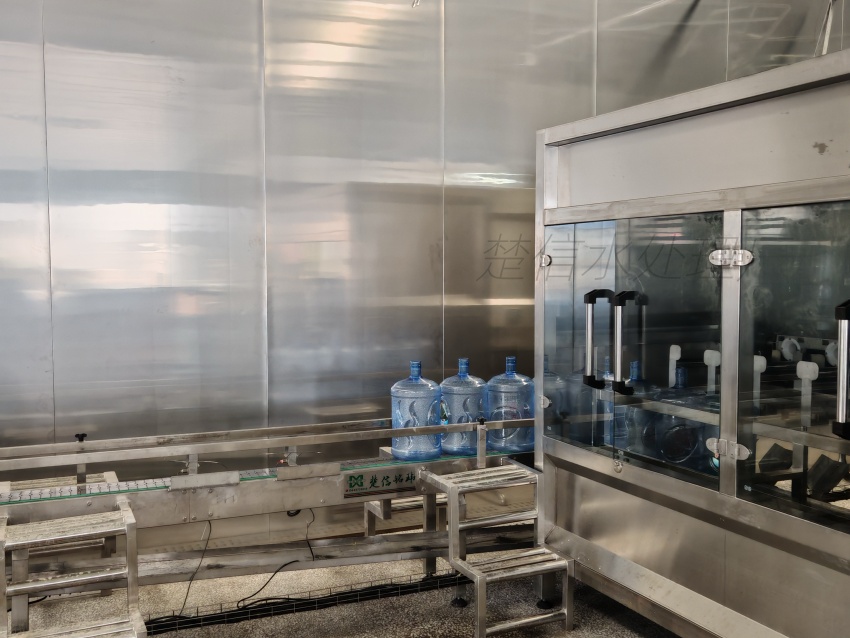
A purified water system does not operate in isolation. Its output feeds directly into container cleaning, filling, and capping operations. For bottled water lines, the three-in-one washing-filling-capping machine integrates these steps into a continuous unit, minimizing intermediate transfer and exposure. For barrelled water lines, the process chain extends through multi-stage barrel washing, disinfection, final rinsing, and automated capping.
The cleanroom environment around the filling zone is equally part of the system logic. Chuxin Mingwei's clean air purification systems are engineered to ISO Class 8 (100,000) standards—upgradable to Class 7 (10,000)—with site-specific airflow design, duct routing, and pressure zoning to prevent secondary contamination at the filling point.
Selection Checklist for Procurement Teams
Before requesting a quotation, gather the following information to enable accurate system design:
- Raw water quality report: TDS, hardness, chlorine, iron, manganese, turbidity, and microbial counts.
- Target water standard: Conductivity or resistivity requirement, microbial limits, and applicable regulatory standards.
- Production capacity: Hourly and daily volume requirements, including future expansion plans.
- Packaging format: Bottle or barrel sizes, material, and whether containers are single-use or returnable.
- Facility constraints: Available floor area, ceiling height, utility connections (power, drainage, compressed air), and cleanroom zoning requirements.
- Automation level: Manual, semi-automatic, or fully automatic operation, including PLC + HMI control preferences.
Next Steps
If your project requires a purified water system tailored to your source water conditions and production targets, the next step is to share your water quality report and capacity requirements. Chuxin Mingwei's engineering team will map the process chain, specify component sizing, and define the delivery scope—from manufacturing through water plant equipment installation and commissioning to operator training and sustained post-installation support.
Contact the team to discuss your project parameters and receive a site-specific system proposal.
Stage 3: Precision Filtration and RO Deionization. Precision filtration removes fine particulates before water enters the reverse osmosis (RO) system. Depending on source water quality and target conductivity, the system may employ single-pass or double-pass RO configurations, with pre-membrane chemical dosing and online monitoring to manage concentrate discharge. RO is not a standalone unit; its performance depends entirely on upstream pretreatment effectiveness. Stage 4: Sterilization, Storage, and Distribution. Post-RO water undergoes disinfection via ozone generators, ozone mixing devices, or ultraviolet (UV) sterilizers. Ozone is effective for finished water and container-related disinfection but requires careful control of dosage, contact time, off-gas, and by-product risks. UV provides physical disinfection, though its efficacy is influenced by water quality, flow rate, lamp degradation, and sleeve fouling, and it offers no residual effect. Treated water is then held in sterile or finished water tanks and circulated through loop piping equipped with CIP cleaning systems, pipeline disinfection, constant-pressure supply pumps, and online monitoring instruments to maintain quality until filling.