
Turnkey Drinking Water Plant Equipment Process Flow: From Raw Water Analysis to Filling Line Integration
Who This Guide Is For
Procurement managers and operations leads evaluating a turnkey drinking water plant equipment process flow need more than a list of machines. They need to understand how raw water quality dictates pretreatment, how membrane selection changes mineral retention, and how filling line speed must synchronize with upstream purification capacity. This guide maps those dependencies using actual equipment logic from Chuxin Mingwei's bottled and barrelled water projects.
Stage 1: Raw Water Testing as the Engineering Baseline
A turnkey drinking water plant cannot be sized by flow rate alone. The starting point is always a raw water quality report covering suspended solids, residual chlorine, hardness, iron/manganese, total dissolved solids (TDS), conductivity, and microbial load. These parameters determine whether the pretreatment chain requires multimedia filtration, activated carbon adsorption, sodium ion exchange softening, or precision filtration before any membrane stage.
For example, groundwater sources often carry higher iron and hardness, requiring oxidation and softening upstream of reverse osmosis (RO). Municipal tap water may have acceptable TDS but elevated residual chlorine, which damages polyamide RO membranes unless activated carbon is specified. Mountain spring water intended for bottled mineral water demands a different approach—ultrafiltration (UF) or nanofiltration (NF) may be selected specifically to retain beneficial minerals while removing pathogens and particulates.
Boundary condition: A softening system reduces calcium and magnesium hardness to control scaling, but it does not remove dissolved salts. Softened water is not equivalent to RO permeate. If the target product is purified drinking water, softening alone is insufficient; it serves as pretreatment before RO, not as a replacement.
Stage 2: Pretreatment and Membrane Process Selection
Once raw water data is established, the process flow splits based on the target water standard:
| Target Product | Typical Process Chain | Key Rationale |
|---|---|---|
| Purified drinking water | Multimedia filter → Activated carbon → Softener → Precision filter → Dual-stage RO → Ozone + UV sterilization | Deep desalination; TDS reduction to drinking water standards |
| Spring / mineral water | Multimedia filter → Activated carbon → Precision filter → NF or UF → Ozone + UV sterilization | Mineral retention; pathogen and turbidity removal without full desalination |
| Barrelled water (5-gallon) | Same as above, scaled for higher volume per unit | Larger batch volumes; recirculating barrel washing adds water demand |
Chuxin Mingwei's bottled purified water filling line uses a dual-stage RO deep purification process combined with ozone and 254 nm UV dual sterilization. The bottled spring water line, by contrast, employs a dual-membrane NF + UF process that balances purification efficiency with mineral retention—filling accuracy held to ≤ ±2 mL with a capping pass rate ≥99.6%.
Operating logic: RO is a pressure-driven membrane separation unit, typically positioned after pretreatment. Single-pass RO achieves roughly 95–99% salt rejection; dual-stage RO pushes permeate quality further and is standard for bottled purified water. NF operates at lower pressure and rejects divalent ions while passing monovalent minerals—making it the correct choice when the product claim is "natural minerals retained."
Stage 3: Storage, Sterilization, and Distribution
Treated water does not go directly to the filler. It enters a sterile storage tank with a recirculating loop that maintains constant pressure and prevents microbial regrowth. The loop typically includes:
- Ozone generator and mixing device for primary disinfection.
- UV sterilizer (254 nm) as a secondary barrier and ozone destruct step.
- CIP (Clean-in-Place) system for periodic pipe and tank sanitation.
- Constant-pressure supply pump with online conductivity and flow monitoring.
For barrelled water operations, the recirculation loop must also supply the multi-station barrel washing and disinfection rinse—adding significant peak water demand that must be factored into the treatment system's rated capacity.
Stage 4: Filling Line Configuration and Synchronization
The filling stage is where upstream water treatment capacity meets downstream packaging speed. A mismatch here causes either idle filler time or buffer tank overflow.
Bottled Water (PET, 500 mL – 5 L)
The standard configuration is a three-in-one washing-filling-capping monoblock. Empty bottles are conveyed in, rinsed with treated water, filled to a precise volume or level, capped, and discharged to inspection, labeling, and case packing. Key quality control points include:
- Rinse water quality and pressure.
- Bottle mouth secondary contamination control.
- Fill level consistency and no-bottle-no-fill logic.
- Cap presence detection and capping torque verification.
- Changeover time between bottle formats.
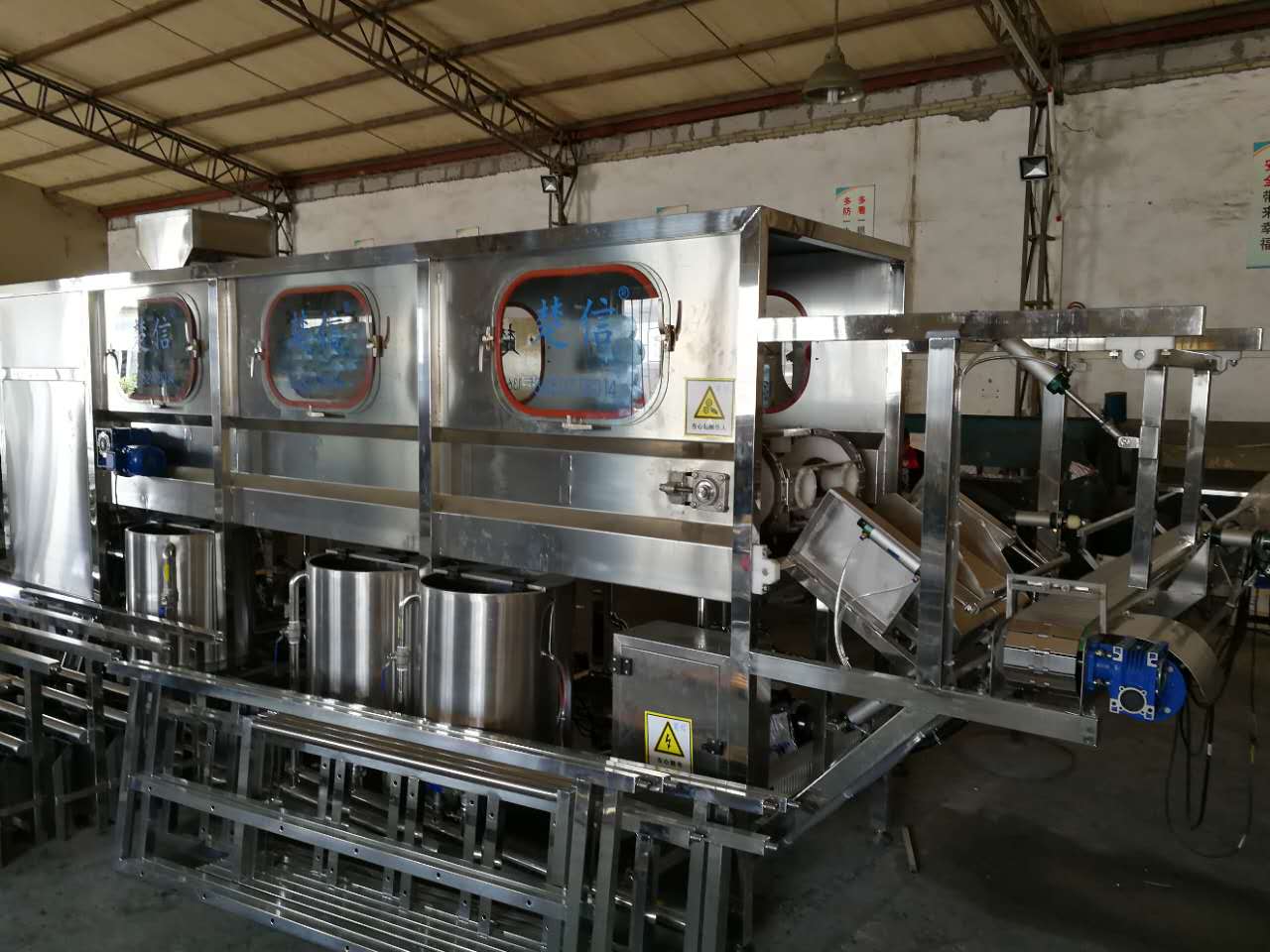
Chuxin Mingwei's bottled lines are PLC-controlled with HMI interfaces, supporting bottle sizes from 500 mL up to 18.9 L and rated outputs from 200 to 2,500 bottles per hour depending on format.
Barrelled Water (3-Gallon, 5-Gallon / 18.9 L)
Barrelled water follows a longer process chain: empty barrel return → inspection and sorting → cap removal → external brushing → internal brushing → multi-station washing and disinfection → finished water rinse → filling → cap application → light inspection → labeling/shrink sleeve → coding → bagging → palletizing. The washing stage alone may include 8–12 stations with hot caustic, acid, and finished water rinses. Automation level and station count are selected based on barrel return condition and hourly throughput targets.
Stage 5: Cleanroom Air and Environmental Control
Both bottled and barrelled filling operations require controlled air environments around the filling zone. Chuxin Mingwei's clean air purification systems are engineered to ISO 14644-1 Class 8 (100,000) standard, upgradable to Class 7 (10,000), with H13 HEPA filtration and airflow ranging from 1,500 to 20,000 m³/h based on room volume and pressure zoning requirements. The system integrates with the filling line's PLC for real-time diagnostics and remote-ready monitoring.
Boundary condition: Cleanroom classification applies to the filling and capping zone, not the entire production floor. Zoning—defining which areas require Class 8, which require Class 7, and where pressure cascades prevent ingress—must be engineered from the actual facility layout, not assumed from a generic template.
Implementation Boundaries and Common Risks
- Capacity mismatch: A 10 T/h water treatment system feeding a filler rated at 2,500 bottles/hour (18.9 L) may run short during peak demand if barrel wash recirculation is not separately calculated.
- Pretreatment undersizing: Skipping raw water analysis and defaulting to a "standard" sand filter + carbon + RO chain can lead to rapid membrane fouling if iron or silica is present above design limits.
- Softening misapplication: Using softening as the sole treatment for a purified water product will fail conductivity and TDS specifications.
- Changeover downtime: Lines configured for multiple bottle sizes must account for mold, guide rail, and filler nozzle changeover time—this is a real production loss that affects effective OEE.
- Cleanroom drift: HEPA filter loading and duct leakage degrade cleanroom class over time; real-time differential pressure monitoring and scheduled filter replacement are non-negotiable.
Next Steps for Procurement Teams
A turnkey drinking water plant equipment process flow is only as reliable as the data it is engineered from. Before requesting a quotation, prepare:
- A current raw water quality report (or arrange for source water sampling).
- Target product specification (purified, spring, mineral) and applicable local standards.
- Daily and peak-hour water demand, including barrel wash recirculation if applicable.
- Facility layout with available floor area, ceiling height, utility connections, and drainage.
- Packaging format list (bottle sizes, barrel sizes, cap types) and target hourly output.
With these inputs, Chuxin Mingwei's engineering team can map a site-specific process flow, define equipment boundaries, and scope the water plant equipment installation and commissioning workflow—including operator training and post-installation support.