
Ultrafiltration System Process Flow for Spring Water: Key Stages, Equipment Configuration & Operational Guidelines
Why Many Ultrafiltration Systems Underperform in Spring Water Lines
Procurement managers and operations leads often assume that a standard ultrafiltration (UF) module can be plugged into any spring water line without re-engineering the pretreatment stage. The result: premature membrane fouling, inconsistent permeate quality, and unplanned downtime. In spring water applications, the UF process must be matched to the specific source water composition, target mineral retention, and downstream filling requirements.
This article walks through the complete UF system process flow, explains the equipment logic behind each stage, and identifies operational boundaries that affect long-term performance. Whether you are specifying a new line or troubleshooting an existing one, understanding these details will help you make better technical decisions.
The Core Process Flow of a Spring Water Ultrafiltration System
A typical spring water UF system follows a sequence designed to protect the membrane while preserving the natural mineral profile. The general flow is:
Raw water → Coarse filtration → Fine filtration / Ultrafiltration → Disinfection → Storage / Circulation → Filling
Unlike purified water lines that use reverse osmosis (RO), spring water treatment relies on ultrafiltration as the primary barrier against suspended solids, colloids, and microorganisms, while allowing dissolved minerals to pass through. The UF membrane pore size (typically 0.01–0.1 μm) is small enough to remove bacteria and most viruses, but large enough to retain beneficial minerals.
Stage 1: Raw Water Intake and Coarse Filtration
Before water reaches the UF membrane, it must be pre-filtered to remove large particles that could clog or damage the membrane. A multi-media filter (sand, gravel, anthracite) is commonly used, as described in typical water treatment process knowledge (K03: Multi-media filtration). This stage reduces turbidity, protects downstream equipment, and extends membrane life. The selection of media type and layer thickness depends on source water quality—seasonal changes in rainfall or runoff can significantly affect solids loading.
Stage 2: Fine Filtration and Ultrafiltration
After coarse filtration, water passes through a cartridge filter (typically 5–10 μm) to catch any remaining fine particles. Then it enters the UF membrane module. The UF system operates in cross-flow mode: water flows parallel to the membrane surface, with a portion permeating through and the remainder carrying away retained contaminants. This design minimizes concentration polarization and fouling.
Key equipment at this stage includes:
- UF membrane housings (spiral-wound or hollow-fiber, depending on application)
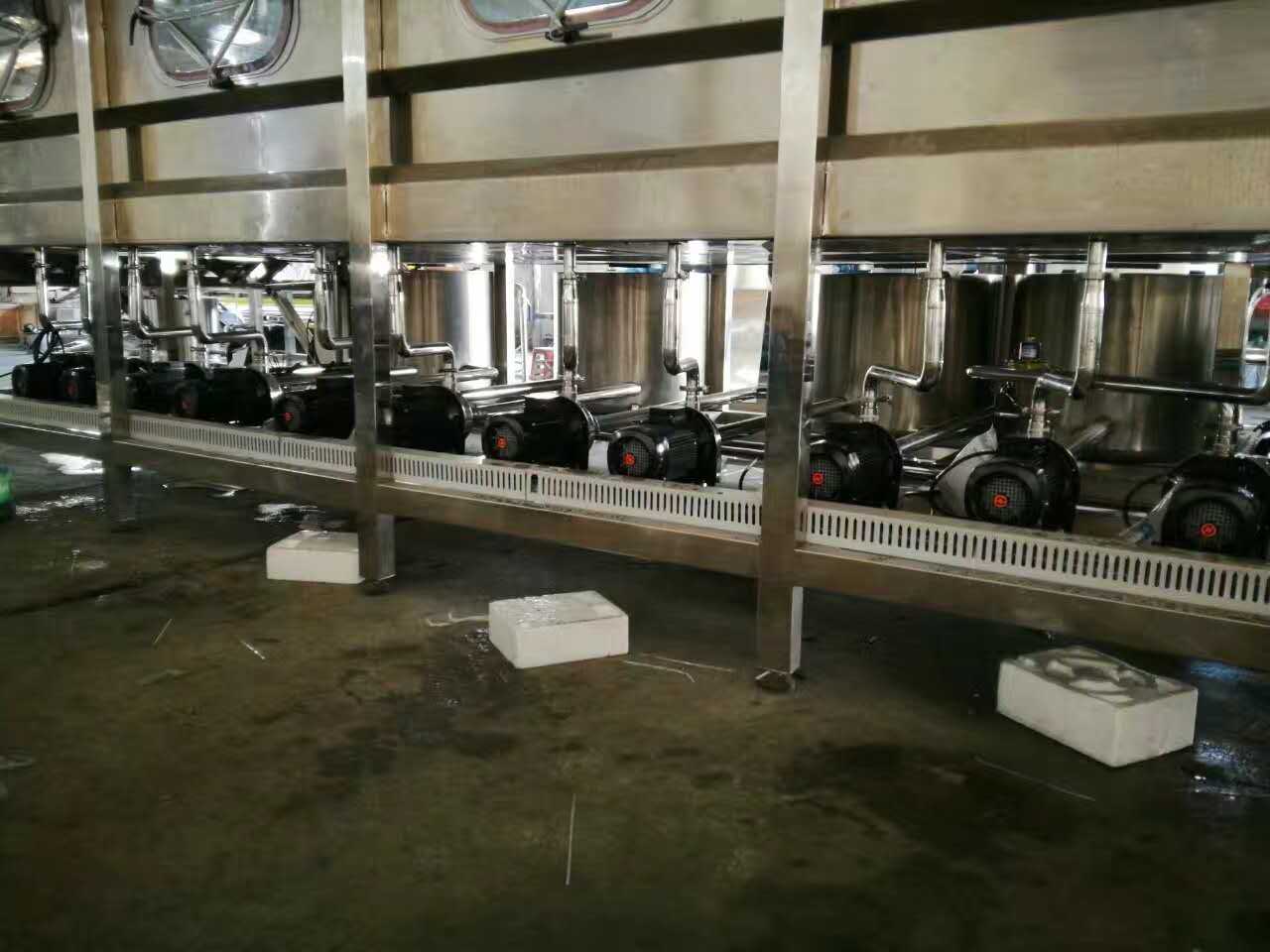
- Feed pump with variable frequency drive to control flow and pressure
- Backwash system (automatic, using permeate water or air-scouring)
- Pressure gauges and flow meters for monitoring differential pressure (ΔP)
For spring water, the UF operating pressure is typically lower than for RO systems (2–4 bar), and the recovery rate is usually 85–95% depending on feed water quality. The membrane should be selected for low fouling tendency and compatibility with disinfectants like chlorine or ozone.
Stage 3: Disinfection and Storage
After UF, the water is disinfected to ensure microbiological safety before filling. Common methods include:
- Ozone injection: Ozone is mixed into the water stream via a venturi or contact column. It provides residual disinfection and helps prevent biofilm in storage tanks. However, ozone dosage must be controlled to avoid generating bromate in spring water containing bromide (K09: Ozone and UV considerations).
- UV sterilization: A 254 nm UV lamp is used as a physical disinfection step. UV does not leave a residual, so it is often combined with ozone for tank-side protection.
Disinfected water is stored in a sterile tank or circulated through a loop to maintain quality. The storage tank must be vented with a HEPA filter and regularly cleaned to prevent recontamination.
Stage 4: Filling and Packaging Integration
The UF system is not an isolated unit; it must be integrated with the filling line. In a bottled spring water production line (e.g., Chuxin Mingwei’s fully automatic line), the process continues with bottle washing, filling, capping, and inspection. The UF system’s output flow rate should match the filling machine’s capacity, with buffer tanks to absorb fluctuations. A typical UF system for a 200–1,800 bottles/hour line (18.9 L bottles) would be sized to deliver 1–10 m³/h of treated water, depending on production volume.
Equipment Configuration Checklist for Procurement Teams
When specifying a UF system for a spring water line, consider the following points:
| Parameter | Consideration |
|---|---|
| Membrane type | Hollow-fiber is common for spring water due to ease of cleaning and lower cost. Spiral-wound may be used for higher throughput. |
| Pretreatment | Multi-media filter + cartridge filter (5 μm) is minimum. If source water has high iron or manganese, add oxidation/aeration step. |
| Cleaning system | CIP (clean-in-place) capability is essential. Automated backwash with permeate water reduces manual labor. |
| Material compatibility | Piping and valves should be stainless steel or food-grade plastic. Avoid copper or brass that could leach ions. |
| Monitoring | Online turbidity, pressure, flow, and temperature sensors. Data logging for preventive maintenance. |
Operational Guidelines and Common Pitfalls
1. Membrane Fouling from Inadequate Pretreatment
Even with a multi-media filter, spring water with high colloidal content (clay, silt) can foul UF membranes quickly. The first sign is a rise in differential pressure. Solution: Verify that the multi-media filter is correctly sized and backwashed at proper frequency. Consider adding a flocculant or coagulant dosing if needed.
2. Ozone Overdose and Bromate Risk
If the feed water contains more than 0.5 mg/L bromide, ozone injection can form bromate, a regulated carcinogen. For spring water, use UV as primary disinfection and limit ozone to a residual of 0.2–0.4 mg/L at the tank outlet. Regularly test for bromate if you use ozone.
3. Bacterial Growth in Storage Tanks
After UF, the water is free of most bacteria, but a storage tank without proper ventilation or a stagnant loop can become a breeding ground. Maintain a recirculation loop, keep the tank level 80% or less, and schedule periodic CIP for the tank and piping.
4. Inconsistent Flow to Filling Machine
If the UF system is not sized with a buffer tank or the pump control is not coordinated with the filler, flow interruptions can cause underfilling or overfilling. Use a level-controlled product tank and a variable-speed pump to match demand.
Practical Boundaries: When UF Is Not the Right Choice
UF is ideal for spring water, mineral water, and mountain spring water where mineral retention is desired. However, if the source water has:
- High dissolved solids (TDS > 500 mg/L) that affect taste
- High nitrate, heavy metals, or other dissolved contaminants
- Very high turbidity (> 50 NTU) that exceeds UF membrane tolerance
Then a different treatment approach (e.g., RO, nanofiltration, or advanced oxidation) may be necessary. Always conduct a full water analysis before finalizing the process flow.
Next Steps for Your Project
A well-designed UF system for spring water requires careful engineering of pretreatment, membrane selection, disinfection integration, and downstream filling line coordination. Start by obtaining a comprehensive water quality report from your source. Then work with a manufacturer that can customize the system to your specific capacity, packaging format, and facility layout.
Chuxin Mingwei designs and manufactures custom water treatment systems for bottled spring water, including UF-based process lines. Our engineers can help you map the process flow, select compatible equipment, and provide installation, commissioning, and operator training. Contact us to discuss your water analysis and production targets.