UV vs. Ozone Disinfection for Bottled Water: Configuration Logic from Source to Full-Line Integration
UV vs. Ozone Disinfection for Bottled Water: Configuration Logic from Source to Full-Line Integration
For procurement managers and operations leads in the beverage and bottled water industry, the choice between Ultraviolet (UV) and Ozone (O₃) disinfection is rarely a binary "either/or" decision. Instead, it is a configuration challenge driven by three critical variables: source water quality, packaging format (small PET bottles vs. reusable PC barrels), and required shelf-life stability.
At Chuxin Mingwei, our engineering team has observed that misaligning disinfection technology with these variables often leads to recurring microbial issues, excessive chemical usage, or unnecessary capital expenditure. Since 2008, we have deployed end-to-end water treatment and filling solutions where the disinfection stage is not an isolated unit but an integrated component of the entire production line.
The Core Decision Matrix: When to Use UV, Ozone, or Both
The fundamental difference lies in the mechanism of action and the residual effect. UV provides immediate, chemical-free microbial inactivation at the point of exposure but offers no residual protection. Ozone provides powerful oxidation and a residual disinfectant effect that persists in the water and on packaging surfaces, but it requires careful off-gassing management to meet taste and safety standards.
1. Small Bottled Water Lines (350mL – 10L PET)
For standard purified water production in single-use PET bottles, the industry standard often leans towards a dual-disinfection approach or a UV-dominant strategy depending on the source.
- Source Water Dependency:*
- If your raw water has high organic load or turbidity, UV transmittance drops significantly, reducing efficacy. In such cases, robust pretreatment (multi-media filtration + activated carbon) is mandatory before the UV unit. As noted in our product specifications for Bottled Purified Water Filling Lines, a typical configuration involves a Dual-stage RO deep purification process combined with ozone and UV (254 nm) dual sterilization. This ensures that even if one method faces a transient load, the other maintains safety margins.
- Packaging Constraints:*
- PET bottles are lightweight and sensitive to oxidation. Excessive ozone can degrade the plastic or alter the taste if not properly degassed. Therefore, for small bottles, UV is often the primary final barrier, with ozone used earlier in the loop for tank and pipeline sanitation.
- Operational Reality:*
- Our Fully Automatic Bottled Purified Water Filling Production Line integrates these systems to minimize manual intervention. The logic here is stability: UV handles the continuous flow, while ozone manages the static sanitation of tanks and pipes during CIP (Clean-in-Place) cycles.
2. Barrelled Water Lines (15L – 22L PC/ABS)
The dynamics change drastically for reusable barrels. The primary risk here is not just the water, but the container itself. Reusable PC barrels undergo transport, storage, and potential external contamination.
- The Necessity of Residual Disinfection:*
- Unlike single-use bottles, barrels require a disinfectant that can sanitize the inner walls and remain active enough to prevent re-contamination during the capping and sealing phase. This is where Ozone becomes indispensable.
- Integrated Sterilization Logic:*
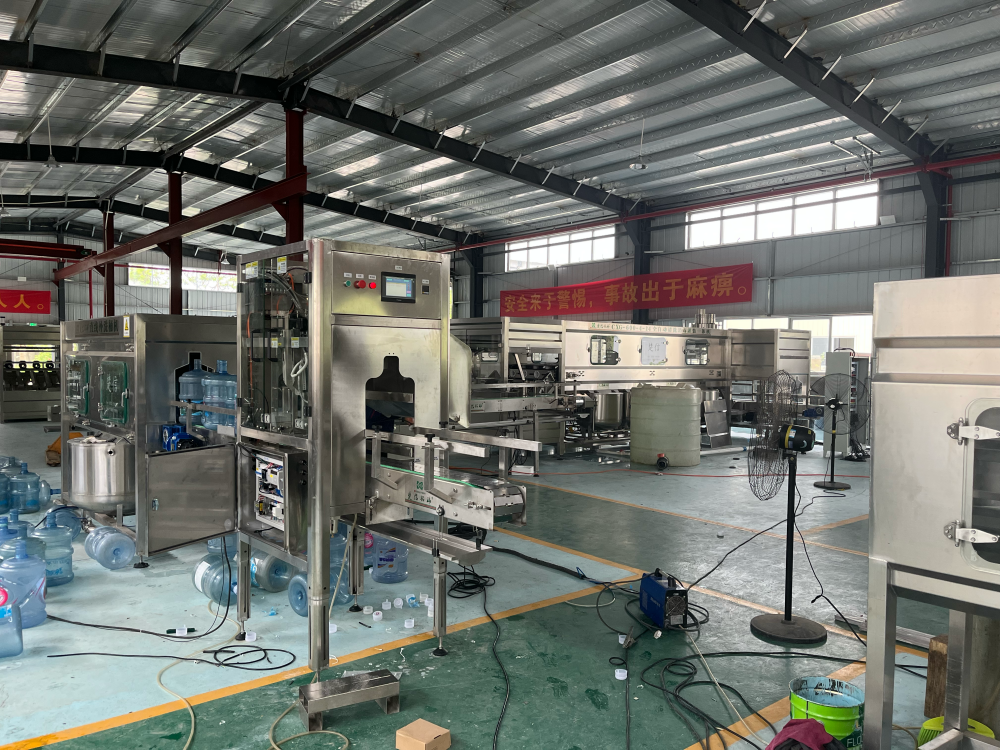
- In our Barrelled Water Sterilization & Filling Production Line, we employ a triple-layer disinfection strategy: internal wash + ozone + UV. The ozone is injected not only into the water but often utilized in the barrel rinsing stage to oxidize organic residues on the container walls.
- Capacity & Contact Time:*
- Effective ozone disinfection requires sufficient contact time. Our modular architectures allow for scaling capacity (500–5,000 barrels per shift) without compromising this critical dwell time. The system is designed so that the ozone concentration decays to safe levels before the final cap is applied, ensuring compliance with taste standards while maximizing microbial reduction.
Implementation Boundaries and Risk Factors
Selecting the right technology also means understanding where each method fails if applied incorrectly.
The UV Limitation: No Residual Protection
UV is excellent for flow-through disinfection but offers zero protection once the water leaves the lamp chamber. If your filling environment (cleanroom) has air quality issues or if the capping process is slow, the water is vulnerable. This is why Clean Air Purification Systems (ISO Class 8/100,000 standard) are often paired with UV-only lines to protect the product during the critical filling window. Without this environmental control, relying solely on UV can be a risk for long-shelf-life products.
The Ozone Limitation: Material Compatibility and Off-Gassing
Ozone is a strong oxidant. While effective, it can corrode standard stainless steel if concentrations are too high or if the material grade (e.g., 304 vs. 316L) is mismatched. Furthermore, incomplete off-gassing leads to "swimming pool" taste complaints.
- Engineering Control:*
- Our systems include precise ozone destruct units and monitoring sensors to ensure the final product meets residual ozone limits (typically <0.1 mg/L for drinking water).
- Process Integration:*
- As highlighted in our Barrel Wash-Fill-Seal Line specifications, the disinfection process must be synchronized with the washing and filling stages. Simply adding an ozone generator to an existing line without adjusting the hydraulic retention time or mixing efficiency often yields poor results.
Budget and Decision Trade-offs
When evaluating quotes for water treatment and filling equipment, the cost difference between UV and Ozone systems is often less significant than the ancillary costs they impose on the rest of the line.
- UV-Centric Configurations:*
- Lower operational complexity regarding gas handling but may require higher-grade cleanroom facilities (HVAC costs) to compensate for the lack of residual disinfection in the filling zone.
- Ozone-Centric Configurations:*
- Higher upfront engineering for gas injection, mixing, and destruction units, plus the need for ozone-resistant materials (gaskets, sensors). However, they can allow for slightly more relaxed environmental controls in the filling area due to the self-sanitizing nature of the water.
For most modern plants aiming for SC compliance and long-term maintainability, a hybrid approach is the most cost-effective over the lifecycle. It balances the immediate kill power of UV with the residual safety of ozone, optimizing both capital expenditure (CapEx) and operational expenditure (OpEx).
Next Steps for Your Project
There is no universal "best" disinfection method; there is only the best configuration for your specific water source, bottle type, and facility layout.
- Analyze Your Source: Obtain a full water quality report. High turbidity or organics will dictate the pretreatment needed before any UV or Ozone unit.
- Define Your Packaging: Are you running 500mL PET bottles at 2,000 BPH or 18.9L PC barrels at 600 BPH? The container material and reuse cycle drive the disinfection logic.
- Audit Your Facility: Assess your current cleanroom classification and capping speed. This determines how much "residual" protection you actually need.
At Chuxin Mingwei, we do not sell standalone disinfection units in isolation. We engineer non-standard, site-specific solutions that integrate water treatment, filling, and clean air support into a cohesive system. Whether you need a Fully Automatic Barrelled Purified Water Production Line or a custom small-bottle setup, our team maps equipment capabilities to your real-world operational contexts.
Ready to optimize your disinfection strategy? Share your water source data, target capacity, and packaging details. We will provide a tailored solution consultation that clarifies the technical boundaries and investment logic for your specific project.