
Wash-Fill-Cap Line Selection: Performance Boundaries for 10L, 11.3L, and 18.9L Barrels
The Engineering Reality of Scale-Up
For beverage, food, and pharmaceutical enterprises planning capacity expansion, upgrading to an integrated wash-fill-cap line is a common strategy. However, assuming that a single configuration can seamlessly handle different container sizes is a frequent source of operational risk.
The performance of these systems—specifically regarding mechanical stability, cleaning efficacy, and filling precision—is dictated by the physical characteristics of the containers. Whether you are producing 10L, 11.3L, or standard 18.9L (5-gallon) barrels, the engineering requirements shift significantly. Selecting equipment without accounting for these differences can lead to bottlenecks in the cleaning phase, inconsistent capping, or compromised product quality.
This analysis focuses on the technical principles behind these variations, providing a risk-boundary assessment for decision-makers validating their investment plans.
Core Technical Differences Across Barrel Sizes
Integrated lines synchronize washing, filling, and capping on a continuous path. While this reduces manual intervention, it also means that changes in barrel geometry directly impact cycle times and system stress.
1. Mechanical Handling and Stability
The primary differentiator between barrel sizes is the handling mechanism required to move heavy volumes safely.
- 18.9L (5-Gallon) Barrels: These require robust gripper systems and precise centering guides due to their weight and volume. The integrated line must manage significant torque during the capping process to ensure seal integrity. Any deviation in bottle diameter or wall thickness can cause misalignment, leading to capping failures.
- 10L & 11.3L Barrels: These smaller formats often share similar neck standards with 18.9L barrels but differ in base geometry and height. The change in center of gravity affects the speed at which the line can safely transport and invert barrels for internal washing. Running 10L barrels on a line optimized for 18.9L may require specific adjustments to guide rails and clamping pressure to prevent tipping.
2. Washing Efficiency and Contamination Control
Cleaning is often the most time-consuming part of the cycle. The integrated washer must effectively remove contaminants from both the exterior and interior of the barrel.
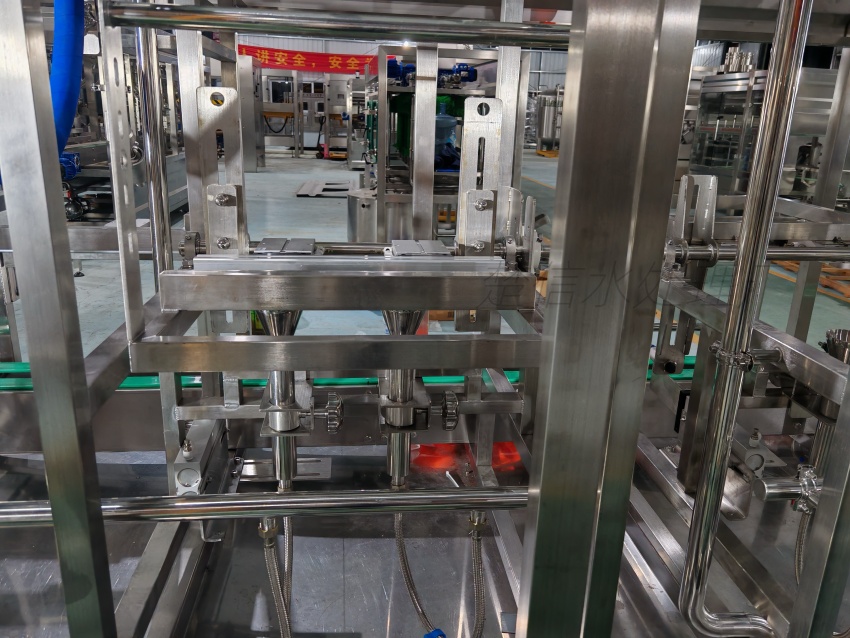
- Surface Area Ratio: Smaller barrels (10L/11.3L) have a lower surface-area-to-volume ratio compared to 18.9L barrels. This means that while the washing time per unit might be shorter, the chemical concentration and spray pressure must be calibrated differently to ensure effective disinfection without wasting resources.
- New vs. Recycled Bottles: As noted in our technical guidelines, the distinction between new and recycled barrels is critical. Recycled barrels carry higher contamination risks. The integrated line’s ability to perform multi-stage washing (outer brushing, inner rinsing, and sterilization) must be matched to the actual contamination level of the source. For scale-up projects, assuming that a line designed for 18.9L recycled bottles will automatically perform well with 10L new bottles is a risky assumption. The contact time and water quality requirements differ.
3. Filling Accuracy and Flow Dynamics
Filling accuracy is paramount for compliance and cost control. Chuxin Mingwei’s integrated lines typically achieve a filling accuracy of ≤ ±2 mL for standard configurations.
- Flow Rate Variations: Larger barrels (18.9L) require longer fill times and potentially different valve configurations to manage the flow rate and prevent splashing or aeration, which can affect water quality (especially for spring water where mineral retention is key).
- Smaller Format Challenges: With 10L and 11.3L barrels, the faster cycle times demand more responsive sensors and valves. If the line’s PLC-based intelligent control system is not tuned for these smaller volumes, it may overfill or underfill, leading to product loss or regulatory non-compliance.
Selection Criteria for Capacity Expansion
When evaluating an integrated wash-fill-cap line for scale-up, procurement managers should focus on the following practical details rather than just the rated output capacity.
| Feature | 18.9L (5-Gallon) Focus | 10L / 11.3L Focus | Key Decision Point |
|---|---|---|---|
| Rated Output | Typically 200–1,800 bottles/hour | Often higher potential due to shorter cycles | Verify actual cycle times, not just theoretical maxs. |
| Mechanical Grip | Heavy-duty, precise centering | Lighter duty, requires sensitive adjustment | Ensure the gripper system supports your specific bottle mold. |
| Washing Process | Extended contact for deep cleaning | Shorter cycles, adjusted chemical dosing | Match washing intensity to actual contamination levels. |
| Filling Valve | High-volume, splash-free design | Fast-response, precision control | Check valve compatibility with your target fill accuracy. |
Implementation Boundaries and Risks
It is crucial to understand that parameters cannot be directly applied from one project to another. The performance of an integrated line is heavily dependent on:
- Source Water Quality: The pre-treatment system (e.g., dual-membrane NF + UF for spring water or two-stage RO for purified water) must be sized correctly to handle the increased water demand of the expanded line.
- Facility Constraints: The physical layout of the cleanroom and the air purification system (ISO Class 8 or higher) must accommodate the new equipment’s footprint and utility connections.
- Operator Training: Integrated lines require skilled operators to manage the PLC controls and troubleshoot minor jams. Scaling up increases the complexity of maintenance and operation.
Next Steps for Validation
To ensure a successful scale-up, we recommend the following steps:
- Conduct a Site Audit: Assess your current facility’s space, utility capacities, and water quality data.
- Define Specific Bottle Parameters: Provide exact dimensions, neck standards, and material specifications for your 10L, 11.3L, and 18.9L barrels.
- Request a Customized Engineering Proposal: Based on your specific needs, Chuxin Mingwei can design a tailored solution that balances purification efficiency, filling accuracy, and long-term maintainability.
By focusing on these technical nuances, you can avoid common pitfalls and select an integrated wash-fill-cap line that truly supports your growth objectives.
Conclusion
The choice between 10L, 11.3L, and 18.9L integrated filling lines is not merely a matter of capacity; it is a complex engineering decision involving mechanical handling, washing efficiency, and filling precision. By understanding these differences and working with a manufacturer who prioritizes site-specific engineering, you can ensure a smooth and profitable expansion.
CTA Text
Ready to optimize your filling line for scale-up? Contact Chuxin Mingwei today for a customized consultation and engineering proposal tailored to your specific barrel sizes and production goals.