
How Water Treatment Plant Equipment Installation & Commissioning Works: Core Logic, Process Stages & Real-World Boundari
Who This Applies To
Procurement managers, plant engineers, and digital project leads in beverage, food, pharmaceutical, and electronics manufacturing — especially those evaluating or already engaged with Chuxin Mingwei’s custom water treatment and filling systems.
What Installation & Commissioning Means — Beyond 'Turning It On'
At Chuxin Mingwei, installation and commissioning are not sequential handover steps. They are integrated engineering phases — each governed by site-specific constraints and validated against actual source water quality, target standards (e.g., GB 5749, USP <1231>), production capacity, packaging format (18.9 L PET, 5-gallon PC, etc.), and facility layout.
The core working principle is scenario-driven validation: every component — from dual-membrane NF+UF units for spring water to two-stage RO + ozone/UV sterilization for purified water — is installed, calibrated, and verified in context, not in isolation.
The Four-Stage Working Logic
1. Pre-Installation Engineering Alignment
Before physical delivery, Chuxin Mingwei conducts a joint engineering review using your site survey data, raw water report, and production schedule. This determines:
- Whether pre-filtration (multi-media + activated carbon) must precede membrane units based on iron/manganese or chlorine levels ;
- If cleanroom airflow routing and pressure zoning must be co-engineered with your bottling line layout ;
- Whether PLC-HMI control logic must integrate with existing MES or SCADA systems.
2. Modular Installation with Interlocked Dependencies
Equipment is installed in functional modules — but their sequence reflects hydraulic, electrical, and process dependencies:
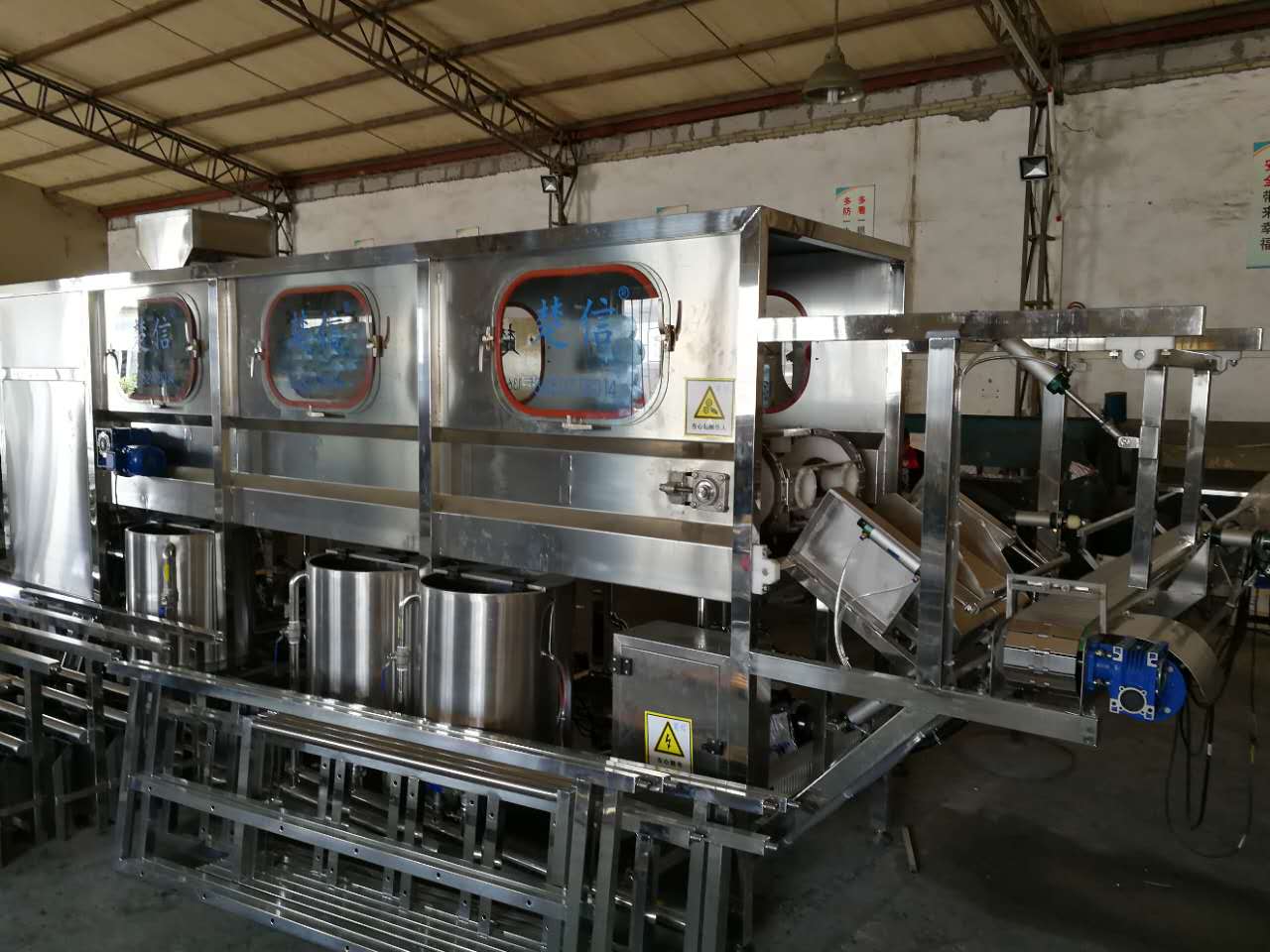
- Water pretreatment (sand filter → carbon → softener → precision filter) must be fully commissioned before high-pressure pumps and membranes;
- Clean air systems (H13 HEPA, ISO Class 8 compliant) are installed before
- filling machines to prevent post-purification contamination;
- Bottle washing-filling-capping units require synchronized timing between conveyor speed, fill valve actuation, and capping torque — all tuned during commissioning, not preset.
3. Commissioning as Iterative Validation
Commissioning is not a single test run. It includes:
- Performance validation: e.g., filling accuracy ≤ ±2 mL and capping pass rate ≥99.6% measured over 72 hours under rated load (P60);
- Stability testing: RO system recovery rate, NF mineral retention ratio, and UV dose (254 nm) output confirmed across three shifts;
- Boundary verification: confirming that compressed air dew point, cooling water temperature, and ambient humidity stay within design thresholds — otherwise, filling consistency or HEPA filter life degrades.
4. Operator Handover & Sustained Readiness
Final sign-off requires documented operator training on:
- Daily startup/shutdown sequences;
- CIP cycle parameters (chemical concentration, temperature, dwell time);
- Fault diagnostics (e.g., low ozone output → check gas flow meter calibration; unstable fill volume → verify bottle neck alignment).
Critical Application Boundaries — What It Does Not Cover
Chuxin Mingwei’s scope explicitly excludes:
- Retrofitting non-standard civil foundations without prior structural assessment;
- Integration with legacy third-party PLCs lacking Modbus TCP or OPC UA interface;
- Continuous operation beyond rated capacity (e.g., running a 2,500-bph purified water line at 3,000 bph without revalidation);
- Post-commissioning water quality liability if source water changes significantly post-handover without re-testing.
Why This Approach Matters for Your Project
Unlike off-the-shelf equipment vendors, Chuxin Mingwei treats installation and commissioning as the final stage of engineering — not logistics. That means:
- No ‘black box’ handover: all control logic, alarm thresholds, and maintenance intervals are documented and reviewed with your team;
- Long-term maintainability is built-in: spare parts lists, service manuals, and PLC backup files are delivered before
- commissioning ends;
- Support continuity is defined: remote diagnostics, annual health checks, and emergency response SLAs are contractually anchored.
Next Step
If your project involves spring water bottling, purified water production, or cleanroom-integrated filling — and you need installation and commissioning logic aligned to your site conditions — request a technical alignment briefing. We’ll map your raw water report, floor plan, and production targets to a validated execution workflow — with no assumptions, only evidence-based engineering.
Commissioning also extends to final packaging integration: for PET bottle lines, validation includes cap-type compatibility (plastic, sport, or aluminum closures) and precise synchronization between fill valve actuation, conveyor speed, and capping torque—especially critical for still water, hot-fill, or carbonated products where temperature, pressure, and hygiene controls differ significantly . For returnable 3- and 5-gallon container lines, commissioning verifies full wash-fill-seal cycle integrity—including bucket inspection, multi-stage internal/external brushing, ozone/UV disinfection, fill accuracy, and post-capping lamp inspection—where throughput, bucket cleanliness, and sterilization method directly shape validation protocols .