
What’s Included in a 5-Gallon Barrel Water Filling Line? A Site-Specific Equipment List Guide
Who This Guide Is For
Procurement managers, plant engineers, and operations leads planning or upgrading a 5-gallon (18.9 L) barrelled water production line — especially those evaluating whether to reuse existing barrels, install a new line, or retrofit an aging system. This list reflects actual configurations deployed by Chuxin Mingwei for beverage, food, and pharmaceutical clients across China — not theoretical or catalog-based assemblies.
Core Equipment Modules — Standard & Conditional
A complete 5-gallon barrel water filling line is not a fixed set of machines. Its composition depends on three site-specific inputs: barrel condition (new or reused), source water quality, and facility constraints (e.g., ceiling height, floor load capacity, utility availability). Below is the baseline modular structure — with clear notes on where customization begins:
- Barrel Inspection & Pre-Handling Unit
*
- Visual inspection station (manual or camera-assisted)
- Optional automatic barrel sorting (by material, age, or defect flag)
- Conditional: Required for reused barrels only; often omitted for new, pre-sterilized barrels.
- Cap Removal & External Cleaning
*
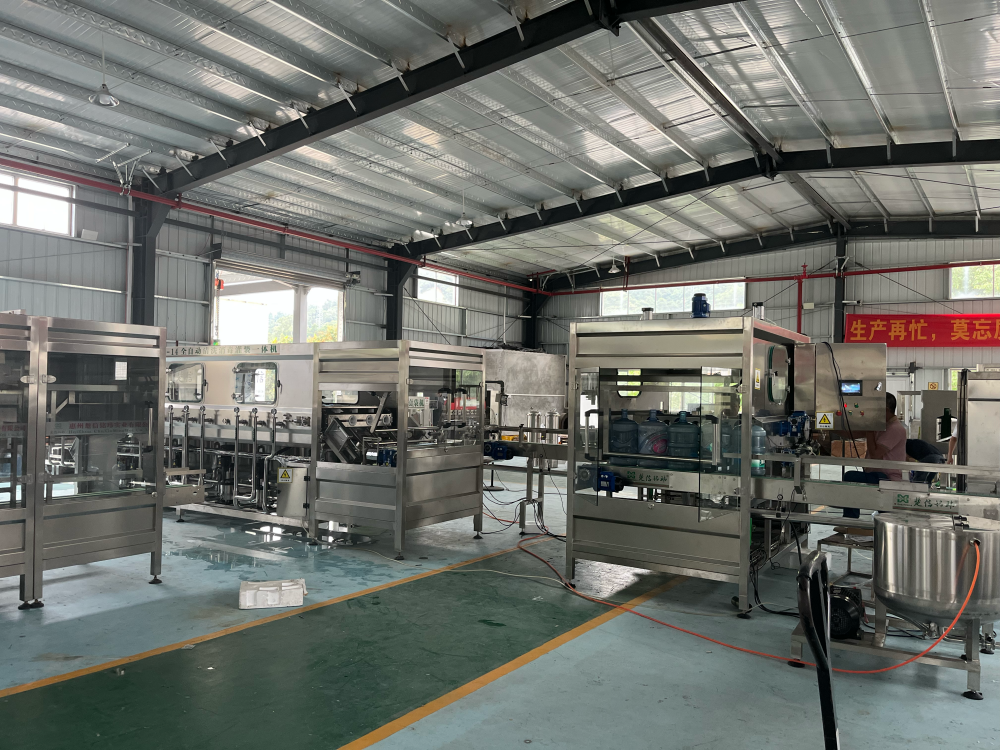
- Automatic cap puller (for reused barrels)
- Rotating external brush washer with adjustable pressure and detergent dosing
- Boundary note: Not applicable for new barrels — but surface sanitization may still be included per hygiene requirements.
- Internal Washing, Sterilization & Rinsing
*
- Multi-stage internal spray nozzles (pre-rinse → alkaline wash → acid rinse → sterilant injection → final purified water rinse)
- UV-C (254 nm) or ozone-injected final rinse for microbial control
- Critical dependency: Final rinse water must meet cleanroom-grade purity — typically supplied from your purified water loop, not municipal tap.
- Filling Unit
*
- Gravity or time-pressure filling heads (1–6 heads, scalable to 200–2,500 barrels/hour)
- Integrated level sensor and auto-compensation for temperature-induced volume drift
- Performance fact: Filling accuracy ≤ ±3 mL per 18.9 L barrel (verified under stable inlet pressure and ambient temperature)
- Capping & Sealing Station
*
- Pneumatic or servo-driven capping head with torque feedback control
- Cap feeder + orientation unit (for plastic or aluminum caps)
- Key boundary: Torque must be calibrated per cap material and barrel neck geometry — over-torque risks thread damage; under-torque compromises seal integrity.
- Post-Fill Inspection & Packaging Support
*
- LED-lit manual or automated lamp inspection station
- Optional leak detection (vacuum or pressure decay test)
- Conveyor-linked sleeve wrapping or shrink-film bundling unit
- Integration note: Clean air systems are engineered in parallel — airflow zoning must align with inspection and packaging zones.
What’s Not Automatically Included — Common Boundary Clarifications
- Water treatment upstream: RO/NF/UF purification systems are scoped separately — based on your raw water analysis and target TDS/mineral profile (e.g., spring water vs. municipal supply).
- Barrel storage & logistics: Pallet racking, AGV paths, or automated barrel depalletizers require separate layout review.
- Utilities & civil works: Compressed air quality (oil-free), drain slope for wastewater, and electrical load balancing are client-responsible preconditions — confirmed during site survey.
- Software & validation: PLC-HMI interface is standard; full regulatory compliance documentation requires early specification.
Next Steps: From List to Execution
- Confirm barrel origin: New or reused? If reused, share average cycle count and current cleaning protocol.
- Share your source water report: TDS, hardness, iron/manganese, microbiological data — this determines pretreatment scope.
- Define your target output: e.g., “1,200 barrels/8-hour shift” — not just “1,200/hr”, which ignores downtime and changeover.
- Provide facility drawings: Floor plan, ceiling height, column spacing, and utility tie-in points (water, air, power, drain).
Once these are submitted, Chuxin Mingwei delivers a validated equipment list — with module specifications, interconnection diagrams, and a clear scope-of-supply table (what’s included vs. client-furnished).
For a preliminary configuration review and equipment quotation, contact our team. To understand how reverse osmosis purification integrates upstream, refer to our guide on RO water treatment equipment working principle.