
5-Gallon Barrel Water Line Quotation Checklist: What Buyers Must Specify to Avoid Cost Overruns
Why Incomplete Specifications Lead to Misquoted 5-Gallon Barrel Water Lines
Many procurement teams request quotations for 5-gallon barrel water filling lines only to discover later that the proposed system doesn’t match their production needs or facility constraints. The root cause? Missing or ambiguous technical inputs at the inquiry stage.
At Chuxin Mingwei, we see recurring gaps: buyers specify "automatic 5-gallon line" but omit whether barrels are reused or new, fail to confirm available utilities, or assume cleanroom integration is included by default. These omissions result in initial quotes that appear competitive but require costly upgrades once site-specific engineering begins.
This checklist helps operations leads, procurement managers, and digital project teams in beverage, food, pharmaceutical, and industrial sectors submit technically complete requests — ensuring accurate pricing, realistic delivery timelines, and seamless commissioning.
Step 1: Define Bottle and Production Requirements
Before issuing a request for quotation (RFQ), clarify these core parameters:
- Bottle type: Are you using recycled 5-gallon (18.9 L) barrels or new ones? Recycled barrels require full internal washing, disinfection, and external brushing; new barrels may skip some cleaning stages but still need sanitization.
- Hourly output: Specify your target production rate in bottles per hour (e.g., 200–1,800 bottles/hour). Note that higher outputs affect conveyor width, number of filling heads, and buffer zones.
- Cap type and sealing method: Confirm if you’re using standard plastic caps, membrane seals, or tamper-evident rings. This impacts capping mechanism design and spare part planning.
Example from practice: A client assumed a "standard" line would handle both new and recycled barrels. Without specifying reuse, the initial quote omitted internal spray nozzles and chemical dosing units — leading to significant cost adjustments during detailed engineering.
Step 2: Clarify Cleaning and Purification Process
The water source and product standard determine the upstream treatment system, which directly affects the filling line’s integration points:
- For purified water, a dual-stage RO reverse osmosis system is typically required, followed by ozone + UV sterilization.
- For spring water, a dual-membrane NF + UF process preserves minerals while ensuring safety.
Ensure your RFQ states:
- Whether the filling line connects to an existing water treatment system or requires a bundled solution.
- If CIP (Clean-in-Place) is needed for pipelines and tanks.
- Water quality standards applicable to your market, as compliance scope must align with regional regulations.
Step 3: Confirm Facility and Utility Readiness
Many projects stall because site utilities don’t match equipment assumptions. To avoid this, verify and document:
- Power supply: Voltage (380V/50Hz standard in CN), phase, and total load requirement.
- Compressed air: Availability, pressure level, and oil-free certification if used in filling zones.
- Drainage and wastewater handling: Capacity for discharge from internal rinsing and CIP cycles.
- Cleanroom integration: If the line operates in a controlled environment, specify ISO class and whether HVAC and HEPA filtration are included in the scope.
Failure to address these can delay installation by weeks and trigger change orders.
Step 4: Define Scope of Supply and Service Boundaries
Not all suppliers include the same components. To compare quotes fairly, confirm what’s included:
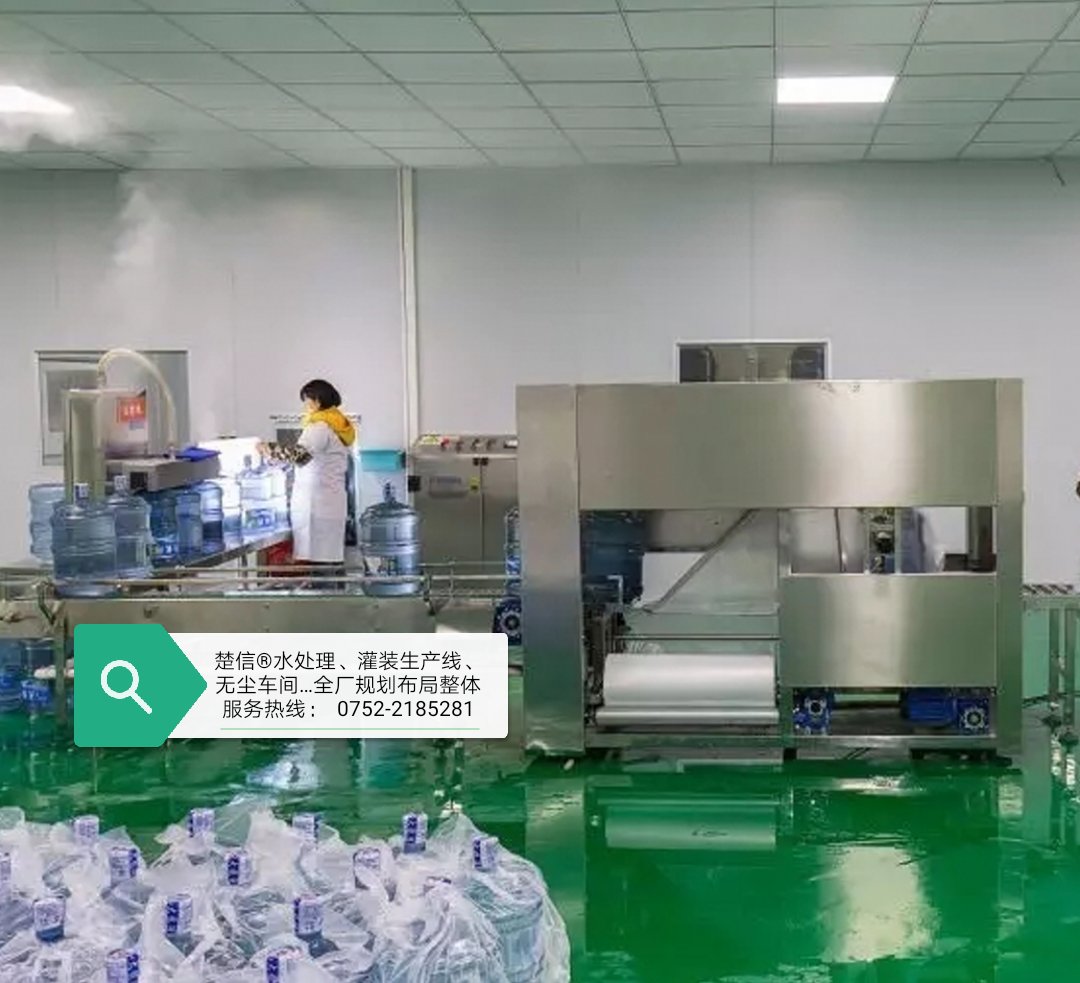
- Mechanical scope: Does it cover empty bottle infeed, automatic unscrambling, internal washing, filling, capping, lamp inspection, bagging, and outfeed?
- Control system: Is it PLC-based with HMI interface? Is remote monitoring supported?
- Installation & commissioning: Are foundation bolts, utility connections, and pipeline welding part of the service?
- Training and documentation: Is operator training, maintenance manual, and electrical schematics provided?
Tip: Reference our bottled water production line quotation guide for sample spec templates.
Common Risks and How to Mitigate Them
- Risk: Assuming 3-gallon and 5-gallon barrels can share one line without validation.
Mitigation: Verify compatibility in barrel diameter, neck size, cap type, and conveyor width. Quick-change tooling should be specified if multi-size operation is needed.
- Risk: Underestimating space for buffer zones and rejected bottle handling.
Mitigation: Allow sufficient length for upstream/downstream conveyors and inspection stations based on machine footprint.
- Risk: Omitting post-installation support terms.
Mitigation: Ask for response time guarantees, spare parts availability, and software update policy.
Next Steps for Accurate Quotation Submission
To get a reliable, site-applicable quote:
- Complete this checklist internally.
- Share your draft specifications with Chuxin Mingwei for pre-quote review.
- Request a site-specific engineering consultation to validate utility and spatial assumptions.
Only with complete inputs can we deliver a quotation that reflects true project cost, performance, and long-term maintainability.