
5-Gallon Bottled Water Filling Process Flow: Critical Stages, Equipment, and Decision Factors
Objective
When sourcing a 5-gallon (18.9 L) bottled water filling line, procurement and operations teams need a clear technical picture of how the process works—not just a list of equipment. The goal is to understand each stage’s purpose, the equipment options available, and the boundaries that affect performance, so that you can evaluate whether a proposed line matches your reuse bottle quality, capacity targets, and facility constraints.
This article breaks down the standard process flow for a 5-gallon bottled water filling machine, references real-world equipment configurations, and highlights the decision points that separate a reliable, long-term line from a setup that will cause constant quality and maintenance problems.
The Standard Process Flow: Step by Step
A 5-gallon water filling line does not start at the filler. It begins with the returned empty bottle and ends with a sealed, labeled, and inspected container ready for distribution. The typical sequence, refined from years of bottle reuse handling, looks like this:
Empty bottle return → inspection & sorting → de-capping → external brushing → internal brushing → multi-station washing & sanitizing → final product water rinse → filling → cap placement & pressing → light inspection → shrink labeling/sleeving → coding → bagging → conveying to warehouse.
This sequence is not optional; each step addresses a specific contamination risk or quality requirement. Skipping or under-sizing any stage increases the likelihood of hygiene failures, off-flavor complaints, or mechanical damage to bottles.
Stage 1: Incoming Bottle Handling
Returned 5-gallon bottles arrive with dirt, labels, caps, and often unknown residues. The first task is to sort out heavily damaged bottles that cannot be safely reused. Then, an automatic de-capper removes the old cap, preventing cross-contamination with the new cap and seal.
Key equipment: automatic de-capping machine, visual inspection station, manual or automated reject conveyor.
Stage 2: Bottle Washing and Sanitization
This is the most critical stage. The core of bottled water quality is not about “filling water into a bottle” but about the combination of empty bottle sorting, brushing, multi-stage washing, chemical sanitization, final rinse, and capping hygiene—all within a controlled environment.
A typical 5-gallon washing system includes:
- External brushing:*
- removes external dirt and labels using rotating brushes and water spray.
- Internal brushing:*
- a dedicated brush cleans the inside wall and bottom, often with a detergent solution.
- Multi-station rinsing:*
- the bottle passes through a series of stations (usually 6 to 12) that apply hot water, sanitizing agent (e.g., peracetic acid or chlorine dioxide), and sterile water rinses. The number of stations and contact time directly affect sanitation effectiveness.
- Final product water rinse:*
- a final rinse with the same treated water that will be filled, ensuring no chemical residue from cleaning agents.
Decision factors: The required cleaning intensity depends on the condition of your returned bottles. If bottles are heavily soiled or come from multiple sources, you will need more brushing stations, higher-pressure pumps, and longer chemical contact time. A line with fewer wash stations may look cheaper but will struggle to maintain hygiene consistency.
Stage 3: Filling and Capping
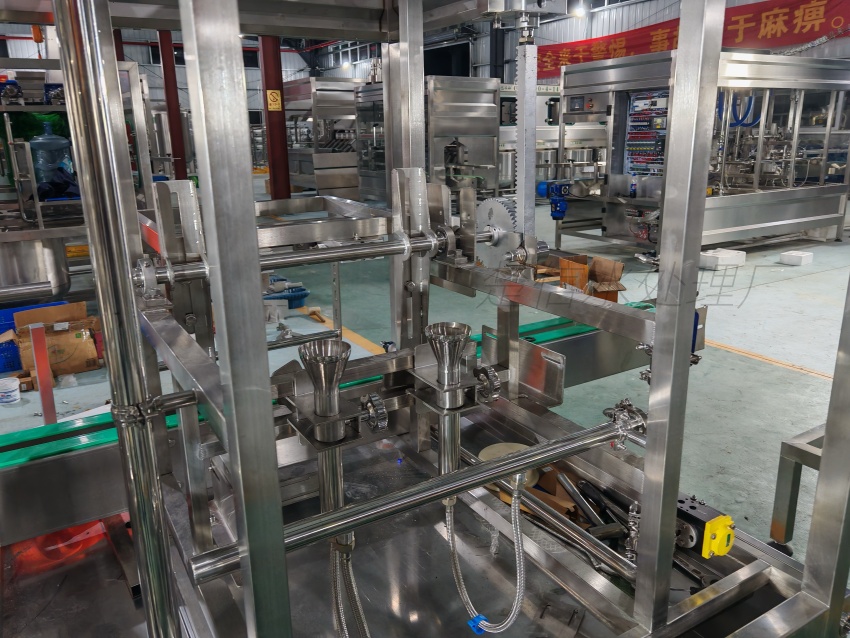
After the final rinse, the clean bottle moves immediately to the filling station. For 5-gallon bottles, the filling is typically done by gravity or pressure filling in a controlled, enclosed environment to minimize airborne contamination. The filler is often integrated with a cap placement and pressing system in a single monoblock unit.
Typical capabilities:
- Filling accuracy within ±2 mL for consistent volume.
- Capping pass rate ≥99.6% to avoid leakers.
- The system handles standard 5-gallon neck finishes and cap types.
Control system: Modern lines use PLC-based intelligent control, synchronizing the washing, filling, and capping steps. This reduces manual intervention and helps maintain consistent cycle times.
Stage 4: Post-Fill Inspection and Packaging
After capping, each bottle passes through a light inspection station where an operator (or automated vision system) checks for cloudiness, visible particles, cap misalignment, and fill level. Accepted bottles then move to:
- Shrink label or sleeve application:*
- a label is placed and heat-shrunk onto the neck or body.
- Inkjet coding:*
- production date, batch number, and expiration date are printed.
- Bagging:*
- a protective plastic bag is applied to the finished bottle.
- Conveying and palletizing:*
- bottles are accumulated and stacked onto pallets for warehousing.
Equipment Integration: Water Treatment and Clean Air
A 5-gallon filling line is not a standalone machine. It requires upstream treated water and a clean filling environment.
For purified water, the process typically starts with a two-stage RO reverse osmosis system, preceded by multi-media and activated carbon filtration, and followed by UV (254 nm) sterilization and ozone dosing. This combination ensures deep purification and residual disinfection. The exact water treatment scheme must be designed based on the source water analysis—not guessed from a catalog.
The filling room should meet ISO Class 8 (100,000) or higher cleanliness standards. A HEPA-based clean air system delivers positive-pressure filtered air to the filling zone, preventing airborne contamination. This system is site-specific, considering airflow, duct routing, and pressure zoning, and is integrated with the filling line controls.
Decision note: When evaluating a filling line supplier, verify that they can engineer the water treatment, air purification, and filling equipment as a coordinated system. A fragmented approach where each subsystem is sourced separately often leads to integration gaps and finger-pointing during commissioning.
Operational Boundaries and Limitations
Even a well-designed line has boundaries. You must understand them to avoid unrealistic expectations:
- Capacity range:*
- A typical 5-gallon line runs at 200–2,500 bottles per hour. The actual output depends on the bottle condition, washing cycle time, and filling speed. Do not assume the published maximum can be sustained continuously with heavily soiled bottles.
- Bottle compatibility:*
- Lines are designed for standard 5-gallon bottles (18.9 L) with specific neck dimensions. If you plan to use 3-gallon or other sizes, changeover parts and adjustments are needed, and the output speed may change.
- Chemical consumption:*
- Washing and sanitizing chemicals are an ongoing operational cost. The actual consumption is influenced by bottle dirtiness, water temperature, and dosing accuracy—not a fixed number from the supplier.
- Facility requirements:*
- Sufficient floor space, water supply, drainage, electrical power, and compressed air must be confirmed before installation. The cleanroom must be built and validated to the required class.
Recommendation: How to Evaluate a 5-Gallon Line Proposal
Based on the process flow and boundaries described, here is a practical checklist for procurement teams:
- Map the process: Make sure the proposed line includes all stages from de-capping to bagging. If a stage is missing, ask the supplier how that function will be handled.
- Assess washing stations: Verify the number of wash stations, type of sanitizing agent, and contact time. Relate these to the condition of your returned bottles.
- Check water treatment integration: The filler supplier should also provide the water treatment system or clearly define the interface specifications.
- Validate cleanroom requirements: Ensure the filling environment design (air filtration, pressure, temperature) is included in the scope.
- Request a site-specific layout: The line must be laid out to fit your actual building, not a generic drawing.
- Understand after-sales support: Confirm training, maintenance, and spare parts availability, especially for critical components like pumps, seals, and UV lamps.
When you approach a supplier like Chuxin Mingwei, you should share your source water quality report, target production capacity, bottle type and condition, available floor space, and utility conditions. This allows the engineering team to design a line that matches your operational reality—not just a standard catalog solution.
Next step: Contact our technical team to discuss your 5-gallon filling line project. We will provide a preliminary process flow diagram and configuration based on your specific requirements.