
Barrel Cleaning Protocol: Differentiating New vs. Recycled PC Barrels to Prevent Cross-Contamination
Why Barrel Origin Dictates Your Cleaning Protocol
Operators preparing a barrelled water sterilization and filling production line face a critical decision before the first run: how should the washing, disinfection, and rinsing stages be configured based on whether the line will process new barrels, recycled (returnable) barrels, or a mix of both?
The answer is not interchangeable. Recycled 3-gallon and 5-gallon barrels accumulate external grime, residual biofilm, and potential chemical carryover from prior use cycles and transport logistics. New barrels, while free from operational history, still carry manufacturing residues, dust from storage, and handling contaminants that require targeted removal. Applying a recycled-barrel protocol to new barrels wastes chemicals, water, and cycle time. Applying a new-barrel protocol to recycled barrels leaves cross-contamination risks unaddressed.
This article provides operators and procurement teams with a structured implementation approach to differentiate cleaning protocols based on verified contamination profiles — aligned with the engineering logic behind Chuxin Mingwei's barrelled water filling line configurations.
Step 1: Classify Barrel Input Streams Before Line Commissioning
Before configuring wash stations, document the barrel sources your line will handle:
| Barrel Type | Typical Contamination Profile | Required Pre-Processing |
|---|---|---|
| New PC/ABS barrels | Manufacturing dust, mold release agents, storage debris, transport particulates | Visual inspection, single-stage internal rinse, light external wash |
| Recycled (returnable) barrels | Biofilm, mineral scaling, external grime, residual cap fragments, odor carryover | Full inspection, cap removal, external brushing, multi-stage internal wash, chemical disinfection, final rinse |
| Mixed input (new + recycled on same line) | Combined risk profile | Line must be configured to the higher standard (recycled protocol), with changeover procedures documented |
Key decision point: If your operation will handle both new and recycled barrels on the same filling line, the wash-fill-cap sequence must be engineered to the recycled-barrel standard as the baseline. Quick-change capabilities and component swap requirements — such as adjustable guide rails, interchangeable wash nozzles, and variable conveyor widths — should be specified in the technical agreement before manufacturing begins.
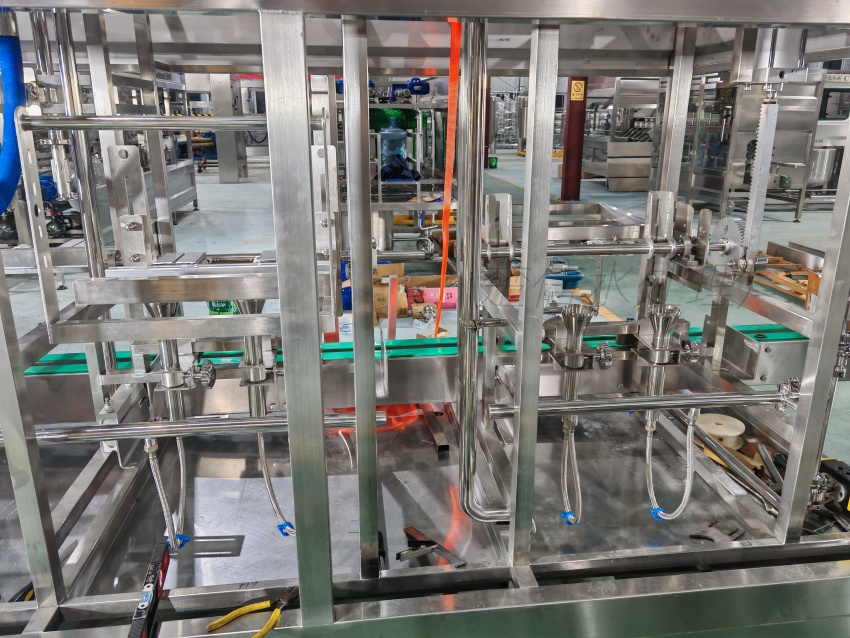
Step 2: Configure the Recycled Barrel Cleaning Sequence
For returnable 3-gallon and 5-gallon barrels, the cleaning protocol must address contamination at every surface zone. Based on standard barrelled water line engineering, the sequence typically includes:
- Incoming inspection — Operators or automated vision systems check for cracks, deformation, embedded foreign objects, and excessive wear at the barrel mouth and handle.
- Cap removal (de-capping) — Automated or semi-automated extraction of residual caps and tamper-evident rings. Leftover cap fragments can jam downstream capping stations.
- External brushing — Rotary or linear brush stations remove transport grime, label adhesive residue, and surface biofilm from the barrel exterior.
- Multi-stage internal wash — A sequence of pre-rinse, alkaline detergent wash, acid wash (for mineral scale), and intermediate rinses. Contact time, temperature, and chemical concentration must be defined in your process documentation — not left to operator judgment.
- Disinfection stage — Chemical sanitization (commonly chlorine-based or peracetic acid solutions) with verified dwell time.
- Final rinse — Using treated water (typically RO or purified water) to remove all chemical residues before the barrel enters the filling zone.
Boundary note: The number of internal wash stages, the specific chemicals, and the rinse water quality are project-specific parameters. They must be determined by your process engineering team based on the actual contamination load of your returned barrels — not assumed from generic equipment catalogs.
Step 3: Configure the New Barrel Cleaning Sequence
New barrels do not require de-capping, external brushing, or multi-stage chemical disinfection. However, skipping cleaning entirely introduces risk. The minimum protocol includes:
- Visual inspection — Confirm no manufacturing defects, foreign particles, or storage damage.
- Internal rinse — Single or dual-stage rinse with treated water to remove dust and mold release residues.
- Light external wash — Low-pressure rinse to remove surface dust before the barrel enters the clean filling environment.
Critical boundary: Even new barrels must meet the hygiene standard of your filling cleanroom. If your filling environment operates under ISO Class 8 (100,000) cleanroom conditions — as supported by Chuxin Mingwei's clean air purification systems — the barrel must not introduce particulate loads that exceed the air handling system's design capacity.
Step 4: Validate Rinse Water Quality and Source
A frequently overlooked variable in barrel cleaning is the quality of the rinse water itself. Using untreated or insufficiently filtered water for the final rinse stage reintroduces contaminants that the preceding wash stages were designed to remove.
Implementation rule: The final rinse water should match or exceed the quality of the product water being filled. For purified water filling lines using dual-stage RO systems, the final barrel rinse should draw from the same purified water loop. For spring water lines using NF/UF membrane processes, the rinse water source must be verified to prevent mineral or microbial reintroduction.
Step 5: Document Changeover Procedures for Mixed Operations
If your facility runs both new and recycled barrels — or switches between 3-gallon and 5-gallon formats — the changeover procedure must be explicit:
- Which components require adjustment or replacement (guide rails, wash nozzles, conveyor widths, capping heads).
- Which process parameters change (wash cycle duration, chemical dosing, rinse volume).
- What verification steps confirm successful changeover (visual checks, test-run inspection, residual chemical testing).
These procedures should be written into your technical agreement and operator training materials before equipment installation begins.
Operational Boundaries and Risk Signals
| Signal | Likely Cause | Immediate Action |
|---|---|---|
| Residual odor in filled barrels | Insufficient disinfection dwell time or exhausted chemical bath | Verify chemical concentration and contact time; replace bath if degraded |
| Particulate in finished product | Inadequate final rinse or rinse water quality below spec | Test rinse water source; check nozzle blockage |
| Cap jamming at capping station | Incomplete de-capping of recycled barrels | Inspect de-capping unit; adjust extraction mechanism |
| Elevated microbial counts post-fill | Biofilm survival in wash stages or cleanroom air quality breach | Audit wash chemical efficacy; verify cleanroom HEPA filtration and positive pressure |
Next Steps for Implementation Teams
- Audit your barrel supply chain — Confirm the ratio of new to recycled barrels and the typical return condition of recycled stock.
- Define your contamination baseline — Collect sample barrels and document the contamination types and severity before specifying wash station counts and chemical systems.
- Specify wash-fill-cap requirements in your technical agreement — Include barrel type compatibility, changeover procedures, and rinse water quality standards as contractual deliverables.
- Coordinate cleanroom air handling with barrel entry points — Ensure that barrel ingress does not compromise ISO Class 8 or Class 7 cleanroom integrity at the filling zone.
For project-specific barrel cleaning protocol design, wash station configuration, and filling line layout tailored to your actual barrel input profile and production capacity, contact Chuxin Mingwei's engineering team to initiate a technical consultation.