
New Guide: Barrelled Water Filling Line Selection — New vs. Reusable Drum Process Comparison
Who This Guide Is For
Procurement managers, operations leads, and digital project teams at beverage, food, pharmaceutical, and industrial clients in China who are launching or scaling barrelled water production — specifically those deciding between new drums (e.g., PET/PC single-use containers) and reusable drums (e.g., 3- or 5-gallon HDPE/PC returnable buckets) as their primary packaging format.
Why Drum Type Is the Foundational Selection Criterion
Barrel type is not a minor configuration option — it defines the entire system architecture. Unlike standardized bottle lines, new and reusable drum processes demand fundamentally different unit operations, utility integration, hygiene controls, and long-term support scope. Chuxin Mingwei designs each barrelled water filling line from actual inputs: your drum specification (material, dimensions, lid type), source water quality, target output capacity, and facility constraints — including floor layout, drainage access, and cleanroom zoning needs.
Core Process & Equipment Differences
| Aspect | New Drum Line | Reusable Drum Line |
|---|---|---|
| Process Flow | Empty drum feeding → rinsing → filling → capping → labeling | Drum inspection → lid removal → external brushing → internal washing & disinfection → multi-stage rinsing → filling → lid placement/pressing → lamp inspection → sleeve wrapping |
| Critical Modules | High-speed filler; integrated capping unit; minimal pre-fill treatment | Drum washer with chemical dosing capability; hot water rinse station; ozone or UV sterilization post-rinse; lid handling module |
| Water Quality Requirement | Moderate: RO or NF-treated water sufficient if final product meets GB 19298 | Strict: Requires full RO + UV/O₃ dual sterilization + particle control due to biofilm risk in reused drums |
| Maintenance Profile | Lower daily labor input; fewer moving parts; filter replacement only | Higher routine labor (drum sorting, lid handling); scheduled chemical tank refills; periodic nozzle and HEPA filter inspection |
| Facility Needs | Standard industrial floor; no special drainage required | Dedicated wastewater collection; corrosion-resistant flooring; ISO Class 8 cleanroom integration recommended for filling zone |
What You Must Verify Before Finalizing Your Choice
- Drum specification: Confirm material (HDPE, PC), dimensions, lid type, and compliance with local reuse standards. Non-standard drums require custom gripper, neck seal, and lid alignment tooling.
- Source water quality: Hardness, iron, manganese, or microbiological content directly impact washer scaling, chemical consumption, and sterilization efficacy — influencing pretreatment design.
- Output requirement: Output targets determine layout feasibility — linear configurations suit lower capacities; higher outputs may require rotary architecture for stability and throughput.
- Support readiness: Reusable drum lines require on-site technician training for chemical handling, washer calibration, and lid defect analysis — included in Chuxin Mingwei’s commissioning service but must be scheduled in advance.
Why Generic Product Listings Fail This Decision
Many suppliers present ‘barrelled water lines’ as a single category. In practice, Chuxin Mingwei treats new and reusable drum lines as distinct engineering solutions. For example:
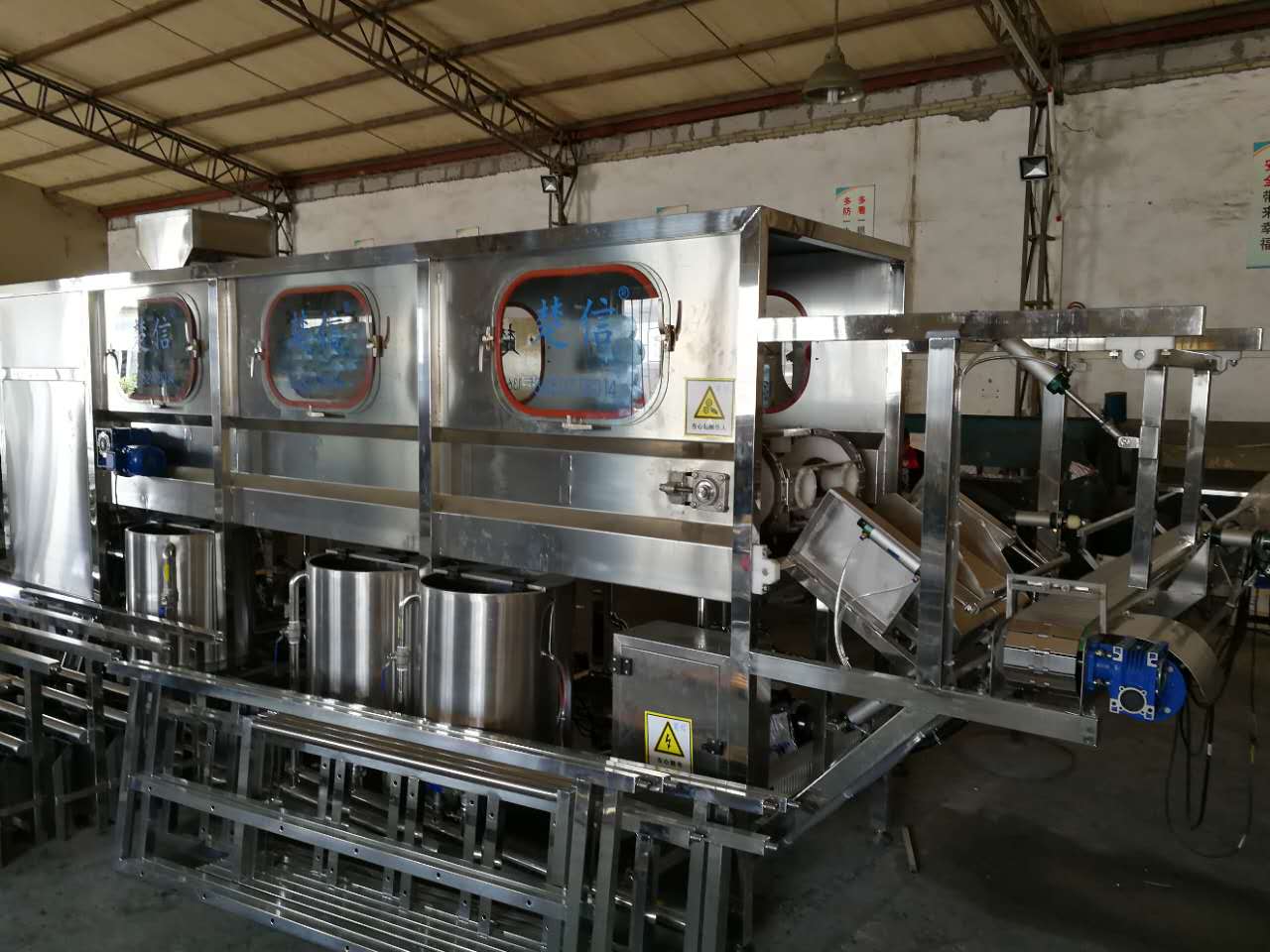
- A reusable drum line for spring water must retain natural minerals before
- internal washing — requiring selective membrane staging upstream of the washer, not downstream.
- A new-drum line for purified water integrates directly with dual-stage RO systems — eliminating redundant filtration stages and reducing footprint.
Next Step: Get a Validated Line Configuration Review
Chuxin Mingwei offers a free preliminary review of your barrelled water filling line scope — including drum compatibility assessment, layout feasibility, and clear mapping of delivery boundaries (what Chuxin Mingwei provides vs. client-responsible items such as civil works, power upgrades, or third-party certification). To begin:
- Share your drum specification (photo, dimensions, material, lid type)
- Provide raw water test report (TDS, hardness, Fe/Mn, SDI, microbiology)
- Confirm target output (barrels/hour) and operational shifts
Then request your barrelled water production line quotation — scoped, itemized, and aligned with Huizhou manufacturing and commissioning protocols.
About This Guide
This article is part of Chuxin Mingwei’s technical content series designed for enterprise procurement decision-making. It reflects our non-standard, site-specific engineering model — where equipment selection is driven by measurable operational context, not catalog categories.