
What delivery boundaries must be clarified to avoid gaps in SC-compliant commissioning for turnkey barrelled water lines
Scenario: Why 'Turnkey' Doesn’t Mean 'No Boundary Work'
You’re a procurement manager or operations lead responsible for installing your facility’s first barrelled water production line. You’ve selected a supplier offering end-to-end engineering — design, manufacturing, installation, commissioning, training, and after-sales support. You expect the line to handle 18.9 L barrels, integrate with your existing water source and building infrastructure, and operate under controlled environmental conditions.
But during commissioning, you encounter mismatches: the filling unit stalls because inlet water pressure drops below operational threshold during peak demand; ductwork for the clean air system clashes with structural beams or lighting fixtures; or your site’s PLC network rejects the vendor’s control signal due to undefined protocol mapping. These are not equipment defects — they reflect unconfirmed delivery boundaries.
Chuxin Mingwei delivers non-standard, site-specific barrelled water lines — engineered from actual source water quality, target output (200–2,500 barrels/hour), packaging format, and facility layout. 'Turnkey' here means coordinated execution — not assumed integration. Boundaries must be explicitly defined, documented, and signed off before fabrication begins.
3 Delivery Boundaries That Must Be Confirmed — With Real-World Context
1. Water Treatment ↔ Filling Unit Interface
- Why it matters: RO permeate flow and pressure must sustain the filling unit’s minimum inlet requirement across full production cycles — especially during capping delay or barrel changeover. Buffer tank sizing and pump response time directly affect stability.
- What to confirm: Feed water pressure range (e.g., ≥0.25 MPa at filling unit inlet), temperature window (5–35°C), and maximum allowable particulate load — verified against your raw water test report, not generic specs.
- Boundary evidence needed: A signed interface diagram showing pipe routing, isolation valves, pressure gauges, and sampling points between RO skid outlet and filling unit inlet — with responsibility assigned for each component.
2. Clean Air System ↔ Facility Integration
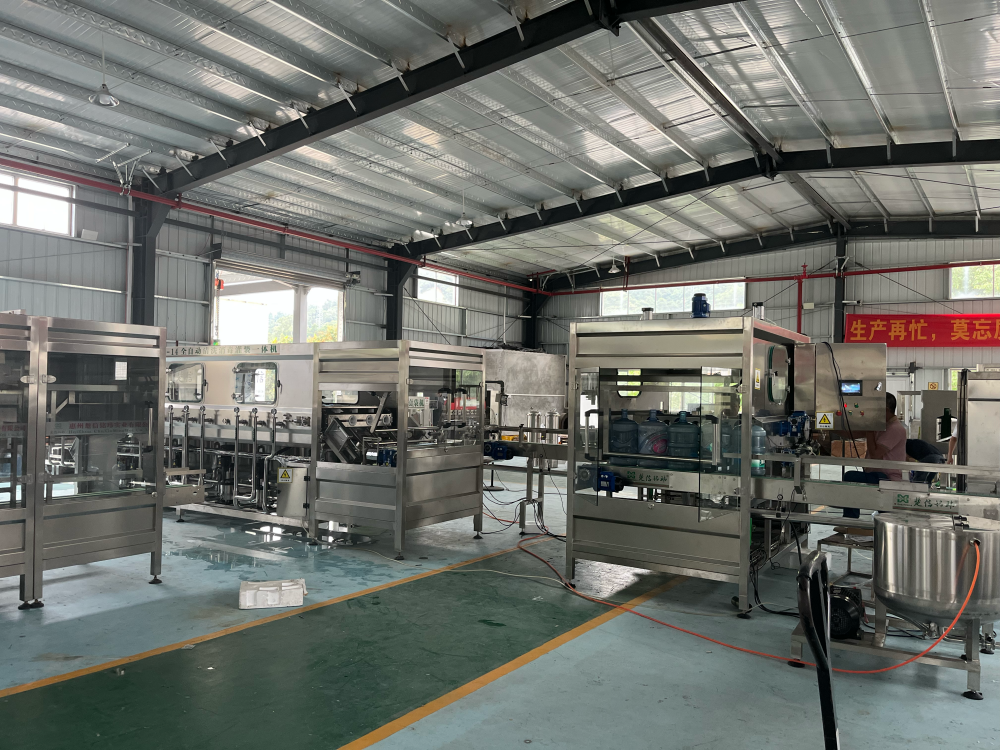
- Why it matters: Airflow effectiveness depends on directional velocity, duct path, ceiling penetration location, and pressure differential between zones — not just total volume. Retrofitting ducts post-construction often requires structural modification or compromises on cleanliness.
- What to confirm: Defined airflow zones (e.g., pre-filling → filling → capping), required positive-pressure gradient (≥5 Pa between adjacent zones), and exact duct entry/exit coordinates relative to your floor plan.
- Boundary evidence needed: A co-signed duct routing overlay on your building’s as-built ceiling plan — indicating penetrations, supports, and clearance requirements — plus confirmation of filtration class (ISO Class 8) based on local hygiene expectations, not external certification claims.
3. Mechanical & Utility Handover Points
- Why it matters: Flange mismatch, grounding resistance variance, or cable entry misalignment cause installation delays and safety rework. Power supply instability or compressed air dew point deviation can trigger repeated shutdowns during SAT.
- What to confirm: Flange standard (e.g., DN40/DN50), pipe material (304 stainless steel), gasket compatibility (EPDM/FKM), voltage tolerance (380 V ±10%), grounding method, and compressed air dew point limit (≤3°C at 0.6 MPa).
- Boundary evidence needed: A handover matrix listing every physical and electrical connection point — with specification, measurement method, acceptance criteria, and owner/vendor responsibility — referenced in both FAT and SAT protocols.
Why First-Time Adopters Are Most Exposed
Unlike repeat buyers, first-time adopters lack internal benchmarks for cleanroom-integrated filling, have no legacy line to compare against, and often rely on external contractors for utility upgrades. Interface gaps discovered during commissioning force trade-offs: accept reduced output, delay launch, or fund unplanned civil/electrical work. Chuxin Mingwei’s engineering-led approach prioritizes stability and long-term maintainability — but only when boundary ownership is established early.
Actionable Next Step: Align Before Fabrication
Don’t wait until equipment arrives to discover that your building’s ceiling height prevents duct installation — or that your electrical panel lacks space for the VFD cabinet.
Do this now: Request the Delivery Boundary Confirmation Sheet — a structured, co-signable document covering all three interface categories above, aligned with your floor plan, utility schematics, and raw water analysis.
Support available: Our project engineers offer free pre-order technical alignment sessions — reviewing your site constraints and clarifying where your team owns verification versus our team owns delivery.
Request your Delivery Boundary Confirmation Sheet
Review how water treatment interfaces impact filling line stability