
Bottled Purified Water Filling Line vs. Alternatives: A Buyer's Decision Checklist for First-Time Deployment
Who Needs This Checklist
Procurement managers and operations leads deploying their first bottled purified water filling line face a recurring decision: is a reverse osmosis (RO) deep-purification line the correct baseline, or would an alternative — such as an NF/UF spring water line, a barrelled water system, or a hybrid multi-format plant — better fit the actual production context?
This guide avoids generic technology rankings. Instead, it structures the comparison around verifiable deployment variables: raw water characteristics, target product standards, packaging formats from small PET bottles to 18.9 L containers, facility layout, and the supplier's post-installation support model.
---
Must-Have Decision Criteria
Before comparing line configurations, four non-negotiable factors must be resolved. These determine whether a bottled purified water filling line is the correct starting point — or whether an alternative architecture should be evaluated.
1. Source Water Quality vs. Target Product Standard
Purified water production relies on dual-stage RO deep purification combined with ozone and UV (254 nm) sterilization to remove dissolved solids, microorganisms, and organic contaminants. This process is necessary when source water contains high total dissolved solids (TDS), heavy metals, or inconsistent mineral profiles that cannot meet bottled drinking water standards through simpler filtration.
Alternative scenario: If the source is a verified natural spring with stable mineral content and low contamination risk, a bottled spring water production line using a dual-membrane NF + UF process may be more appropriate. This configuration balances purification efficiency with mineral retention — preserving the natural characteristics that define spring water as a product category.
The decision boundary is clear: if product positioning requires mineral retention and source water quality supports it, NF/UF is the correct process. If the standard requires near-complete demineralization, RO-based purified water lines are mandatory.
2. Packaging Format and Realistic Capacity Alignment
A common specification error is treating "bottles per hour" as a universal metric. When switching from a 500 mL reference bottle to 1.5 L, 5 L, 11.3 L, or 18.9 L formats, filling time, liquid flow dynamics, bottle stability on conveyors, and downstream packaging rhythm all shift. Parameter tables should therefore document material, bottle type, capacity, and test conditions together — avoiding a single peak-speed figure detached from actual operating conditions.
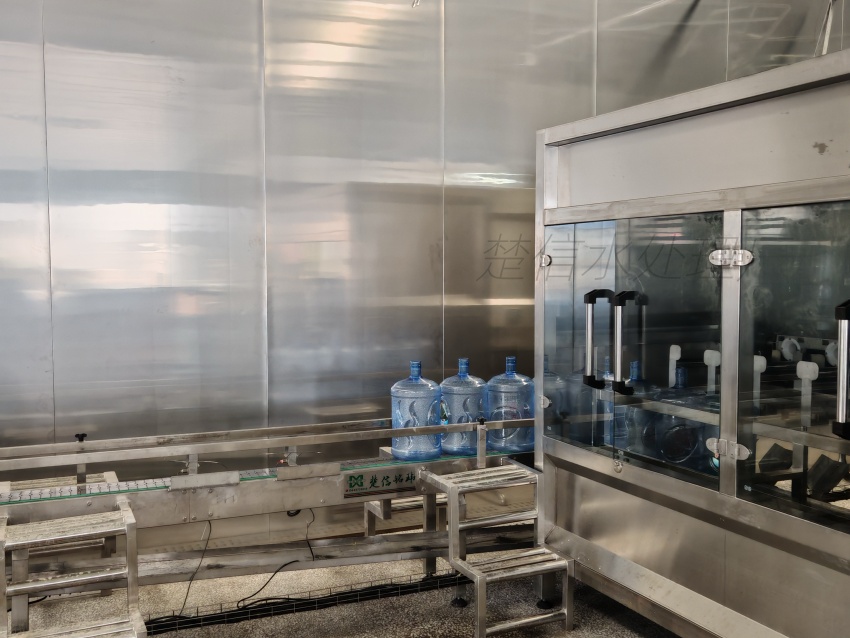
Chuxin Mingwei's bottled purified water filling line supports 5 L, 11.3 L, and 18.9 L (5-gallon) bottle types with rated capacities of 200–2,500 bottles per hour, customizable to project requirements. The spring water line covers 18.9 L, 11.3 L, 5 L, and other standard drinking water bottles at 200–1,800 bottles per hour (based on 18.9 L reference).
Comparison checkpoint: If your business model requires frequent format switching, verify that the equipment supplier provides documented changeover procedures, compatible change parts, and realistic throughput data for each format.
3. Integrated Washing-Filling-Capping vs. Separate Stations
The washing-filling-capping three-in-one (monoblock) configuration concentrates three processes on a continuous transport path, reducing transfer points and bottle-mouth exposure between stations. This design supports unified timing and control, which is critical for maintaining hygiene in purified water production where any post-treatment contamination undermines the RO process.
However, a monoblock unit does not replace upstream water treatment, bottle supply systems, or downstream labeling and packaging. A complete bottled water production line typically includes: water treatment, finished water storage and disinfection, preform blowing or empty bottle unscrambling, washing-filling-capping, visual inspection or online detection, inkjet coding, labeling, shrink wrapping or cartoning, and palletizing.
Alternative consideration: For barrelled water (3-gallon, 5-gallon, or 10–18.9 L returnable or one-way barrels), the front-end process differs significantly. Barrel lines require inspection, cap removal, external brushing, internal brushing, multi-station washing, disinfection, and final rinsing before filling — a workflow that cannot be collapsed into a standard bottle monoblock. If your operation serves both bottled and barrelled segments, these are fundamentally separate line architectures.
4. Cleanroom and Environmental Control
Purified water filling demands controlled environmental conditions to prevent recontamination after RO treatment. Chuxin Mingwei's clean air purification systems are engineered for water bottling and barrelled water filling cleanrooms, designed to meet ISO Class 8 (100,000) standards with upgrade paths to Class 7 (10,000). These systems integrate with the water treatment and filling line through site-specific airflow design, duct routing, and pressure zoning.
Decision boundary: If your facility cannot accommodate cleanroom infrastructure — or if local regulations do not require it for your product category — this affects both line selection and total project cost. Confirm regulatory requirements before specifying environmental control systems.
---
Optional Factors That Influence Configuration
Once must-haves are resolved, the following variables shape the final line design but do not determine the core technology choice.
Automation Level and Control Architecture
Both the purified water and spring water lines feature PLC-based intelligent control systems with HMI interfaces. The purified water line emphasizes fully automated end-to-end workflow with synchronized bottle washing, filling, capping, and inspection — requiring minimal manual intervention. The level of automation should match your available operator skill base and maintenance capacity, not simply default to the highest specification.
Capacity Calculation Beyond Nameplate Ratings
A frequent planning error is converting line speed (bottles per hour) directly into finished water volume without accounting for process water consumption. Actual capacity planning must include bottle washing water, CIP (clean-in-place) cycles, equipment flushing, formulation losses, peak buffering, and planned operating hours. The correct approach is to calculate per-shift finished product volume first, then overlay process water and safety margins, verifying that raw water tanks and finished water tanks can balance short-term fluctuations. Final calculations should be confirmed through project-specific material balance analysis.
---
Operational Risks and Troubleshooting Boundaries
Even well-specified lines encounter operational issues. Understanding common failure modes helps evaluate whether a supplier's support model matches your risk tolerance.
Inconsistent Filling Levels
When filling levels vary across bottles, the first diagnostic step is determining whether all filling heads fluctuate simultaneously or whether a single valve position is abnormal. Line-wide fluctuations typically point to supply liquid level, pressure, temperature, foaming, return flow, or speed issues. Single-valve anomalies require inspection of the filling valve, seals, sensors, pneumatic paths, and bottle positioning. Before making adjustments, preserve alarm logs and trend records for analysis.
Capping Failures: Loose or Misaligned Caps
Capping problems require systematic troubleshooting: verify cap specifications, cap orientation in the sorter, cap chute alignment, and missing-cap detection first. Then inspect bottle mouth dimensions, bottle positioning, capping head height, torque component wear, and operating rhythm. If failures occur only with specific bottle formats or at high speeds, check changeover parts and conveyor stability.
Support boundary: These troubleshooting procedures assume that the equipment supplier has provided complete documentation, training, and access to spare parts. If your supplier's after-sales model does not include remote diagnostics, on-site response commitments, or operator training, your operational risk increases significantly — regardless of equipment quality.
---
Long-Term Support and Delivery Scope
The comparison between line configurations extends beyond equipment specifications to the supplier's delivery execution model. Chuxin Mingwei's approach covers end-to-end engineering services: design, manufacturing, installation, commissioning, operator training, and after-sales support. The emphasis is on non-standard, site-specific solutions engineered from actual source water quality, target water standards, production capacity, packaging format, and facility constraints.
Key questions for any supplier comparison:
- Does the quotation itemize what is included and excluded (e.g., bottle preforms, caps, labels, packaging materials, utility connections)?
- Is the water treatment system designed based on a current source water analysis report — or a generic template?
- Are cleanroom requirements, water plant cleanroom process flow, and environmental controls addressed in the initial proposal?
- What is the documented procedure for format changeovers, and are change parts included?
- What are the post-installation support boundaries: remote diagnostics, spare parts availability, response time commitments, and operator retraining?
For a detailed breakdown of investment considerations, refer to the bottled water production line cost guide.
---
Decision Summary
| Factor | Bottled Purified Water Line | Spring Water Line Alternative | Barrelled Water Line Alternative |
|---|---|---|---|
| Core purification | Dual-stage RO + ozone/UV | NF + UF (mineral retention) | Format-dependent |
| Target product | Demineralized purified water | Natural mineral/spring water | Dispenser-format water |
| Typical formats | 5 L, 11.3 L, 18.9 L | 5 L, 11.3 L, 18.9 L, others | 3 gal, 5 gal, 10–18.9 L barrels |
| Front-end process | Standard bottle handling | Standard bottle handling | Barrel inspection, washing, disinfection |
| Cleanroom requirement | ISO Class 8 typical | ISO Class 8 typical | ISO Class 8 typical |
The correct choice is not determined by technology superiority but by alignment with your source water, product positioning, packaging strategy, and facility reality.
---
Next Steps
If you are evaluating a bottled purified water filling line for your facility, the most productive starting point is a current source water quality report and a clear definition of your target product standard, packaging formats, and planned capacity. With these inputs, a site-specific comparison between RO-based purified water, NF/UF spring water, and barrelled configurations can be completed — including material balance calculations, layout constraints, and cleanroom requirements.
Contact Chuxin Mingwei's engineering team to discuss your project parameters and receive a configuration proposal based on your actual operating context.