
Bottled Purified Water Filling Line: Operator Troubleshooting and Compliance Risk Checklist
Who This Guide Is For
This article is written for operations leads, plant managers, and procurement teams who run or evaluate a bottled purified water filling line—typically for 5 L, 11.3 L, or 18.9 L (5-gallon) PET formats. If your facility uses a two-stage RO reverse osmosis process integrated with automated bottle washing, filling, and capping, the risks and diagnostic steps below apply directly to your daily output quality and compliance posture.
Rather than reviewing broad industry trends, this guide focuses on real operational friction points: where purified water lines drift out of spec, how to trace root causes, and what boundaries define your equipment supplier's responsibility versus your in-house maintenance scope.
---
Must-Have Baseline: What Every Purified Water Line Must Deliver
Before troubleshooting anomalies, confirm your line meets these non-negotiable operational baselines. These reflect standard configurations of Chuxin Mingwei's fully automatic bottled purified water filling production line and common industry practice for RO-based systems.
Water Quality and Purification Integrity
- Dual-stage RO deep purification
- combined with ozone and UV (254 nm) dual sterilization must consistently achieve target conductivity and microbial limits.
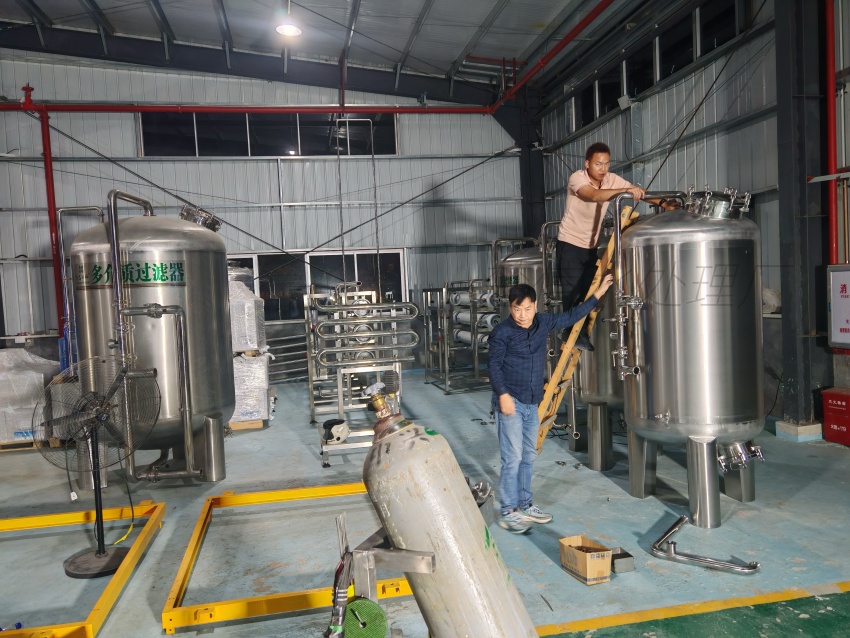
- Pretreatment stages—including multi-media filtration, activated carbon, softening, and precision filtration—must be serviced on schedule. Membrane fouling upstream is the most frequent cause of downstream filling contamination.
- Online monitoring for conductivity, pH, and ORP (oxidation-reduction potential) should trigger automatic diversion or alarm when readings exceed threshold.
Filling Accuracy and Capping Integrity
- Filling accuracy should remain within tight tolerances across all production runs, with level consistency verified by inline inspection.
- The integrated washing-filling-capping unit must maintain continuous sterile airflow and positive pressure within the clean zone to prevent bottle-mouth secondary contamination.
- Critical quality control points include rinse water quality and pressure, no-bottle-no-fill logic, missing-cap detection, and capping torque calibration.
Cleanroom and Environmental Compliance
- Filling zones should operate within an ISO Class 8 (100,000)
- cleanroom environment, with optional upgrade paths to Class 7 (10,000) for higher-risk product categories.
- HEPA filtration (H13 grade) and controlled airflow patterns must be verified at regular intervals.
---
Optional Factors: Upgrades That Reduce Risk but Are Not Mandatory
Not every facility needs maximum automation on day one. The following are value-add configurations that reduce long-term operational risk and can be phased in based on budget and production volume.
| Optional Upgrade | Risk It Mitigates | When to Consider |
|---|---|---|
| PLC + HMI real-time diagnostics with remote-ready interface | Reduces mean-time-to-diagnosis for filling anomalies | When your maintenance team is small or off-site |
| CIP (Clean-in-Place) automated cycle programming | Eliminates human error in sanitation scheduling | When running multiple shifts or high-frequency changeovers |
| Inline vision inspection for cap alignment and fill level | Catches defects before packaging stage | When capping pass rate shows recurring variance |
| Variable-frequency drive (VFD) on filling pumps | Smooths flow rate transitions during format changeovers | When switching between 5 L, 11.3 L, and 18.9 L bottles frequently |
---
Common Anomalies and Troubleshooting Paths
Below are the most frequently reported issues on bottled purified water lines, along with structured diagnostic steps. These reflect real-world operator scenarios rather than theoretical failure modes.
Anomaly 1: Capping Torque Drift — Seals Fail Intermittently
Symptom: Random bottles leak during transport or fail vacuum decay tests. Torque readings vary across the same batch.
Diagnostic Path:
- Check cap hopper feed consistency—are caps oriented correctly and free of deformation?
- Inspect capping head wear. Magnetic or clutch-based capping heads lose calibration over time.
- Do not simply increase torque settings. Excessive torque can damage bottle threads or deform caps, while insufficient torque compromises seal integrity. Adjustments must follow the equipment manufacturer's torque specification range.
- Verify bottle-mouth dimensions. Even minor molding variations in PET preforms can cause inconsistent engagement.
Boundary Note: If your line uses caps or preforms from multiple suppliers, dimensional variance is a common root cause that typically falls outside filling equipment warranty scope.
Anomaly 2: RO Membrane Performance Decline — Conductivity Creeps Upward
Symptom: Product water conductivity gradually rises over weeks. CIP cycles do not restore baseline performance.
Diagnostic Path:
- Review pretreatment logs—when was the multi-media filter last backwashed? Is activated carbon approaching exhaustion?
- Check differential pressure across RO membrane housings. Rising differential pressure indicates particulate fouling or biofilm formation.
- Verify antiscalant dosing rates if your system includes membrane pre-dosing.
- Inspect concentrate (reject) flow rate. A declining concentrate-to-permeate ratio signals membrane degradation.
Boundary Note: RO membrane lifespan depends heavily on raw water quality and pretreatment maintenance. Membrane replacement due to inadequate pretreatment is typically classified as a consumable cost, not a warranty claim.
Anomaly 3: Filling Volume Inconsistency — Some Bottles Under-Filled
Symptom: Random bottles show fill levels below target. Inline checkweigher rejects increase.
Diagnostic Path:
- Confirm "no-bottle-no-fill" sensor alignment. Misaligned photoelectric sensors cause skipped fills or double-dosing.
- Inspect filling valve seals and springs. Worn seals allow drip-back or incomplete valve closure.
- Check product water tank level stability. Rapid level fluctuations during high-speed filling can cause pressure variance at the filling nozzle.
- For gravity-fill systems, verify head tank height and overflow return line are unobstructed.
---
Risk Boundaries: Where Supplier Responsibility Ends and Yours Begins
Clear risk allocation prevents disputes during commissioning and warranty periods. The following boundaries apply to most custom-engineered bottled purified water filling lines delivered by Chuxin Mingwei.
Supplier Scope (Typically Included)
- Equipment design, manufacturing, factory acceptance testing (FAT), and site installation.
- Commissioning support, including initial parameter tuning for your specific bottle formats.
- Operator training covering normal operation, basic troubleshooting, and daily maintenance routines.
- Warranty coverage for mechanical and electrical defects under normal operating conditions.
Operator Scope (Your Responsibility)
- Raw water quality monitoring and pretreatment consumable replacement (filter media, carbon, membranes).
- Cap and preform quality control—dimensional checks, storage conditions, and supplier qualification.
- Cleanroom environmental maintenance, including HEPA filter replacement and air balance verification.
- Adherence to recommended CIP schedules and sanitation chemical concentrations.
- Timely reporting of anomalies before they escalate into major failures.
Shared Responsibility Zone
- Format changeovers:*
- If your line handles multiple bottle sizes (e.g., 5 L and 18.9 L), changeover procedures, required tooling, and expected downtime should be documented in the technical agreement before delivery.
- Capacity validation:*
- Rated capacity (e.g., 200–2,500 bottles/hour) is based on specific bottle dimensions and operating conditions. Actual throughput depends on upstream water treatment output, downstream packaging speed, and changeover frequency. Capacity calculations must also account for rinse water consumption, CIP cycles, equipment flushing, blending losses, peak buffering, and planned runtime—final figures should be confirmed through project-level material balance.
---
Long-Term Support: What to Expect After Commissioning
Sustained line performance depends on structured post-installation support. When evaluating a supplier or reviewing your existing contract, confirm these elements are explicitly defined:
- Spare parts criticality classification:*
- Identify which components are high-wear (filling valve seals, capping head clutches, sensors) versus long-life (frame, tank, conveyor structure). Maintain minimum stock of high-wear items on-site.
- Remote diagnostics capability:*
- PLC systems with remote-ready interfaces allow supplier engineers to review alarm logs and parameter drift without a site visit—reducing mean-time-to-resolution.
- Scheduled preventive maintenance visits:*
- Annual or semi-annual inspections catch wear patterns before they cause unplanned downtime.
- Process revalidation support:*
- If your raw water source changes seasonally or your product formulation shifts, your water treatment process may need revalidation. Confirm whether your supplier offers this as a billable service or includes it in an extended support agreement.
---
Next Steps
If your bottled purified water filling line is experiencing recurring anomalies, approaching a warranty expiration, or you are evaluating a new line investment, start with a structured risk review:
- Document your current baseline: Record filling accuracy trends, capping performance, RO conductivity readings, and cleanroom particle counts over a 30-day window.
- Map anomalies to root causes: Use the troubleshooting paths above to classify each issue as equipment-related, consumable-related, or process-related.
- Clarify support boundaries: Review your technical agreement to confirm which items fall under supplier warranty versus operator maintenance.
- Engage your supplier with specific data: Rather than reporting "the line is underperforming," provide timestamped logs, sample photos, and operating conditions at the time of failure.
For facilities in the planning stage, request a site-specific proposal that accounts for your raw water quality report, target production capacity, bottle format mix, and facility layout constraints. Generic catalog specifications cannot replace engineered solutions tailored to your actual operating context.
Contact Chuxin Mingwei's engineering team to schedule a technical consultation or request a risk assessment for your existing or planned bottled purified water filling line.