
Bottled Water Plant Procurement Checklist: A Practical Guide for Industrial Buyers
Bottled Water Plant Procurement Checklist: What Industrial Buyers Must Confirm
Investing in a bottled water plant is a capital-intensive decision for procurement managers and operations leads in the beverage, food, and pharmaceutical sectors. Unlike off-the-shelf equipment, these systems are engineered to match specific water sources, production goals, packaging formats, and facility layouts. A clear procurement checklist minimizes miscommunication, avoids costly redesigns, and ensures long-term operational stability. This guide outlines the essential technical and operational checkpoints based on real-world implementation practices from Chuxin Mingwei — a Huizhou-based manufacturer of custom water treatment and filling lines.
1. Define Your Source Water Characteristics
The starting point for any bottled water line is the raw water. Whether it’s municipal supply, groundwater, or spring source, its composition directly determines the purification process.
- For purified water: If total dissolved solids (TDS) exceed 200 ppm or chemical contaminants are present, a dual-stage reverse osmosis (RO) system is typically required. This ensures consistent product quality meeting national drinking water standards.
- For natural spring water: To retain beneficial minerals while removing pathogens and particulates, a nanofiltration (NF) + ultrafiltration (UF) process is often more suitable. This balances purity with mineral retention, preserving taste and market differentiation. Action step: Provide recent water test reports (within 6 months) to your supplier before quoting.
2. Specify Target Production Capacity and Bottle Format
Capacity isn’t just about “bottles per hour” — it must align with actual shifts, downtime allowances, and future scalability. Chuxin Mingwei’s published lines support:
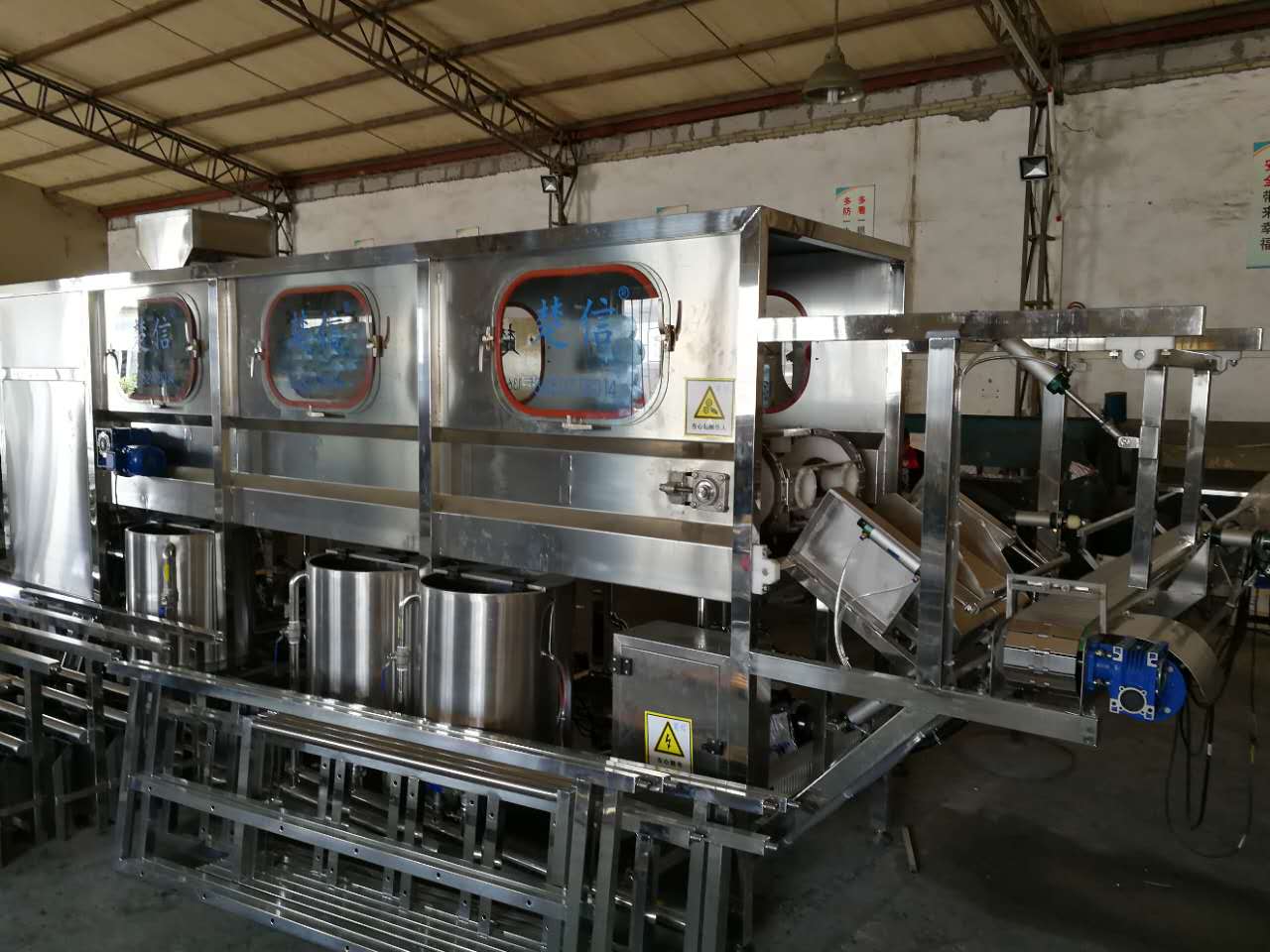
- Rated output: 200–1,800 bottles/hour for spring water (based on 18.9L);
- Up to *2,500 bottles/hour
- for purified water lines;
- Compatible sizes: 18.9 L, 11.3 L, and 5 L standard drinking water bottles. Also confirm:
- Bottle material (PET);
- Cap type (plastic, sport cap, aluminum);
- Need for integrated bottle washing-filling-capping units. Boundary note: Higher speeds may require upgraded conveyors, blowers, or compressed air systems — discuss utility readiness early.
3. Select the Right Purification Technology
Don’t assume one-size-fits-all. The core process should reflect both input water and product intent.
| Application | Recommended Process | Key Components |
|---|---|---|
| Purified Drinking Water | Dual-stage RO + Ozone/UV sterilization | Multi-media filter, activated carbon, RO membranes, ozone generator, UV lamp (254 nm) |
| Natural Spring Water | NF + UF + Mineral Retention | Dual-membrane system, precision filters, optional remineralization |
| PLC-based intelligent control systems ensure stable operation and data logging — essential for quality audits in regulated industries. |
4. Evaluate Cleanroom and Air Quality Requirements
Filling areas must prevent microbial contamination. For bottled water plants, clean air systems are not optional. Key specs from Chuxin Mingwei’s clean air solutions:
- Filtration efficiency: H13 HEPA;
- Airflow range: 1,500 – 20,000 m³/h (project-specific);
- Cleanroom design: Engineered to meet ISO Class 8 (100,000); upgradable to Class 7 (10,000). The system should include PLC + HMI controls with real-time diagnostics and remote monitoring capability. Implementation tip: Duct routing, pressure zoning, and airflow balance must be modeled during engineering — site-specific design is non-negotiable.
5. Clarify Delivery Scope and Service Boundaries
Many procurement issues arise from unclear scope. Know exactly what’s included: Typically included:
- Equipment design and manufacturing
- Factory acceptance testing (FAT)
- On-site installation and mechanical completion
- Commissioning and performance verification
- Operator training
- After-sales technical support Often excluded (must confirm):
- Civil works (foundations, drainage)
- Utility connections (power, compressed air, water inlet)
- Bottle, cap, and label supply
- Third-party certification costs Ask for a detailed bill of materials (BOM) and service workflow diagram before signing.
6. Plan for Long-Term Maintainability
Stability over time matters more than initial price. Prioritize suppliers who emphasize post-installation execution. Check:
- Availability of local spare parts;
- Response time for technical support;
- Training completeness (including maintenance procedures);
- Software/firmware update policies for control systems. Systems with standardized components and documented workflows reduce dependency on single technicians.
Next Steps
Before requesting a formal quotation, compile:
- Raw water analysis report
- Target daily output (in bottles or liters)
- Preferred bottle sizes and cap types
- Available floor space and utility specs (power, air, drainage)
- Cleanroom class requirement (if applicable) With this information, manufacturers like Chuxin Mingwei can deliver a technically accurate proposal — avoiding guesswork and change orders.