
Bucket Washer-Filler Process Flow: Why Contamination Persists and How to Correct It
The Hidden Cost of Incomplete Barrel Cleaning
In recycled barrel water production, the most frequent quality failure is not underfilled containers or misaligned caps — it is residual contamination that survives the washing stage and reaches the finished product. Operators often trace this back to the filling valve or the cleanroom environment, but in most cases, the root cause lies earlier in the bucket washer-filler process flow.
A 5-gallon (18.9L) PC barrel that has completed dozens of delivery cycles accumulates biofilm inside the neck, mineral deposits on the inner wall, and external grime around the handle and base. If the washing sequence does not address each of these zones with the correct mechanical action, chemical concentration, and contact time, no downstream sterilization step can fully compensate.
This article dissects the standard barrel wash-fill-seal process chain, explains where failures typically occur, and provides corrective actions that procurement managers and plant engineers can evaluate against their current or planned equipment.
Standard Bucket Washer-Filler Process Flow
Based on configurations used in 3-gallon, 5-gallon, and other returnable large-container water lines, the typical sequence is:
Empty barrel return → Inspection & sorting → Decapping → External brushing → Internal brushing → Multi-stage washing & disinfection → Final product-water rinse → Filling → Capping → Visual inspection → Labeling/shrink sleeve → Date coding → Bagging → Conveying to warehouse
Each stage serves a distinct function. Skipping or compressing any stage creates a specific contamination pathway.
Stage 1: Inspection and Sorting
Returned barrels vary widely in condition. Some arrive with visible algae, others with hairline cracks or deformed mouths that prevent proper sealing. Manual or automated inspection at this stage removes barrels that cannot be reliably cleaned or sealed.
Common failure: Cracked or heavily scratched barrels pass into the line. Internal scratches harbor biofilm that brushing and chemical washing cannot reach.
Corrective action: Establish a rejection criterion based on barrel cycle count, visible damage, and mouth deformation. Document and enforce it at the sorting station before barrels enter the washer.
Stage 2: Decapping
Automatic decapping machines remove the old cap and, in some configurations, the shrink sleeve remnant. If the cap is not fully removed, it blocks the internal brush and multi-stage nozzles downstream.
Common failure: Partial decapping leaves plastic fragments inside the barrel neck, which lodge in the filling valve or contaminate the finished product.
Corrective action: Verify decapping completeness with a sensor or visual checkpoint. Ensure the decapping tool matches the specific cap and neck geometry of the barrels in circulation.
Stage 3: External and Internal Brushing
External brushing removes dirt, labels, and adhesive residue from the barrel surface. Internal brushing uses a rotating brush head to mechanically dislodge biofilm and mineral scale from the inner wall.
Common failure: Brush heads wear down over time, reducing contact pressure against the barrel wall. Operators may not notice the gradual decline in cleaning effectiveness until microbial test results deteriorate.
Corrective action: Schedule brush head replacement based on measured wear, not calendar intervals. Track brush diameter and replace when it falls below the manufacturer's minimum specification for the barrel size in use.
Stage 4: Multi-Stage Washing and Disinfection
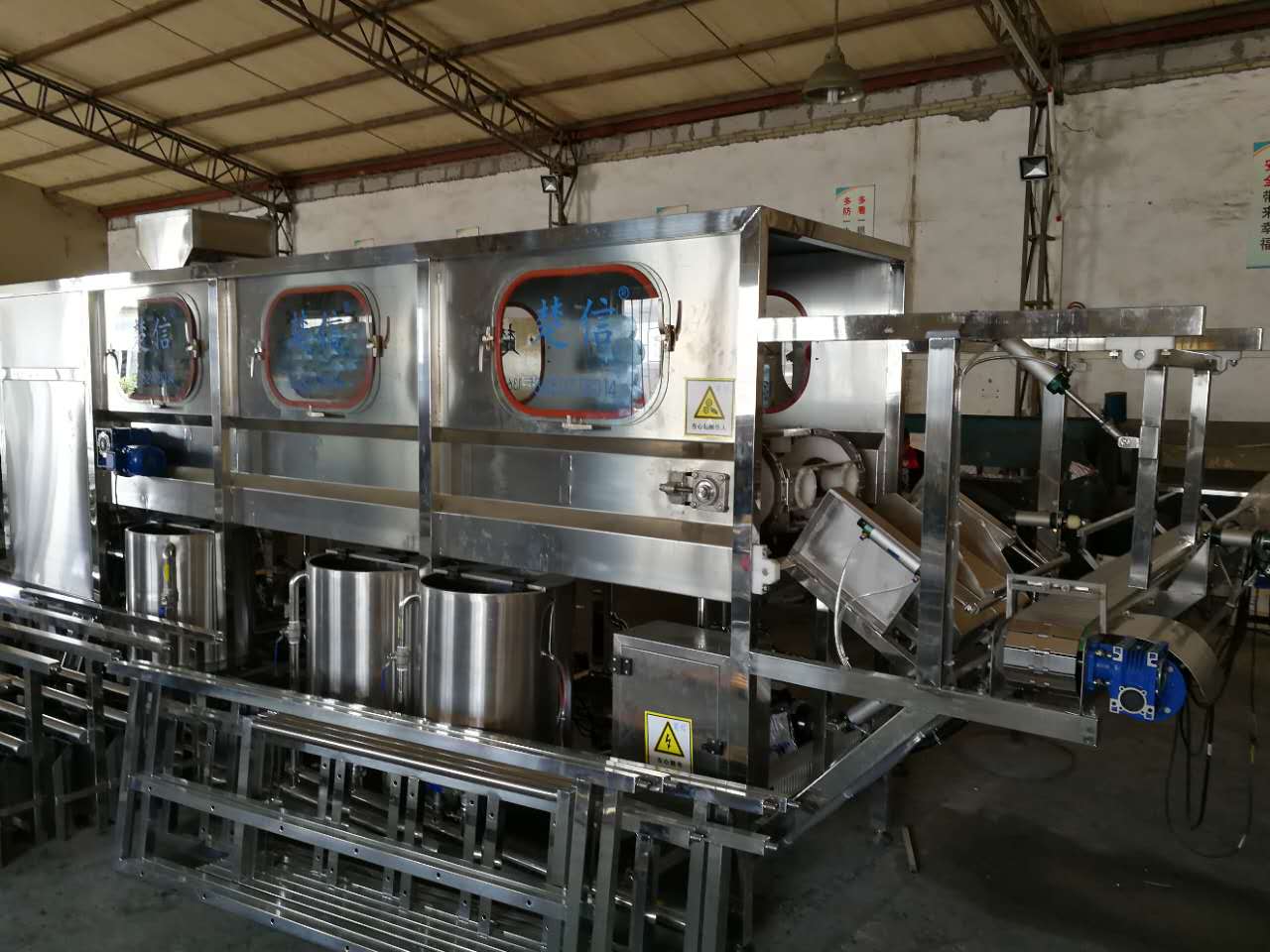
This is the core of the bucket washer-filler process flow. A typical multi-stage washer includes:
- Hot alkaline wash — dissolves organic residue and biofilm.
- Acid wash (optional) — removes mineral scale.
- Disinfectant rinse — typically chlorine dioxide or peracetic acid at controlled concentration.
- Intermediate rinses — remove chemical carryover between stages.
The number of stages, nozzle pressure, solution temperature, and contact time are all configurable based on the contamination level of returned barrels and the target water standard.
Common failure: Chemical concentration drifts below effective levels due to dilution, evaporation, or consumption by organic load. The system continues to run, but the disinfection stage no longer achieves the required microbial reduction.
Corrective action: Install inline concentration monitors or enforce timed manual titration checks. Link dosing pumps to flow meters so that chemical addition scales with actual barrel throughput rather than running on a fixed timer.
Stage 5: Final Product-Water Rinse
After chemical washing, the barrel interior must be rinsed with finished product water — not raw or partially treated water — to eliminate any chemical residue. This rinse also serves as the last particle removal step before filling.
Common failure: The final rinse uses water from a source that has not passed through the complete purification chain, reintroducing microorganisms or particulates into a chemically clean barrel.
Corrective action: Confirm that the final rinse water is drawn from the same sterile storage tank that feeds the filling valve, with verified conductivity and microbial parameters.
Filling and Capping: Where Secondary Contamination Enters
Once the barrel is clean, it moves to the filling station. In a wash-fill-seal integrated system, the barrel transitions from the final rinse to the filling valve within a controlled environment, minimizing exposure time.
Key variables at this stage include:
- Filling accuracy — typically within ±2 mL for volumetric systems.
- Capping pass rate — target ≥99.6% for automatic cap sorting, placement, and pressing.
- Cap disinfection — caps pass through a UV or chemical disinfection unit before being applied to the barrel.
Common failure: The cleanroom environment around the filling zone is not maintained at the required ISO Class 8 (100,000) standard, allowing airborne particles and microorganisms to settle on the open barrel mouth during the brief transition from rinse to fill.
Corrective action: Integrate the filling zone with a dedicated clean air purification system featuring H13 HEPA filtration, positive pressure zoning, and real-time particle monitoring. Verify that airflow patterns do not create dead zones above the filling valves.
Equipment Configuration Decisions That Affect Process Stability
When specifying a barrelled water filling line, several configuration choices directly impact the reliability of the washer-filler sequence:
| Decision Point | Impact on Process Flow |
|---|---|
| Number of washing stages | More stages allow separation of alkaline, acid, and disinfectant cycles, reducing chemical cross-contamination |
| Barrel compatibility | Lines configured for 18.9L standard PC barrels may require adjustment for 15L, 20L, or 22L non-standard variants |
| Automation level | Fully integrated wash-fill-seal systems reduce inter-process handling and exposure; semi-automatic lines require manual transfer between stations |
| Cleanroom specification | ISO Class 8 is standard for drinking water filling; Class 7 may be required for specific product categories or regional regulations |
| Capacity planning | Rated output of 200–1,800 barrels/hour is configurable; oversizing the washer relative to the filler creates bottlenecks, while undersizing forces reduced contact times |
Operational Boundaries and Risk Factors
Even a well-configured bucket washer-filler line has operational boundaries that must be respected:
- Barrel material degradation: PC barrels have a finite service life. As the plastic yellows and micro-cracks develop, no washing process can restore the original surface integrity. Establish a maximum cycle count and enforce barrel retirement.
- Seasonal water quality variation: Source water turbidity and microbial load change with seasons. The washing chemical concentration and contact time that work in winter may be insufficient in summer. Adjust dosing parameters based on periodic water quality testing.
- Operator training: Automated systems reduce but do not eliminate human judgment. Sorting decisions, brush inspection, and chemical monitoring all require trained personnel who understand the consequences of each checkpoint.
- Maintenance intervals: Nozzle clogging, pump wear, and sensor drift degrade washing performance gradually. Base maintenance schedules on operating hours and measured performance parameters, not arbitrary calendar dates.
Next Steps for Evaluating Your Barrel Line
If you are planning a new barrelled water production line or upgrading an existing one, the washer-filler process flow should be evaluated as a single integrated system — not as a collection of standalone machines. The key inputs for a proper equipment proposal include:
- Barrel specifications: Sizes in circulation (e.g., 18.9L, 15L, 20L), material (PC or PET), mouth type, and average return condition.
- Target capacity: Barrels per hour or per shift, with allowance for future expansion.
- Water source and treatment: Raw water quality report, which determines the purification process and the quality of water available for the final rinse stage.
- Facility constraints: Available floor space, cleanroom zoning possibilities, utility connections (water, power, drainage), and ceiling height for conveying systems.
- Regulatory requirements: Local food safety licensing standards, which dictate cleanroom classification, documentation, and testing protocols.
Sharing these details with your equipment supplier enables a line design where each stage of the bucket washer-filler process flow is correctly sized, properly sequenced, and matched to your actual operating conditions — rather than a generic configuration that leaves contamination risks unaddressed.