
Bucket Washer-Filler Working Principle: How Multi-Stage Cleaning, Filling, and Capping Prevent Contamination in Barrel W
Why barrel water quality issues often trace back to the bucket washer-filler
When a barrelled water producer receives complaints about off-flavor, short shelf life, or microbial contamination, the immediate assumption is often the water treatment system. But in many cases, the root cause lies in the bucket washer-filler—the integrated machine that cleans, disinfects, fills, and caps reusable barrels. If the washing sequence is incomplete, the rinse water is contaminated, or the capping is inconsistent, even the purest treated water will be compromised before it reaches the consumer.
Understanding the working principle of a bucket washer-filler is therefore not just a technical exercise—it is a practical tool for procurement managers, plant operators, and quality assurance teams. It helps you:
- Identify the correct machine specifications for your barrel type and production volume.
- Diagnose recurring quality issues.
- Set realistic maintenance and cleaning protocols.
This article explains how a typical bucket washer-filler (also called a washing-filling-capping integrated machine) operates, stage by stage, and highlights the operational boundaries that affect its performance.
Core operating logic: sequential cleaning and controlled filling
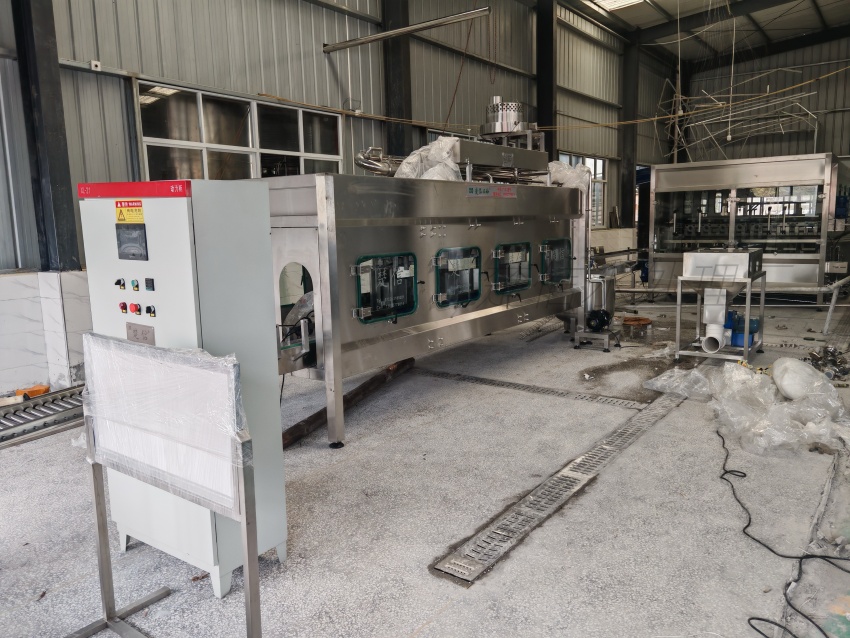
A bucket washer-filler is a monoblock machine that combines barrel washing, disinfection, filling, and capping into a single automated sequence. The core logic is to minimize barrel handling and exposure to ambient air, thereby reducing the risk of secondary contamination.
As described in Chuxin Mingwei's standard barrel water line configuration, the process chain for a recyclable barrel line is:
Empty barrel → inspection/sorting → cap removal → external brushing → internal brushing → multi-station washing & disinfection → final rinse with product water → filling → cap placement & pressing → leak/level inspection → labeling → shrink film → coding → bagging → conveyor output.
In a bucket washer-filler, the steps from external brushing through capping are integrated into a single machine. The machine is controlled by a PLC (Programmable Logic Controller) with HMI (Human-Machine Interface), which manages the timing, sequence, and interlocking of each station.
Stage 1: Barrel entry, inspection, and de-capping
Barrels arrive on the conveyor. An automatic de-capper removes the existing cap. A sensor checks for missing or damaged barrels. This stage is critical because a stuck cap or a severely deformed barrel can jam the downstream washing stations. The machine typically includes a reject mechanism for barrels that fail the initial check.
Stage 2: External brushing
Rotating brushes clean the outer surface of the barrel—especially the bottom, neck, and handle areas where dirt accumulates during transport. The brushing is performed in a dedicated chamber with water spray to prevent dust from spreading. This step prevents external contaminants from being carried into the washing zones.
Stage 3: Internal multi-stage washing and disinfection
This is the heart of the bucket washer-filler. The barrel is inverted, and a retractable brush or spray nozzle enters the interior. The multi-station washing typically includes:
- Pre-rinse – Uses recycled water to remove loose debris and residual liquid.
- Detergent wash – A food-grade alkaline or acid cleaner is circulated through the barrel, often at elevated temperature (40–60 °C) to break down biofilm and grease. The detergent is recirculated and filtered.
- Intermediate rinse – Removes detergent residues with clean water.
- Disinfection – Ozone is injected into the rinse water or directly into the barrel; alternatively, UV (254 nm) lamps are used. The goal is to achieve a microbial kill rate suitable for drinking water standards. Ozone provides residual disinfection but requires controlled dosing and off-gas treatment; UV is a physical method that does not leave residues but requires clean water and regular lamp maintenance.
- Final rinse – Uses treated product water (the same quality as the water to be filled) to remove any disinfectant residues and ensure the barrel interior is chemically neutral.
Each washing station is separated by drain zones to prevent cross-contamination between chemicals. The number of washing stations, the chemical concentration, and the contact time are adjustable based on the barrel condition and the target water standard.
Stage 4: Filling
After the final rinse, the barrel moves to the filling station, which is enclosed within the same machine frame. The fill nozzle enters the barrel mouth, and water is dispensed by gravity or low-pressure pump. A level sensor (e.g., capacitive or ultrasonic) or a flow meter controls the precise volume. Filling accuracy for a typical 18.9 L barrel is usually within ±2 mL. The filling environment is kept clean, often with a local HEPA filter or positive air pressure to prevent airborne contamination.
Stage 5: Capping and sealing
Pre-sterilized caps are fed from a cap hopper, sorted, and placed onto the barrel mouth. The capping press applies a controlled torque to ensure a leak-proof seal. A cap presence sensor rejects any barrel without a cap. The capping pass rate is typically ≥99.6% when the cap and barrel neck dimensions are within specification. After capping, the barrel proceeds to a light inspection station (for visual check of clarity and foreign objects) and a level detection sensor.
Operational boundaries and selection considerations
A bucket washer-filler is not a one-size-fits-all solution. Its performance depends on several factors that must be matched to your specific production context:
| Factor | Impact on performance |
|---|---|
| Barrel condition | Heavily soiled or aged barrels may require longer wash cycles, more washing stations, or manual pre-treatment. The machine must allow adjustable wash time, detergent concentration, and temperature. |
| Water quality for final rinse | The final rinse must use the same treated water as the filling water. If your water treatment system (RO, NF, or UF) produces water with high TDS or microbial count, the rinse will reintroduce contaminants. |
| Disinfection method | Ozone requires accurate dosing, contact time, and off-gas destruction; UV relies on water clarity, lamp condition, and sleeve cleanliness. The choice depends on your target water standard and local regulations. |
| Cleanroom environment | The filling area should be maintained at ISO Class 8 (100,000) or better. A separate clean air purification system (HEPA filtration) can be integrated with the bucket washer-filler to control airborne particles. |
| Production capacity | Typical barrel water lines range from 200 to 2,500 barrels per hour (based on 18.9 L). The bucket washer-filler's cycle time, number of washing stations, and conveyor speed must match your target output. |
Practical implications for operators and procurement managers
- Do not evaluate the machine in isolation.
- The bucket washer-filler is one part of a larger system. The de-capper, conveyor, labeler, and bagger must all be balanced with the machine's throughput.
- Verify the washing sequence.
- Ask the supplier for a detailed process flow diagram showing the exact number of washing stations, chemical types, contact times, temperatures, and drainage points. This is your best tool for comparing different machines.
- Plan for CIP maintenance.
- The washing tank and internal piping of the bucket washer-filler will accumulate scale and biofilm over time. Ensure the machine has a clean-in-place (CIP) capability or at least a manual cleaning procedure.
- Check barrel and cap compatibility.
- Non-standard barrel dimensions, neck finishes, or cap types may require custom tooling. Always provide barrel samples to the supplier before ordering.
Conclusion
A bucket washer-filler is more than a filling machine—it is a hygiene control system. Its working principle revolves around sequential cleaning, disinfection, and controlled filling executed in a single integrated machine. Understanding each stage's purpose, operating logic, and limitations helps you select the right equipment, avoid the most common cause of quality issues, and maintain consistent product safety.
When evaluating a supplier, look for a manufacturer that can engineer the machine to your specific barrel type, water quality, and facility layout, rather than offering a generic model. At Chuxin Mingwei, we design and build bucket washer-fillers as part of a complete barrel water line, with full support from raw water analysis to commissioning and after-sales service.