Custom Barrelled Water Filling Line: Engineering Decisions from Source Water to Stable Output
When a beverage, food, or pharmaceutical manufacturer plans a new barrelled water line, the first question is rarely about machine speed. It is about whether the system can consistently handle the actual source water, the chosen barrel format, and the facility's operational rhythm. A custom barrelled water filling line must be engineered around these variables, not around a generic capacity chart.
Why Source Water and Barrel Format Define the Line
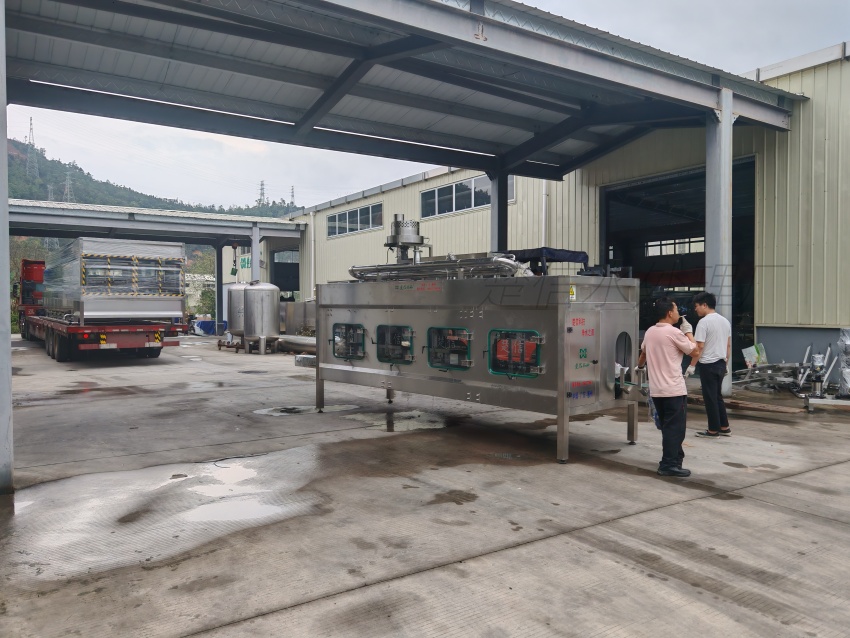
Barrelled water production involves reusable or single-use containers, typically in 3-gallon, 5-gallon, or 10L–18.9L sizes. The process starts with barrel inspection, cap removal, external and internal brushing, multi-stage washing, disinfection, and final rinsing. Only after these steps does the water enter the filling and capping stage. If the source water has high turbidity, seasonal variation, or specific mineral content, the upstream treatment must be matched accordingly. For example, spring water applications often use a dual-membrane NF + UF process to balance purification with mineral retention, while purified water lines rely on two-stage RO combined with ozone and UV sterilization.
The filling equipment itself must align with the barrel's physical characteristics and the required hygiene level. Integrated washing-filling-capping units reduce transfer points and minimize exposure, but they do not replace the need for proper water treatment, clean air support, or downstream packaging. A line's rated capacity, such as 200–1,800 bottles/hour for 18.9L barrels, is a reference point. Actual output depends on shift planning, CIP cycles, peak buffering, and the stability of the raw water supply.
Key Selection Criteria for Procurement Teams
- Water Quality Baseline: Provide a recent source water report. The treatment train (multi-media filtration, activated carbon, softening, RO, NF, UF, or UV/ozone) must be sized to meet your target standard, not just a generic purity label.
- Capacity vs. Realistic Runtime: Do not convert bottles/hour directly into daily volume. Account for rinsing water, CIP cleaning, equipment flushing, blending losses, and planned downtime. Calculate per-shift finished volume first, then add process water and a safety margin.
- Barrel Type and Handling: Reusable barrels require inspection, cap removal, and thorough internal/external cleaning. Single-use barrels simplify the front end but change packaging logistics. The line must accommodate your chosen format without excessive changeover time.
- Cleanroom and Airflow Integration: Filling zones typically require ISO Class 8 (100,000) cleanroom conditions, with optional upgrades to Class
- Airflow routing, pressure zoning, and HEPA filtration must be designed around the line layout, not added as an afterthought.
- Control System and Diagnostics: PLC-based intelligent control with HMI interface enables real-time monitoring, fault logging, and remote-ready diagnostics. This reduces manual intervention and supports consistent capping pass rates.
Implementation Boundaries and Risk Control
A custom line is not a plug-and-play product. Delivery includes design, manufacturing, installation, commissioning, operator training, and after-sales support, but it does not cover civil works, utility connections, or external packaging supply unless explicitly contracted. The equipment's compatibility with specific bottle sizes, cap types, and water temperatures must be confirmed during the engineering phase. For instance, filling accuracy is typically ≤ ±2 mL, but this assumes stable water pressure, proper valve configuration, and calibrated sensors.
Common risks include underestimating CIP water consumption, mismatching airflow to the actual filling footprint, or assuming a single machine can handle all liquid types without valve or pressure adjustments. These are not theoretical; they are documented in project handover reviews and directly impact uptime and maintenance costs.
Next Steps for Decision Makers
- Request a site-specific engineering assessment based on your source water report, target capacity, barrel format, and facility layout.
- Clarify the exact scope of supply: what is included in the line, what requires third-party coordination, and what falls under post-installation support.
- Review the delivery workflow: design approval, manufacturing lead time, installation schedule, commissioning criteria, and training plan.
- Confirm long-term maintainability: spare parts availability, remote diagnostics capability, and response boundaries for after-sales service.
A well-engineered barrelled water filling line is not about maximum speed on paper. It is about stable output, predictable maintenance, and a clear path from source water to packaged product. If your team is evaluating options, start with the water quality data, the barrel handling reality, and the facility constraints. The rest follows from there.
For a detailed technical discussion or a site-specific configuration review, contact our engineering team with your source water report, target capacity, and packaging format. We will map the equipment capabilities to your operational context and provide a clear scope of work.
相关推荐
- [Chuxin Mingwei water purification equipment for hotel water supply systems](/)
- bottled water production line quotation