
Determining Required Cleanroom Classification for Water Bottling Facilities Based on Production Scale
Diagnostic: Why Air Quality Matters in Water Bottling
For procurement managers and operations leads evaluating a new bottled or barrelled water facility, treating air purification as an afterthought often leads to secondary contamination risks. Airborne particulates can compromise product sterility, reduce capping pass rates, and trigger quality audit failures. Selecting the appropriate cleanroom classification depends on your production scale, filling technology sensitivity, and facility constraints.
Root Cause Analysis: What Drives Cleanroom Selection?
Airborne particles are a primary vector for microbial contamination in non-sterile filled products like purified and spring water. Filtration efficiency and airflow volume must align with your operational risk profile:
- High-Speed Filling Lines:*
- Faster line speeds increase turbulence around open bottle necks, raising particle ingress risk. This often requires higher-grade air control and precise pressure zoning.
- Product Sensitivity:*
- Purified water relies on multi-stage RO and UV/Ozone sterilization, while spring water uses dual-membrane NF + UF to balance purification with mineral retention. Both require strict environmental control to maintain brand integrity and fill accuracy (≤ ±2 mL).
- Facility Layout:*
- Existing building constraints may limit duct routing and airflow paths, requiring customized engineering rather than standard off-the-shelf units.
Decision Checklist: How to Determine Your Requirements
Use this checklist to evaluate whether your project requires a standard ISO Class 8 environment or an upgrade to ISO Class 7.
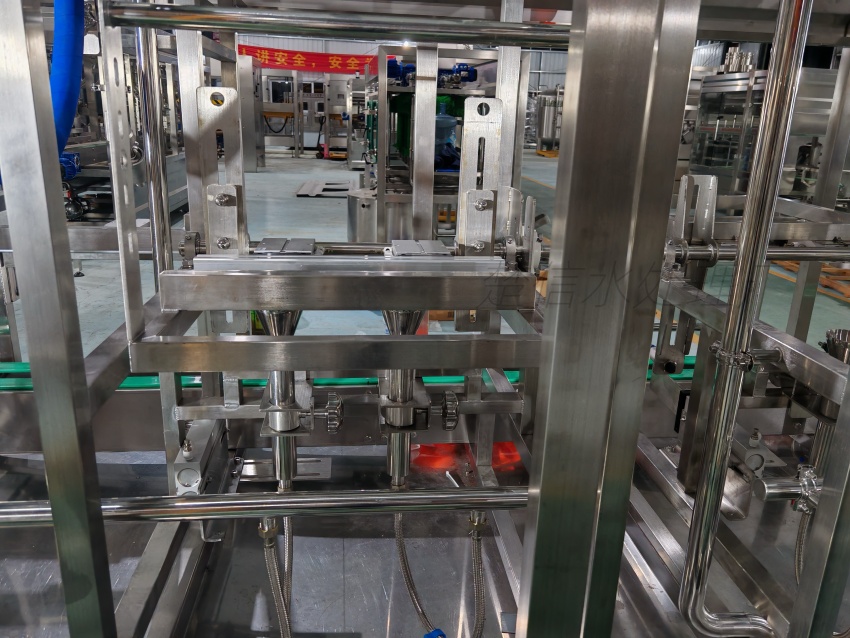
1. Assess Production Capacity & Line Speed
- Standard Requirement:*
- For small-to-medium scale lines (e.g., 200–1,800 bottles/hour for 18.9L barrels), ISO Class 8 is typically sufficient when paired with proper positive pressure maintenance.
- High-Volume Requirement:*
- If deploying high-speed fully automatic lines (e.g., up to 2,500+ bottles/hour) or operating in markets with stricter hygiene expectations, consider upgrading to ISO Class 7. Note that rated capacity varies by bottle format; parameters must always specify test conditions.
2. Evaluate Product Type & Process Complexity
- Purified Water:*
- Built on dual-stage RO deep purification combined with ozone and UV (254 nm) sterilization. A stable ISO Class 8 environment with H13 HEPA filtration is generally adequate to prevent post-filtration contamination.
- Spring/Natural Water:*
- Requires balancing purification with mineral retention. Because these processes are sensitive to external variables, a controlled air environment is vital to ensure natural characteristics are preserved during filling and capping.
3. Review Facility Constraints & Scalability
- Space & Ducting:*
- Custom-engineered systems must account for existing airflow paths. Ensure your supplier provides site-specific engineering for duct routing and pressure zoning.
- Future Expansion:*
- Look for PLC + HMI control systems with real-time diagnostics and remote-ready interfaces, allowing for monitoring and potential future upgrades without major infrastructure changes.
Resolution: Key Specifications to Verify
When evaluating vendors for your clean air purification system, verify the following technical parameters against your operational needs:
| Parameter | Standard Recommendation (ISO Class 8) | High-Spec Option (ISO Class 7) |
|---|---|---|
| Filtration Efficiency | H13 HEPA Filters | H13 HEPA Filters (upgraded airflow distribution) |
| Airflow Range | 1,500 – 20,000 m³/h (Project-specific selection) | Higher volume, optimized distribution |
| Control System | PLC + HMI with real-time diagnostics & remote-ready interface | Advanced data logging & trend analysis |
| Compliance | ISO 14644-1 Class 8 standard | Optional Class 7 configuration |
Escalation Boundary: When to Engage Engineering Support
Do not attempt to size air purification units based solely on floor area. Incorrect sizing leads to poor pressure differentials, dead zones, and inconsistent air exchange rates.
Engage professional engineering support if:
- You are integrating the air system with an existing water treatment and filling line.
- Your facility has unique humidity or temperature challenges affecting capping pass rates or liquid flow.
- You require a turnkey solution that includes design, manufacturing, installation, commissioning, and operator training.
Next Steps for Buyers
To ensure your investment aligns with long-term operational stability:
- Define Your Baseline: Confirm your target output capacity (bottles/hour) and bottle formats (e.g., 18.9L, 5L, 11.3L).
- Request Site-Specific Design: Ask suppliers to provide airflow and pressure zoning plans based on your actual facility layout and existing utility connections.
- Verify Integration Capabilities: Ensure the air purification system can seamlessly integrate with your chosen filling line (e.g., Chuxin Mingwei's Bottled Spring Water or Purified Water Filling Lines).
Chuxin Mingwei delivers engineered water treatment and filling systems for beverage, food, pharma, electronics, and heavy industry sectors. Custom design, manufacturing, installation, and long-term support — based on your water quality, capacity, layout, and budget.
Contact our engineering team to discuss your facility's specific cleanroom requirements and receive a tailored proposal.