
What Equipment Is Needed for a Bottling Facility Purification Project? Complete Configuration List & Function Overview
What Equipment Is Needed for a Bottling Facility Purification Project? Complete Configuration List & Function Overview
When scaling up or launching a new bottled water production line, one of the most critical procurement questions is: What equipment is actually needed for a complete purification project? The answer isn’t a fixed checklist — it depends on your source water, target product (purified vs. spring), production volume, packaging format, and facility environment.
Based on Chuxin Mingwei’s engineering approach, this guide breaks down the core equipment groups required for a fully functional bottling facility purification system, explains integration logic, and highlights key decision points that impact performance and compliance.
Core Equipment Groups in a Bottling Facility Purification System
A complete purification project integrates three interdependent systems:
- Water Purification System
- Filling & Packaging Line
- Clean Air Support System
Each must be configured to match the others — otherwise, bottlenecks, contamination risks, or underutilized capacity can occur.
1. Water Purification System: From Source to Sterile Product Water
The purification system transforms raw water into microbiologically safe, chemically stable product water suitable for bottling. Configuration depends on source water quality and product type.
For bottled purified water, Chuxin Mingwei typically deploys a dual-stage RO reverse osmosis process, including:
- Multi-media filter
- Activated carbon filter
- Softener (if hardness is high)
- Precision cartridge filter (5 μm)
- First-stage RO membrane array
- Second-stage RO for deeper deionization
- Ozone generator and UV sterilizer (254 nm)
- Stainless steel product water tank with CIP cleaning capability
This setup ensures consistent TDS removal and microbial control, supporting customizable production capacities based on 18.9 L bottle output.
For bottled spring water, where mineral retention is important, a non-RO approach is used:
- Dual-membrane NF + UF (nanofiltration + ultrafiltration) process
- Targeted disinfection via ozone/UV
- Selective pathogen and turbidity removal while preserving natural mineral profile
Both configurations include PLC-based monitoring of pressure, flow, and water quality parameters to support stable operation.
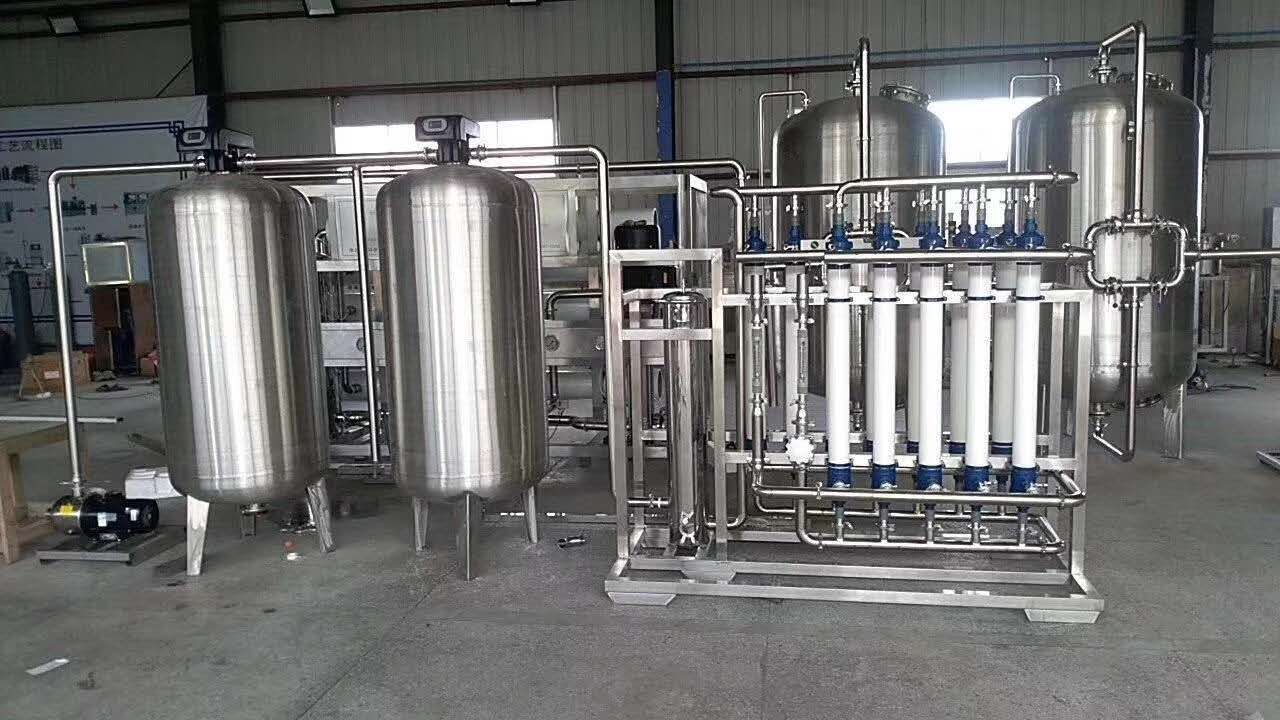
Key fact: The purification process is not isolated — its output flow rate and water quality directly determine the stable operation of the downstream filling line.
2. Filling & Packaging Line: Synchronized Wash-Fill-Cap Operations
The filling line handles empty container preparation, precise filling, and sealing. For large-format bottled water (e.g., 5-gallon / 18.9 L), Chuxin Mingwei offers integrated bottle washing-filling-capping units.
Key components include:
- Bottle unscrambling and conveyor system
- In-line bottle rinser (using sterile product water)
- Gravity or pressure-assisted filling valves with high precision
- Automatic capping machine
- Integrated PLC control with HMI interface
These units are synchronized with the purification system’s output, ensuring continuous feed without over-pressurizing storage tanks.
Note: For reused barrels, additional upstream equipment like automatic cap removers, internal brush washers, and multi-stage disinfection rinse stations are required — but these are only included if specified during procurement.
3. Clean Air Purification System: Maintaining ISO-Classified Environments
To prevent airborne contamination during filling, especially for still water products, a dedicated clean air system is essential.
Chuxin Mingwei designs systems meeting ISO Class 8 standards, with optional upgrade to Class 7. Key elements:
- Pre-filter + mid-efficiency filter + H13 HEPA final filter
- Air handling unit with variable frequency drive (VFD)
- Ductwork routed according to cleanroom zoning
- Positive pressure control to block unfiltered air ingress
- Real-time monitoring via PLC + remote-ready interface
Airflow is selected based on room volume, occupancy, and process layout to maintain consistent air quality in critical zones.
Critical point: The cleanroom must encompass at least the filling zone — and ideally extend to cap delivery and post-filling conveyance.
Implementation Prerequisites: What You Must Specify Before Final Design
To receive an accurate equipment list and quotation, you must provide:
- Source water quality report (TDS, hardness, iron, manganese, bacteria)
- Target product standard (e.g., GB 19298 or internal specification)
- Hourly/daily production capacity
- Bottle size(s): e.g., 18.9 L, 11.3 L, 5 L
- New vs. reused containers (impacts pre-wash requirements)
- Factory floor plan with utility locations (water, power, drainage)
- Local environmental conditions (dust levels, ambient temperature)
Without these, any equipment proposal remains preliminary.
Risks of Incomplete or Mismatched Configurations
Common failures stem from overlooked dependencies:
- Installing a high-output RO system but pairing it with a low-capacity filler → idle time and energy waste
- Omitting HEPA filtration in dusty environments → increased reject rates during lamp inspection
- Using generic ozone dosage without validating contact time → incomplete microbial kill
These issues often emerge only after commissioning, leading to unplanned downtime and retrofit costs.
Next Steps: How to Get Your Site-Specific Equipment List
If you’re evaluating a purification project, start by gathering your water analysis and production targets. Then:
- Request a bottled water production line quotation to define scope
- Share your factory layout for airflow and pipeline routing assessment
- Clarify whether you’ll use new or recycled containers
Chuxin Mingwei will map your inputs to a validated equipment configuration, including technical specifications, integration boundaries, and long-term maintenance access points.
All systems are delivered as end-to-end engineering services: design, manufacturing, installation, commissioning, operator training, and after-sales support.