
Decision Memo: Estimating Retrofit Costs for New Bottle Formats on Monoblock Fillers
Decision Memo: Estimating Retrofit Costs for New Bottle Formats on Monoblock Fillers
To: Procurement Managers and Operations Leads
Subject: Cost Estimation and Implementation Strategy for Bottle Format Changeovers
1. Objective
Beverage and water producers frequently need to introduce new packaging formats—such as shifting from standard 5 L bottles to 11.3 L formats, or transitioning from round to square profiles—to meet market demands. When utilizing a monoblock washing-filling-capping machine, the assumption is often that a format change only requires purchasing a few mechanical molds. However, inaccurate cost estimation at this stage leads to budget overruns, utility bottlenecks, and extended downtime. This memo outlines the comprehensive cost components and technical prerequisites required to accurately estimate a monoblock filler retrofit.
2. Alternatives: Defining the Scope of Retrofit
Before estimating costs, the engineering team must classify the format change into one of two categories, as this dictates the financial scope:
- Alternative A: Minor Profile Change (Same Volume).*
- Transitioning between shapes (e.g., round to square) of the same capacity. This primarily requires replacing star wheels, guide rails, and adjusting the capping chute. The cost is largely confined to custom-machined change parts and brief mechanical calibration.
- Alternative B: Major Volume Change (e.g., 5 L to 11.3 L).*
- This requires comprehensive modifications. Filling valves must be recalibrated for different flow rates and liquid levels. Capping heads may need replacement if the neck finish differs. Furthermore, the physical footprint of the bottle alters the dynamics of the entire production line.
3. Evidence: Often Overlooked Cost Items
To build an accurate budget, procurement teams must look beyond the monoblock filler itself and evaluate the following interconnected systems.
3.1 Mechanical Compatibility and Change Parts
The core expense involves manufacturing and installing new handling components. Bottle diameter, bottle height, cap type, and container material serve as critical inputs for determining changeover compatibility on a monoblock system. If the new format utilizes a different neck standard, the capping heads and cap-sorting elevators must be entirely replaced, not just adjusted. Evaluating a new packaging format requires strict selection criteria focusing on bottle and neck standards, cap types, and whether the containers are new or recycled, as recycled containers often require more rigorous inspection and handling mechanisms.
3.2 Utility and Water Treatment Matching
A larger bottle format directly impacts the facility's utility consumption. When upgrading bottle formats, the water treatment production capacity must be recalculated to account for bottle washing, CIP cycles, and system losses, rather than just the net filling volume. If a plant shifts to a higher total hourly output volume, the existing reverse osmosis (RO) or ultrafiltration (UF) system may become a bottleneck. The cost estimate must include potential upgrades to high-pressure pumps, membrane arrays, or raw water storage to maintain continuous supply to the filler.
3.3 Conveying and Buffer Dynamics
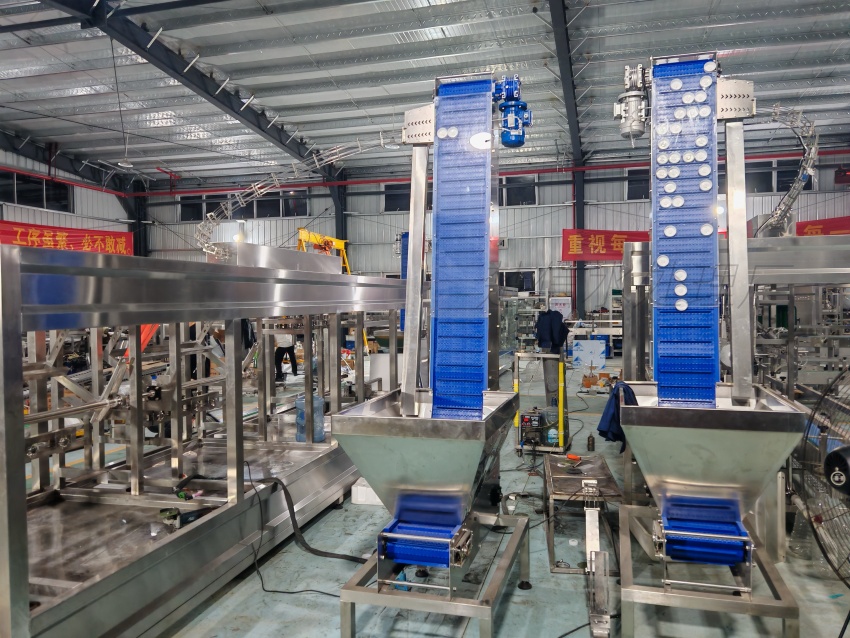
Monoblock fillers do not operate in isolation. A change in bottle diameter and height alters the center of gravity and friction on conveyor belts.
- Hardware adjustments:*
- Guide rails along the entire infeed and discharge conveyors must be replaced.
- Buffer zones:*
- The accumulation tables and buffer zones must be recalculated to prevent bottle crushing or line starvation, especially when integrating with downstream packaging equipment like shrink wrappers or palletizers.
3.4 Cleanroom Airflow Rebalancing
For facilities producing purified or spring water under ISO Class 8 (100,000) cleanroom standards, introducing a physically larger bottle displaces more air within the filling enclosure. This can disrupt the laminar airflow provided by H13 HEPA filtration systems. The retrofit budget should include an allowance for HVAC rebalancing and particle count re-certification to ensure the cleanroom maintains positive pressure and compliance.
3.5 Implementation and Downtime Costs
The most significant hidden cost is lost production time. The budget must account for the labor hours required for mechanical teardown, electrical PLC parameter updates, and sanitary validation. When budgeting for the physical integration, procurement teams must also account for the water plant equipment installation and commissioning required to validate the new format under live production conditions. This includes the cost of water, electricity, and packaging materials consumed during the testing phase before achieving the target filling accuracy (e.g., ≤ ±2 mL) and capping pass rate (≥99.6%).
4. Recommendation
Do not approve a retrofit budget based solely on a supplier's quote for change parts. Procurement teams should mandate a site-specific engineering audit that maps the new bottle format against the entire production ecosystem—from raw water treatment capacity to downstream packaging constraints.
Partnering with an end-to-end engineering provider ensures that the monoblock filler modifications are synchronized with your facility's actual utility limits and operational workflows, prioritizing long-term stability over short-term hardware savings.