
How to Evaluate a Custom Barrelled Water Filling Line Through Maintenance and Support Realities
How to Evaluate a Custom Barrelled Water Filling Line Through Maintenance and Support Realities
A Real-World Starting Point: The 18.9L Barrel Plant Facing Downtime
A mid-sized bottled water producer in Guangdong operates a custom barrelled water line handling 18.9L returnable containers. After two years, unplanned stoppages increased—not due to mechanical failure, but because routine maintenance tasks (like internal brush replacement or ozone injector calibration) required vendor dispatches that took 5–7 days. Spare parts weren’t locally stocked, and operator training hadn’t covered basic diagnostics.
This scenario is common when procurement focuses solely on capacity (e.g., “200–1,800 bottles/hour”) without validating the sustained operability of the system.
Why Maintenance and Support Define Long-Term Value
Chuxin Mingwei’s approach to custom barrelled water filling lines—such as those integrated with spring or purified water treatment—prioritizes stability, applicability, and long-term maintainability from the engineering phase. This means:
- Equipment layout accounts for service access (e.g., wash heads, filling valves, HEPA filter housings)
- Control logic includes diagnostic alerts for early intervention
- Training covers not just startup, but daily checks, cleaning cycles, and fault interpretation
As noted in our bottled spring water production line design, even high-precision components like the integrated washing-filling-capping unit (with ≤ ±2 mL filling accuracy) depend on consistent maintenance to sustain performance.
Key Evaluation Criteria for Procurement Teams
When assessing a custom barrelled water filling line, ask these maintenance- and support-focused questions:
1. Is the maintenance workflow designed into the equipment?
Look for features like:
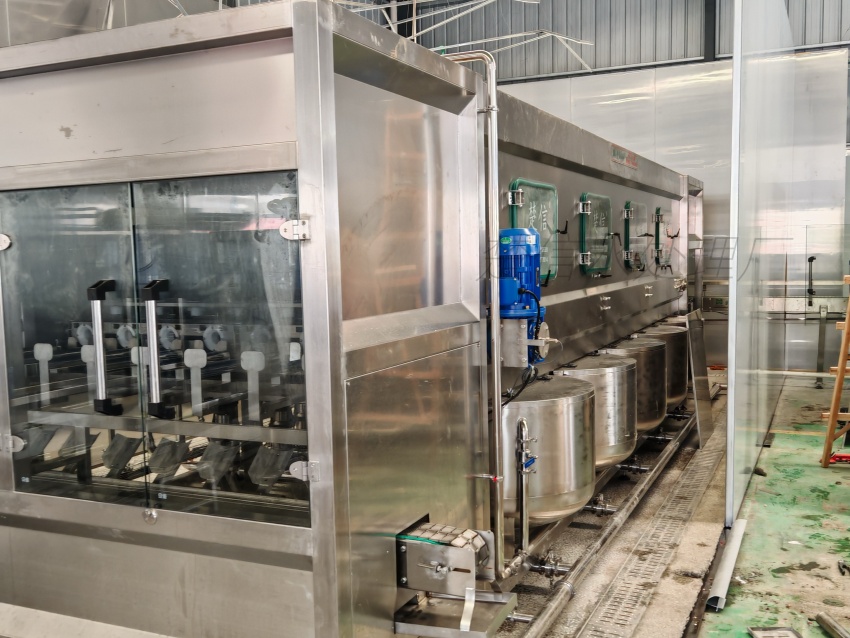
- Quick-disconnect fittings for CIP (Clean-in-Place) circuits
- Modular pump or valve groups that can be serviced without full line shutdown
- HMI interfaces that log cycle counts, pressure deviations, or UV intensity decay
For example, Chuxin Mingwei’s clean air systems for bottling areas include PLC + HMI control with real-time diagnostics—enabling operators to spot airflow anomalies before they breach ISO Class 8 standards.
2. What’s included in after-sales support—and what isn’t?
Clarify boundaries upfront:
- Is remote troubleshooting available? For how long post-commissioning?
- Are critical spares (e.g., NF/UF membranes, capping heads, HEPA filters) stocked regionally?
- Does training cover preventive maintenance schedules aligned with your shift patterns?
Our end-to-end service scope explicitly includes operator training and after-sales support—but only for components within the delivered system. External utilities (compressed air quality, cooling water temp) remain the client’s responsibility.
3. How does the design accommodate your facility constraints?
A line rated for 1,800 barrels/hour is useless if maintenance aisles are too narrow or ceiling height limits crane access for motor replacement. Chuxin Mingwei engineers each solution based on actual site conditions, including space for future filter changes or control cabinet access.
Implementation Boundaries to Confirm
Avoid assumptions. Verify:
- Whether “automated” includes self-diagnostics or just motion control
- If consumables (ozone generators, UV lamps, membrane cartridges) are quoted separately
- Whether software updates or cybersecurity patches are part of long-term support
Note: Performance claims like “capping pass rate ≥99.6%” assume proper maintenance of torque settings and cap feed alignment—tasks that must be executable by your team.
Next Steps: Qualify Beyond the Brochure
Before finalizing a custom barrelled water filling line:
- Request a maintenance task map: Ask the supplier to outline weekly, monthly, and annual service actions—including estimated downtime and skill level required.
- Review the spare parts list: Ensure critical wear items are available within your region or via agreed lead times.
- Simulate a failure scenario: During FAT (Factory Acceptance Test), practice replacing a key component (e.g., a filling nozzle) to assess ergonomics and documentation clarity.
Chuxin Mingwei structures its engineering services to make these validations possible—because a filling line’s true ROI emerges not on day one, but over years of stable operation.
---
Ready to align your barrelled water project with realistic maintenance and support expectations? Contact our engineering team to discuss your source water, packaging format, and facility layout—we’ll clarify what’s included, what’s not, and how we ensure long-term operability.
相关推荐
- [Chuxin Mingwei water purification equipment for hotel water supply systems](/)
- bottled water production line quotation