
How to choose customer scenario, bottled sprin: selection, rollout and support checklist
Fully Automatic Bottled Spring Water Filling Line: A Practical Guide to Customer Scenario
Direct Answer: How to Match Equipment to Your Operational Reality
Selecting a fully automatic bottled spring water filling line requires aligning the washing-filling-capping synchronization, purification stage, and bottle format with your actual plant constraints rather than relying on nominal hourly ratings. The equipment must be engineered from your specific source water quality, target product standards, production capacity, packaging format, and facility footprint. Prioritizing stability, applicability, and long-term maintainability ensures the line delivers consistent output without frequent changeover delays or hygiene bottlenecks.
Key Signals to Evaluate Before Selection
Before finalizing specifications, procurement and engineering teams should verify four operational signals:
Source Water Variability: Spring water characteristics shift with seasons and extraction points. The purification stage must balance microbial safety with mineral retention, avoiding over-treatment that degrades product positioning.
Bottle Format & Throughput Targets: Compatible formats typically include 18.9 L, 11.3 L, and 5 L containers. Rated output generally ranges from 200 to 1,800 bottles per hour depending on bottle size and line configuration.
Hygiene & Cleanroom Requirements: Washing, filling, and capping occur in a continuous path. Real-time diagnostics, PLC-based control, and pressure zoning reduce cross-contamination risks during peak shifts.
Downstream Integration Points: The filling unit connects to upstream water treatment and downstream labeling, shrink-wrapping, coding, and palletizing. Layout boundaries must account for material flow, maintenance access, and future expansion.
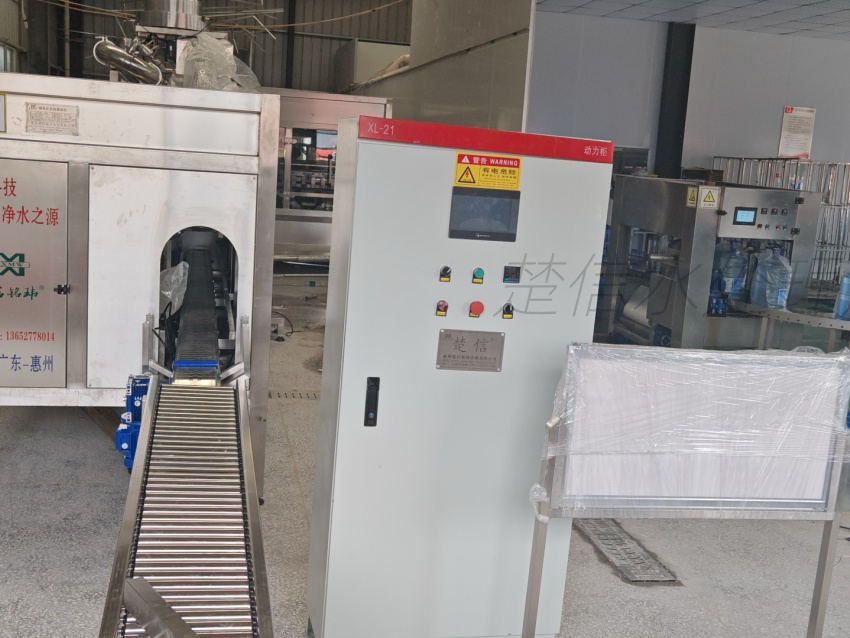
Implementation Actions: From Process Design to Floor Layout
Once signals are validated, implementation follows a structured sequence:
- Process Matching: For spring water, a dual-membrane NF + UF process is often selected to preserve natural minerals while meeting safety thresholds. This contrasts with deep-purification RO systems used for purified water, where lower conductivity is the primary goal.
- Washing-Filling-Capping Synchronization: The integrated unit controls rinse pressure, liquid level consistency, and cap torque. Filling accuracy typically maintains ≤ ±2 mL tolerance, with a capping pass rate ≥99.6% under standard operating conditions.
- Capacity Calculation & Buffer Planning: Nominal bottles-per-hour ratings do not equal finished goods volume. Actual daily output must account for bottle rinsing water, CIP cleaning cycles, equipment flushes, formulation losses, peak buffering, and planned runtime. Final calculations require a project-specific material balance confirmation.
- Layout & Expansion Reserves: Duct routing, airflow zoning, and utility connections (compressed air, cooling water, power) should reserve space for future capacity upgrades or format changes without disrupting ongoing production.
Operational Boundaries & Risk Mitigation
Understanding what the system does and does not cover prevents scope gaps during commissioning:
Upstream Dependency: The filling line assumes stable feedwater quality. Raw water testing, seasonal fluctuation management, and pre-filtration performance remain the responsibility of the water treatment subsystem.
Packaging & Consumables Supply: Bottle blanks, caps, labels, and shrink films are typically sourced externally. Changeover times and compatibility depend on supplier tolerances and line adjustment protocols.
Maintenance Access & Cleaning Dead Zones: Regular inspection of flushing nozzles, seal integrity, and sensor calibration is required. Lines should be designed with clear service corridors and modular components to minimize downtime.
Budget Context: When evaluating total investment, teams should review the full bottled water production line cost (/help/424) structure, including utilities, consumables, and after-sales support tiers, rather than focusing solely on equipment purchase price.
Next Steps for Procurement & Engineering Teams
To move from evaluation to deployment, provide your site survey data, raw water analysis report, target bottle formats, and desired shift schedule. Chuxin Mingwei’s engineering team will map these inputs to a customized washing-filling-capping configuration, verify capacity buffers against your facility constraints, and outline delivery, installation, and operator training timelines. For transparent budget planning, consult our detailed breakdown of the bottled water production line price (/article/bottled-purified-water-filling-line-capacity-layout) components before finalizing vendor shortlists.
Conclusion
A fully automatic bottled spring water filling line performs reliably when its purification stage, mechanical synchronization, and capacity planning are calibrated to actual site conditions. By validating source variability, confirming format compatibility, calculating realistic throughput buffers, and defining clear maintenance boundaries, procurement and operations teams can avoid common misalignments and secure a production asset that supports long-term scalability.
Call to Action
Share your water quality report, facility layout, and target capacity. Our engineering team will return a customized process flow, equipment specification matrix, and implementation timeline within five business days.