
Fully Automatic Bottled Water Production Line Process Flow: Key Stages, Equipment Setup & Operational Guidelines
Objective: Define a Stable, Compliant Bottled Water Production Flow
Procurement managers and operations leads evaluating a fully automatic bottled water production line need more than a list of machines. The core objective is to design a continuous, synchronized process flow that matches your source water quality, target product standard, bottle format, and daily capacity — while maintaining hygiene control and minimizing manual intervention.
This memo outlines the standard process chain, the engineering logic behind each stage, and the selection variables that determine whether a line performs reliably in real-world conditions.
Stage 1: Water Treatment — The Foundation of Product Quality
The process flow begins with water treatment. The configuration depends entirely on your raw water report and target product type.
Purified Water Route
For bottled purified water, the typical chain is:
Raw water tank → Multi-media filtration → Activated carbon filtration → Softening → Precision filtration → Reverse Osmosis (RO) → Disinfection → Product water storage and circulation
- Multi-media filtration removes suspended solids and reduces turbidity to protect downstream membranes.
- Activated carbon filtration adsorbs residual chlorine, odors, and organic compounds — critical for protecting RO membranes and improving taste.
- RO systems separate dissolved salts and most microorganisms under pressure. Actual rejection rates depend on feed water TDS, temperature, hardness, and recovery rate — not a fixed guarantee.
- Disinfection typically combines ozone and UV (254 nm). Ozone provides residual protection in storage and containers; UV offers physical disinfection without chemical byproducts but requires clear water and maintained lamp intensity.
Spring Water / Mineral Water Route
For spring or mineral water, the goal is safety without stripping characteristic minerals. The chain shifts to:
Source assessment → Coarse filtration → Fine filtration / Ultrafiltration (UF) → Targeted disinfection → Storage → Filling
UF retains minerals while removing suspended solids, colloids, and bacteria. The treatment intensity must be calibrated to your source water report and the product standard you intend to meet.
Selection variable: Your raw water test report determines every upstream decision. A line designed without water quality data is a line built on assumptions.
Stage 2: Bottle Handling — From Preform to Clean Container
For PET bottled water, the container preparation chain is:
PET preform → Blow molding → Empty bottle conveying → Bottle rinsing
- Blow molding quality depends on preform condition, heating curve, stretch ratio, pre-blow and high-pressure blow timing, mold cooling, and compressed air quality. Common defects include uneven wall thickness, off-center bases, and deformed bottle mouths — all of which cause downstream filling and capping failures.
- Air conveyors transport empty bottles to the filling zone. The conveying speed must synchronize with the filler's rated capacity to prevent bottle accumulation or starvation.
Stage 3: Washing-Filling-Capping — The Integrated Core
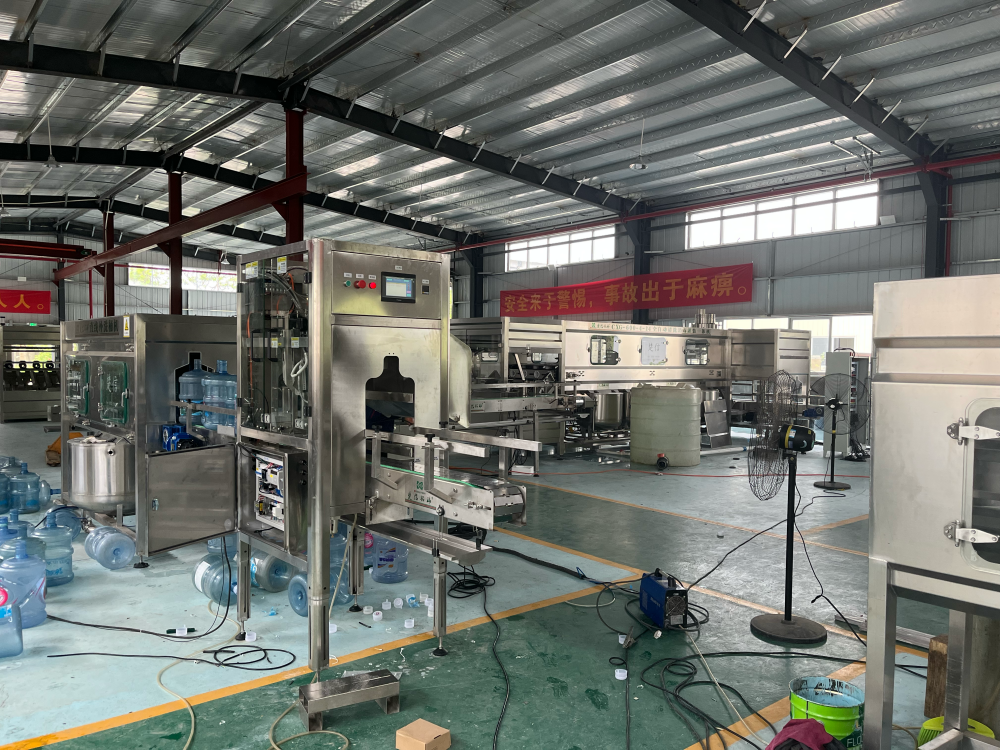
The wash-fill-cap monoblock (three-in-one machine) is the operational center of a fully automatic bottled water line. It integrates bottle rinsing, precise filling, and cap application into a single enclosed unit, reducing intermediate conveying and exposure to contamination.
Operating Logic
- Rinsing: Empty bottles are inverted and rinsed with product water or sterile water to remove internal dust and particles.
- Filling: Bottles are filled to a target volume. Filling accuracy on well-configured systems typically holds within ±2 mL, though actual performance depends on bottle consistency, liquid temperature, and valve maintenance.
- Capping: Caps are sorted, sterilized (often via UV or ozone water), and applied with controlled torque. Capping pass rates on stable lines reach ≥99.6%, provided caps and bottle threads are dimensionally consistent.
Key Selection Variables
- Bottle format range: 330 mL to 10 L are common. Switching between sizes requires changeover parts and adjustment time — factor this into your product mix planning.
- Rated capacity vs. actual throughput: A line rated at 2,000 bottles per hour (BPH) may deliver less if upstream blow molding or downstream packaging creates bottlenecks.
- Filling method: Gravity, pressure, or flow-meter filling — each suits different bottle sizes and product types.
Stage 4: Downstream Detection, Drying, and Labeling
After capping, the process flow continues through quality verification and presentation:
- Level and cap detection: Vision systems or sensors identify under-filled bottles, missing caps, or skewed caps. Rejected units are automatically diverted.
- Bottle drying: Air knives remove surface moisture to ensure label adhesion and prevent ink smearing during coding.
- Labeling: Options include pressure-sensitive labels, shrink sleeves, or roll-fed OPP labels. The choice depends on bottle shape, branding requirements, and line speed.
- Date coding: Inkjet or laser coders apply batch and expiry information.
Stage 5: End-of-Line Packaging and Palletizing
The final stage groups and prepares finished bottles for storage and distribution:
- Shrink wrapping or carton packing: Bottles are grouped (e.g., 6-pack, 12-pack, 24-pack) and wrapped in PE film or placed in corrugated cartons.
- Handle application: Optional, depending on pack format and market preference.
- Palletizing: Automatic stackers arrange packs onto pallets in programmed layer patterns. Selection should account for pack weight, pallet dimensions, stacking height, warehouse clearance, and forklift routing.
Clean Air and Hygiene Infrastructure
A fully automatic line does not operate in isolation. The filling zone requires controlled air quality to prevent secondary contamination.
- Cleanroom design for the filling area typically targets ISO Class 8 (100,000) or higher, with HEPA filtration, positive pressure, and defined air change rates.
- Personnel and material flow must be separated. Air showers, pass-through boxes, and clean corridors are standard supporting elements.
- CIP (Clean-in-Place) systems enable automated cleaning of water treatment piping, storage tanks, and filling circuits without disassembly.
Boundary note: Specific cleanroom classification and acceptance criteria vary by product category and local regulatory requirements. Confirm the applicable standard with your local authority and facility design partner before finalizing the layout.
Decision Framework: What Determines Your Line Configuration
| Decision Factor | Impact on Process Flow |
|---|---|
| Raw water quality (TDS, hardness, microbiology) | Determines treatment chain depth — single RO, dual RO, or UF-only |
| Target product (purified, spring, mineral) | Defines whether minerals are retained or removed |
| Bottle formats and changeover frequency | Influences monoblock selection and changeover tooling |
| Daily capacity and shift pattern | Drives equipment sizing and buffer design |
| Facility footprint and clean zone layout | Constrains equipment arrangement and conveying routes |
| Local regulatory and licensing requirements | Sets disinfection method, cleanroom class, and documentation scope |
Operational Boundaries and Risk Notes
- Water treatment is not a standalone step. Product water storage, circulation piping, container hygiene, and filling environment collectively determine final water quality at the consumer's hands.
- Activated carbon is not permanent. Adsorption saturation, bacterial growth, and media attrition require scheduled monitoring, backwashing, and replacement based on operational data — not a fixed calendar interval.
- RO performance varies with conditions. Feed water temperature, SDI, and recovery rate all shift actual output and rejection. Design margins should reflect your worst-case seasonal water quality.
- Line synchronization matters more than individual machine speed. A 2,500 BPH filler paired with a 1,500 BPH labeler will never reach rated capacity. End-to-end throughput balancing is essential.
Recommendation: Start With Water, Then Build the Line
A stable fully automatic bottled water production line is engineered backward from your product standard and forward from your raw water report. The process flow described above is the standard reference chain — but your actual configuration should be tailored to your site conditions, capacity targets, and regulatory environment.
Chuxin Mingwei has designed and manufactured water treatment and bottled water filling systems since 2008, covering bottle formats from 330 mL to 10 L and barrel formats up to 18.9 L. Our scope includes process design, equipment fabrication, installation, commissioning, operator training, and sustained after-sales support.
Next step: Share your raw water test report, target product type, daily capacity requirement, and facility layout. We will propose a matched process flow and equipment configuration for your review.
Stage 2: Bottled Water Filling & Packaging — Synchronized Line Design
Once product water is stored and circulated, the filling line takes over. For PET bottled water (350 mL to 10 L), the standard process chain is: PET preform → Blow molding → Empty bottle conveying → Rinsing → Filling → Capping → Level/cap inspection → Drying → Labeling or sleeve labeling → Inkjet/laser coding → Shrink wrap or carton packing → Palletizing. Core equipment includes semi-automatic or fully automatic blow molding machines with high-pressure air compressors and molds, air conveyors, bottle and cap feeding systems, and a rinse-fill-cap 3-in-1 monoblock. Downstream operations rely on automatic cap sorters, cap disinfection units, vision inspection for level, missing cap, and skewed cap, as well as labeling machines, shrink wrap or carton packers, and palletizers. Selection variables include water type, bottle shape, neck finish, bottle height and capacity range, bottles per hour, fill volume per bottle, product changeover frequency, ambient or special filling requirements, label format, date coding, packaging combination, and palletizing method — and whether a complete automatic line from blow molding to palletizing is required.