
How Carbon Dioxide Mixers Control Water-Syrup and CO2 Ratio: System Design & Stable Operation Insights
How Carbon Dioxide Mixers Control Water-Syrup and CO2 Ratio
In carbonated beverage production, the stability of the final product's taste and shelf life depends entirely on the precision of the mixing stage. A Carbon Dioxide (CO2) Mixer is not merely a blending tank; it is a continuous process system designed to synchronize water treatment output, syrup dosing, and gas injection under strict thermodynamic conditions.
For procurement managers and operations leads in the beverage sector, understanding the internal logic of these mixers is critical for specifying equipment that delivers consistent Brix (sugar content) and CO2 volumes, regardless of line speed fluctuations.
The Core Operating Logic: Synchronization of Three Variables
The primary function of a CO2 mixer is to combine treated water, concentrated syrup, and food-grade CO2 into a homogeneous liquid ready for isobaric filling. Stability is achieved not by mixing alone, but by managing three interdependent variables:
- Proportional Accuracy: Maintaining a fixed water-to-syrup ratio to ensure consistent sweetness and acidity.
- Thermodynamic Equilibrium: Cooling the liquid to optimal temperatures to maximize CO2 solubility.
- Gas-Liquid Contact Efficiency: Ensuring complete dissolution of CO2 without excessive foaming or gas loss.
1. Vacuum Deaeration: The Prerequisite for Stability
Before any mixing occurs, the process water must undergo vacuum deaeration. Dissolved oxygen and other non-condensable gases in the water compete with CO2 for solubility. If these gases are not removed, the final product will exhibit inconsistent carbonation levels and accelerated oxidation, leading to flavor degradation.
High-performance mixers utilize a vacuum tank to lower the pressure of the incoming water, forcing dissolved gases to escape before the water enters the carbonation chamber. This step is non-negotiable for achieving stable CO2 volumes (often measured in "volumes of gas" per volume of liquid).
2. Precision Proportioning: Water and Syrup
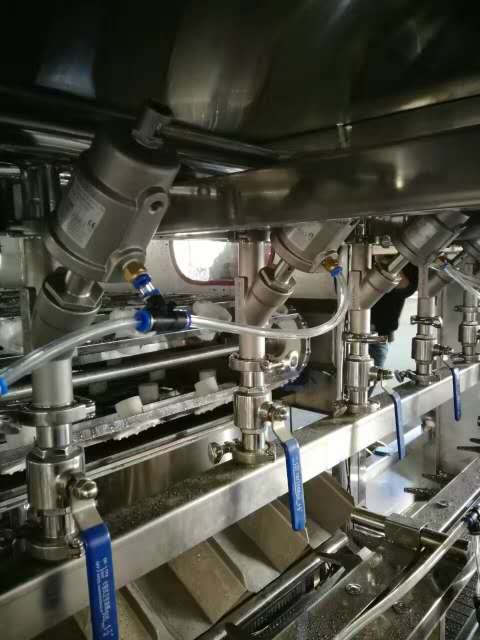
The mixing ratio is typically controlled by a combination of flow meters and proportional regulating valves. In modern systems, the water flow acts as the master signal, while the syrup pump adjusts its speed dynamically to maintain the target Brix.
- Continuous Adjustment:*
- Unlike batch mixing, continuous mixers adjust in real-time. If the water pressure fluctuates, the syrup dosing rate changes instantly to preserve the ratio.
- Hygiene & CIP:*
- The mixing chamber and associated piping must be designed for full CIP (Clean-in-Place) coverage. As noted in industry standards for beverage lines, cleaning efficacy depends on flow velocity, temperature, and the absence of dead legs in the valve clusters. Residual syrup in dead zones can lead to microbial growth and off-flavors in subsequent batches.
3. Plate Heat Exchange Cooling
CO2 solubility is inversely proportional to temperature. To achieve high carbonation levels efficiently, the mixed liquid must be cooled rapidly. Plate heat exchangers are the standard solution here, chilling the product to near-freezing temperatures (typically 2–4°C) immediately before or during carbonation.
This cooling stage is critical: if the liquid enters the carbonator too warm, the system must work against higher equilibrium pressures, increasing gas consumption and the risk of foaming during the transfer to the filler.
System Boundaries and Integration Risks
Specifying a CO2 mixer requires more than just selecting a flow rate. The equipment must be viewed as part of a larger hydraulic and pneumatic system.
Matching Flow and Pressure with the Filler
A common engineering oversight is mismatching the mixer's output capacity with the isobaric filling machine's demand. The mixer must provide a continuous, pulse-free flow at a pressure slightly higher than the filler's bowl pressure to ensure smooth transfer.
- Flow Fluctuation:*
- If the mixer cannot respond quickly to the filler's valve openings (especially in high-speed rotary fillers), pressure drops can cause CO2 to break out of the solution, creating foam in the transfer pipe.
- Pressure Stability:*
- The CO2 supply pressure must be regulated precisely. Fluctuations in gas pressure directly impact the saturation level of the liquid.
The Impact of Temperature on Foaming
As highlighted in technical analyses of carbonated lines, temperature rise is a primary cause of foaming andLiquid Level (liquid level) instability in the filler. Even a 1°C increase in the product temperature after leaving the mixer can reduce CO2 solubility enough to cause nucleation (bubble formation) when the pressure is released at the filling valve. Therefore, the insulation of pipes between the mixer and the filler is as important as the mixer's cooling capacity.
Selection Criteria for Procurement
When evaluating CO2 mixers for a new line or retrofit, focus on these technical differentiators:
- Deaeration Efficiency:*
- Verify the residual oxygen specification post-deaeration. High-end systems target <10 ppb (parts per billion).
- Control Architecture:*
- Look for PLC-based systems with HMI interfaces that allow real-time monitoring of Brix, CO2 volume, temperature, and pressure. Remote diagnostics capabilities are increasingly standard for troubleshooting.
- CIP Design:*
- Ensure the manufacturer provides a validated CIP program that covers the syrup pumps, mixing valve, carbonator, and all interconnecting piping. Ask for documentation on flow rates and temperatures required for effective cleaning.
- Capacity Range:*
- While standard units may cover 1–20 T/H (tons per hour), confirm the turndown ratio. Can the system maintain accuracy at 50% capacity, or does it require a minimum flow threshold?
Conclusion
The CO2 mixer is the heart of any carbonated beverage line. Its ability to control the water-syrup-CO2 ratio determines the sensory consistency of the final product. Successful implementation relies on a holistic design that integrates vacuum deaeration, precise thermal management via plate heat exchangers, and robust synchronization with the downstream filling equipment.
For facilities planning upgrades or new installations, the focus should shift from simple capacity metrics to the stability of the control loop and the completeness of the hygiene design.
Next Steps
If you are defining specifications for a carbonated beverage line or troubleshooting ratio instability in an existing setup, our engineering team can review your process parameters. We provide tailored assessments of mixing systems, ensuring alignment with your water quality, production capacity, and packaging requirements.
Request a Solution Consultation to discuss your specific project needs.