
How to Calculate Realistic Hourly Output for Spring Water Bottling Lines
Direct conclusion
Realistic hourly output for a bottled spring water filling line cannot be calculated by converting a single "bottles per hour" figure into finished water volume. You must first define the target bottle format, then account for process water consumption, cleaning cycles, peak buffering, and post-filling packagingBeat. Only after these variables are balanced can you confirm a stable, repeatable hourly output that matches your actual production schedule.
Why nominal capacity rarely matches real output
Many equipment listings quote a maximum speed based on a specific bottle size, water temperature, and ideal line conditions. In practice, the actual hourly output depends on several operational variables:
- Bottle format and volume: A line rated at 1,200 bottles/hour for 500 mL PET bottles will not reach the same speed when running 18.9 L barrels. Larger formats require longer filling times, slower capping cycles, and different downstream packagingBeat.
- Source water characteristics: Spring water often contains natural minerals and seasonal variability. Processes designed to preserve mineral content while ensuring microbiological safety may require additional filtration stages or controlled flow rates, which can affect line speed.
- Process water and cleaning cycles: The line consumes water for bottle rinsing, CIP cleaning, equipment flushing, and formulation losses. These are not part of the finished product but must be accounted for in the overall water balance.
- Post-filling packagingBeat: Labeling, shrink wrapping, coding, bagging, and palletizing must synchronize with the filling speed. If downstream equipment cannot match the filling rate, the line will bottleneck, reducing effective hourly output.
How to calculate realistic output step by step
Step 1: Define the target bottle format and capacity
Start by confirming the exact bottle type, volume, and cap specification. For example, a line configured for 18.9 L spring water bottles will have a different filling valve timing, capping torque requirement, and downstream handling speed compared to 500 mL PET bottles. Equipment specifications should always state the bottle format, capacity, and test conditions alongside the rated speed.
Step 2: Account for process water and safety margins
Do not convert bottle-per-hour directly into finished water volume. You must also include:
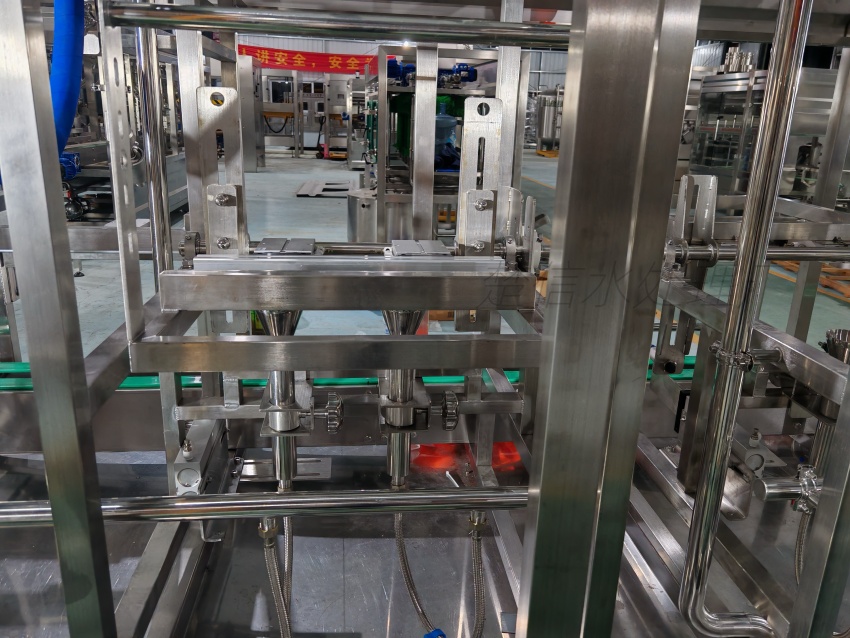
- Bottle rinsing water
- CIP cleaning cycles
- Equipment flushing and formulation losses
- Peak buffering and planned operating hours
A common approach is to first calculate the finished product volume per shift, then add process water and safety margins. Verify that the raw water tank and finished water tank can balance short-term fluctuations. Final calculations should be confirmed through a project material balance.
Step 3: Validate downstream packaging synchronization
The filling line does not operate in isolation. After filling and capping, bottles typically pass through inspection, labeling, shrink wrapping, coding, bagging, and palletizing. If any of these stages cannot match the filling speed, the line will operate below its nominal capacity. Ensure that the entire line is balanced for the target bottle format and operating speed.
Step 4: Confirm source water treatment compatibility
Spring water requires a process that balances purification with mineral retention. Systems using dual-membrane nanofiltration (NF) combined with ultrafiltration (UF) can achieve this balance, but the exact configuration depends on source water quality, target product standards, and production capacity. Seasonal variations in source water may also require adjustable flow rates or additional pre-treatment, which can affect line speed.
Signals that your capacity calculation may be off
- Frequent bottlenecks at the labeling or palletizing stage
- Inconsistent filling levels across multiple valves
- Capping torque variations or misaligned caps at higher speeds
- Water tank levels fluctuating beyond design margins during peak operation
- CIP cleaning cycles interrupting production more often than planned
If you observe these signals, the line may be operating beyond its balanced capacity, or the downstream equipment may not be synchronized with the filling rate.
Implementation boundaries and next steps
Capacity planning for spring water bottling lines is a project-specific exercise. The following variables must be confirmed before finalizing equipment selection:
- Source water quality report and seasonal variability
- Target bottle format, volume, and cap type
- Required hourly output and planned operating hours
- Facility layout, utility supply, and cleanroom requirements
- Downstream packaging and palletizing configuration
Chuxin Mingwei provides customized spring water filling production lines engineered from actual source water quality, target water standards, production capacity, packaging format, and facility constraints. Each project includes design, manufacturing, installation, commissioning, operator training, and after-sales support.
If you are evaluating a new spring water bottling line or planning a capacity upgrade, share your source water report, target bottle format, and required hourly output. Our engineering team will provide a material balance calculation and line configuration proposal based on your specific conditions.
[Request a capacity assessment for your spring water line]