
How to Convert Bottles/Hour to Finished Water Volume for 5-Gallon Production Planning
How to Convert Bottles/Hour to Finished Water Volume for 5-Gallon Production Planning
The Core Problem: Why "Bottles/Hour" Misleads Production Planning
For procurement managers and operations leads in the beverage and water treatment sectors, a common pitfall is assuming that a machine rated at 200–1,800 bottles/hour directly translates to that many finished liters of product per hour. In reality, this rating often represents the theoretical maximum speed under ideal conditions, ignoring the critical time lost to cleaning cycles, bottle handling, and water consumption.
When planning a fully automatic bottled spring water filling production line or a bottled purified water filling line, relying solely on the headline speed can lead to undersized raw water tanks, insufficient storage capacity, and unrealistic delivery schedules. The true operational metric is not just the fill rate, but the net output after accounting for all non-productive time.
Technical Principles of Capacity Conversion
To calculate the actual finished water volume for a 5-gallon (18.9 L) production line, you must apply a multi-step conversion logic that integrates equipment specifications with operational realities.
1. Distinguish Between Theoretical and Net Capacity
The manufacturer's specification for a Bottled Spring Water Filling Production Line typically lists a range such as 200–1,800 bottles/hour based on standard 18.9 L bottles. However, this figure assumes continuous operation without interruption.
In a real-world scenario involving recycled barrels (common for 5-gallon lines), the process includes:
- Empty bottle handling:*
- Depalletizing and conveying.
- Washing cycles:*
- Multi-station rinsing, disinfection, and final rinse.
- Filling and capping:*
- Synchronized operations with an accuracy of ≤ ±2 mL; capping pass rate ≥99.6%.
- CIP (Clean-in-Place):*
- Scheduled cleaning breaks.
As noted in industry diagnostics, you cannot simply multiply the hourly bottle count by the bottle volume. You must account for washing water usage, CIP cleaning, equipment flushing, blending losses, peak buffering, and planned run times. The final calculation should be confirmed by a project material balance.
2. The Water Balance Equation
A critical step often overlooked is the water balance calculation. For a 5-gallon barrel filling machine, the system consumes water not just for the product, but for:
- Pre-rinse and post-rinse:*
- Cleaning the interior and exterior of the barrel before filling.
- Ozone/UV Sterilization:*
- Maintaining water quality standards (e.g., ISO Class 8 cleanroom air support).
- System Flushing:*
- Daily or shift-end maintenance.
If your target output is 1,000 bottles per shift, the raw water intake required will be significantly higher than 1,000 × 18.9 L. The system design must ensure that the raw water tank and finished water storage can handle these short-term fluctuations without bottlenecks.
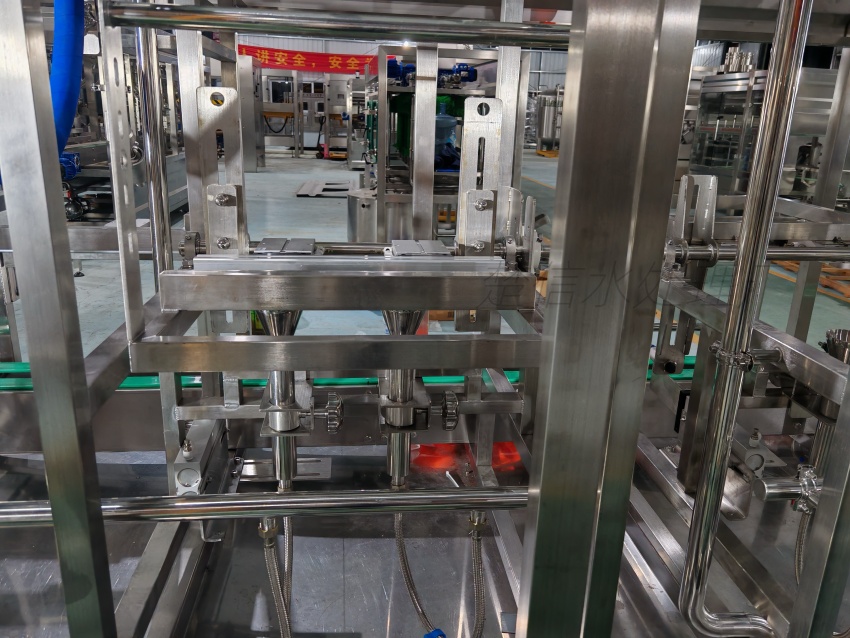
Practical Calculation Framework
To move from a marketing spec sheet to a reliable production plan, follow this diagnostic framework:
Step 1: Define the Shift Profile
Determine the actual operating hours per shift. If a line runs for 8 hours but requires time for CIP and changeover, the effective production time is reduced.
Step 2: Apply Efficiency Factors
Apply a realistic efficiency factor to the rated capacity. High-speed lines may experience minor stoppages and cycle variations that reduce the effective output compared to the theoretical max.
Step 3: Calculate Gross vs. Net Volume
- Gross Volume:*
- Effective Bottles × 18.9 L.
- Net Product Volume:*
- Gross Volume minus any spillage or rejection rates. While capping pass rates are typically ≥99.6%, rejections still occur.
Step 4: Verify Infrastructure Support
Ensure your water treatment systems (e.g., dual-membrane NF + UF for spring water or dual-stage RO for purified water) can sustain the flow rate calculated above. The clean air purification systems must also maintain ISO Class 8 (100,000) standards during peak production to prevent contamination.
Implementation Boundaries and Risks
When converting units, be aware of the following boundaries:
- Bottle Type Variance:*
- The rated capacity for 18.9 L bottles may differ significantly from 11.3 L or 5 L configurations due to different handling speeds and filling valve dynamics.
- Source Water Quality:*
- For spring water, the NF + UF process balances purification with mineral retention, which affects flow rates compared to the aggressive dual-stage RO used for purified water.
- Cleaning Cycles:*
- The frequency of CIP depends on the product type and local hygiene regulations. This directly impacts the available production window.
Selection and Optimization Recommendations
For operations teams looking to optimize their bottled water production line:
- Audit Current Metrics: Track actual bottles produced per hour over a week, not just the theoretical max.
- Model Water Demand: Use the calculated net output to size your raw water tanks and pumps. Add a safety margin for peak demand.
- Integrate Air Systems: Ensure your industrial clean air solutions are sized to match the peak airflow requirements of the filling line, maintaining pressure zoning for ISO compliance.
Conclusion
Accurately converting bottles/hour to finished water volume requires more than simple multiplication. It demands a holistic view of the entire production ecosystem, including washing cycles, water consumption, and equipment downtime. By applying a rigorous calculation model that accounts for these variables, procurement managers and operations leads can ensure their custom water treatment and filling solutions are designed for stability, applicability, and long-term maintainability.
Do not rely on headline specs alone. Validate your production plans against real-world operational data and site-specific constraints.
Next Steps
Ready to align your production capacity with your facility's infrastructure? Contact our engineering team to perform a detailed material balance calculation and site-specific design review for your 5-gallon water filling line.
Contact [Chuxin Mingwei Engineering Team]
---
Key Points Summary
- Capacity Reality:*
- Rated bottles/hour is a theoretical max; actual output is lower due to cleaning and changeovers.
- Water Balance:*
- Total water intake exceeds product volume due to rinsing, CIP, and sterilization needs.
- Efficiency Factor:*
- Apply a realistic efficiency multiplier to rated speeds for accurate shift planning.
- Infrastructure Check:*
- Ensure raw water tanks and clean air systems support the calculated peak load.
- Product Specifics:*
- Spring water lines (NF+UF) and purified water lines (RO) have different flow and cleaning profiles.
---
Knowledge Evidence
[
{
"": "",
"source_excerpt": "Do not simply convert the filling line capacity from bottles per hour to finished product water volume. Bottle rinsing water must also be accounted for,CIPas well as cleaning, equipment flushing, mixing losses, peak buffering, and scheduled operating time."
},
{
"": "",
"source_excerpt": "Inspection of returnable containers, cap removal, external brushing, internal brushing, multi-station cleaning, sanitization, and final rinse."
}
]