
How Vacuum Deaeration Improves Carbonation Stability: Engineering Logic, Configuration Basis & Common Misconceptions
Decision Context: Why Dissolved Gas Control Matters Before Carbonation
For beverage producers running carbonated filling lines—whether for sparkling water, flavored sodas, or functional drinks—carbonation stability is a direct function of what is already dissolved in the water before CO₂ is introduced. Process water that retains high levels of dissolved oxygen (DO) and dissolved nitrogen creates competing gas pressure inside the bottle, reducing the effective solubility of CO₂ and increasing the risk of foaming, under-fills, and inconsistent carbonation levels across production batches.
Vacuum deaeration addresses this upstream variable. By stripping non-condensable gases from treated water before it enters the carbonator, the system creates a lower partial-pressure environment that allows CO₂ to dissolve more predictably and remain stable through filling, capping, and distribution.
This memo is structured for procurement managers, operations leads, and engineering teams evaluating whether vacuum deaeration is necessary for their specific carbonated beverage project, and how it integrates with the broader water treatment and filling line configuration.
Objective: What the System Must Achieve
The primary engineering objective of vacuum deaeration in a carbonated beverage line is to reduce dissolved oxygen to below 0.5 mg/L (and ideally below 0.2 mg/L) before the water reaches the carbonation unit. Secondary objectives include:
- Consistent CO₂ absorption rates across varying production speeds and ambient temperatures.
- Reduced foaming during filling, which directly affects fill-level accuracy and line throughput.
- Extended shelf stability by minimizing oxidative degradation of flavor compounds in finished products.
- Lower CO₂ consumption per liter of finished beverage, since deaerated water absorbs CO₂ more efficiently.
These objectives are not theoretical—they map directly to measurable production KPIs: fill accuracy (typically targeted at ≤ ±2 mL deviation), capping pass rates (≥99.6% in well-configured lines), and post-production carbonation variance.
Operating Principle: How Vacuum Deaeration Works
Vacuum deaeration operates on Henry's Law: the solubility of a gas in a liquid is proportional to the partial pressure of that gas above the liquid. By reducing the pressure inside a sealed vessel to well below atmospheric levels (typically operating between 20–80 mbar absolute), dissolved gases—primarily O₂ and N₂—are driven out of solution and evacuated by a vacuum pump system.
Process Sequence
- Feed water entry: Treated water (typically post-RO or post-UF, depending on the source water profile and target water quality) enters the deaeration vessel through a distribution header or spray nozzle array.
- Surface area maximization: The water is dispersed into thin films or droplets inside the vessel, dramatically increasing the gas-liquid interface area.
- Vacuum extraction: A liquid-ring vacuum pump or dry screw vacuum system maintains the vessel at the target vacuum level. Stripped gases are continuously evacuated.
- Deaerated water discharge: The treated water exits the vessel via a sealed discharge pump, maintaining vacuum integrity, and flows to the carbonation mixer.
The efficiency of gas removal depends on three controllable variables: vacuum depth, water temperature (warmer water releases gases more readily), and contact time/surface area inside the vessel.
Configuration Basis: When Vacuum Deaeration Is Justified
Not every carbonated beverage line requires a dedicated vacuum deaeration unit. The decision depends on a combination of product requirements, source water characteristics, and production scale.
Scenarios Where Vacuum Deaeration Is Typically Specified
| Condition | Rationale |
|---|---|
| Target DO < 0.3 mg/L for premium sparkling water or sensitive flavor profiles | Oxidative flavor degradation is measurable at higher DO levels |
| High-speed filling lines (>12,000 bottles/hour) | Foaming risk scales with line speed; deaeration reduces fill disruptions |
| Source water with high dissolved gas content (e.g., groundwater with elevated N₂ or CO₂ from geological sources) | Pre-existing gas load competes with intentional carbonation |
| Warm-climate production facilities where water temperature exceeds 20°C before carbonation | CO₂ solubility drops significantly at higher temperatures; deaeration compensates |
| Products requiring extended shelf life (>6 months) with strict carbonation retention specs | Headspace gas composition affects long-term CO₂ loss through PET permeation |
Scenarios Where Vacuum Deaeration May Be Deferred
- Low-speed production lines (<3,000 bottles/hour) producing standard carbonated water for local distribution with short shelf-life expectations.
- Facilities where source water is already low in dissolved gases and ambient temperatures remain below 15°C year-round.
- Projects with tight capital budgets where the carbonator is oversized to compensate for gas competition—though this increases ongoing CO₂ consumption costs.
Integration with Water Treatment and Filling Systems
Vacuum deaeration does not operate in isolation. Its placement and specification depend on the upstream water treatment configuration and the downstream filling line design.
Upstream Dependencies
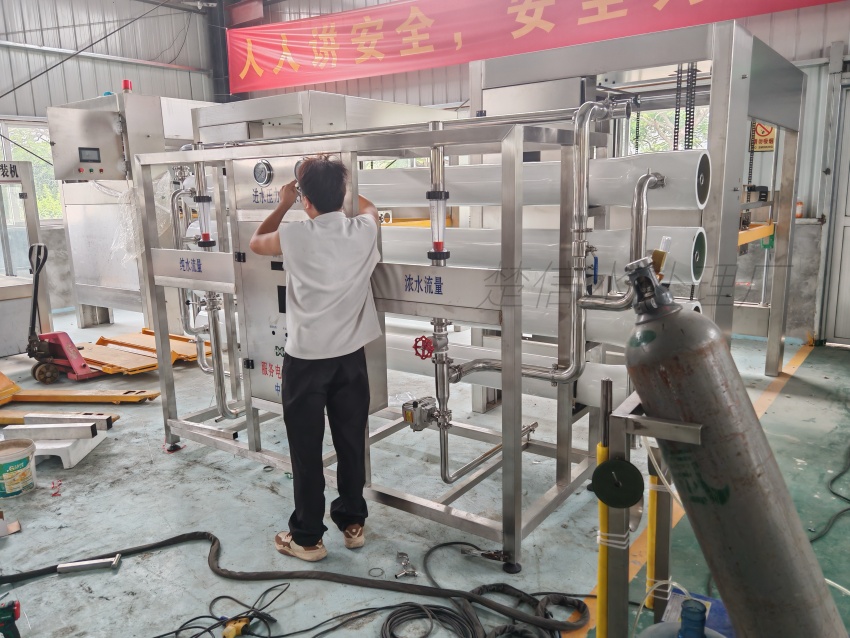
The deaeration unit is typically positioned after the final water treatment stage—whether that is a two-stage RO system, an NF+UF dual-membrane configuration (as used in spring water applications where mineral retention is required), or a multi-media filtration plus activated carbon setup. The key requirement is that the feed water to the deaerator must already meet the target chemical and microbiological quality. Deaeration removes dissolved gases; it does not purify.
This aligns with a foundational principle in water treatment system design: the raw water quality report is the starting point for all downstream equipment selection. Suspended solids, residual chlorine, hardness, iron/manganese content, TDS, conductivity, and microbial load all determine the pretreatment and membrane configuration that precedes deaeration. A deaerator fed with inadequately treated water will experience fouling on internal surfaces, reducing gas-stripping efficiency over time.
Downstream Integration
After deaeration, the water flows directly to the carbonation mixer (typically a venturi-type or static-mixer carbonator), where food-grade CO₂ is injected under controlled pressure and temperature. The carbonated water then proceeds to the isobarometric filler—the filling valve type specifically designed for carbonated products, which maintains counter-pressure inside the bottle to prevent CO₂ breakout during the fill cycle.
The choice of filling valve is critical here. As documented in filling equipment configuration standards, water, hot-fill products, and carbonated products have fundamentally different requirements for filling valve design, temperature control, pressure management, and hygiene protocols. A gravity filler designed for still water cannot handle carbonated product without severe foaming and fill-level variance. The deaeration system's effectiveness is only fully realized when paired with a correctly specified isobarometric filler.
Common Misconceptions and Boundary Conditions
Misconception 1: "Deaeration replaces proper water treatment"
It does not. Deaeration targets dissolved gases only. If the source water has high TDS, hardness, or microbial contamination, those must be addressed by RO, UF, or appropriate pretreatment before the water reaches the deaerator. This is consistent with the broader engineering principle that softening, filtration, and desalination each solve distinct problems—and no single unit operation substitutes for another.
Misconception 2: "Any vacuum pump will work"
Vacuum pump selection must match the vessel volume, target vacuum depth, and gas load. Undersized pumps cannot maintain the required vacuum level under continuous flow conditions, leading to inconsistent deaeration performance. Liquid-ring pumps are common for their reliability and tolerance of moisture carryover; dry screw pumps are specified where water contamination of the pump seal fluid is a concern.
Misconception 3: "Deaeration is only about oxygen"
While dissolved oxygen is the most discussed parameter (due to its impact on flavor oxidation), dissolved nitrogen is equally relevant to carbonation stability. N₂ creates nucleation sites inside the bottle, triggering CO₂ breakout and foaming during filling. Effective deaeration strips both gases simultaneously.
Boundary Condition: Temperature Sensitivity
Vacuum deaeration efficiency improves with higher water temperatures, but carbonation efficiency improves with lower temperatures. This creates a practical sequencing requirement: deaerate first (at ambient or slightly elevated temperature), then chill the water to 2–5°C before carbonation. Facilities that attempt to combine deaeration and carbonation in a single temperature zone will compromise one or both processes.
Evidence and Verification
Post-installation verification should include:
- Inline DO measurement at the deaerator discharge, with continuous logging to confirm <0.5 mg/L under all production speeds.
- Carbonation level testing (volumes of CO₂) at the filler discharge and after 24 hours of equilibration, to confirm that deaeration is translating into consistent carbonation retention.
- Fill-level audits to quantify foaming reduction and its impact on fill accuracy.
These measurements should be part of the commissioning protocol and included in the ongoing quality assurance program. For teams evaluating the total project scope—including equipment delivery, installation, and commissioning—it is important to clarify the water plant equipment installation and commissioning boundaries early in the procurement process, so that deaeration performance verification is included in the acceptance criteria.
Recommendation
Vacuum deaeration is a justified capital investment for carbonated beverage lines where product quality specifications, production speed, or source water conditions make dissolved gas competition a measurable risk to carbonation stability. It is not a universal requirement, but its absence in high-specification lines typically manifests as chronic foaming issues, inconsistent carbonation levels, and elevated CO₂ consumption.
For procurement teams evaluating this decision, the recommended sequence is:
- Obtain a complete raw water analysis, including dissolved gas profiles (DO, dissolved N₂, and dissolved CO₂).
- Define the target carbonation level (in volumes of CO₂) and acceptable variance range.
- Model the gas competition at your expected production temperature and line speed.
- Specify the deaeration unit based on flow rate, target DO, and vacuum depth—integrated with the upstream treatment and downstream carbonation/filling system as a single engineered package.
Chuxin Mingwei engineers water treatment and filling systems based on actual source water quality, target product specifications, and facility constraints. If your carbonated beverage project requires an integrated assessment of deaeration, carbonation, and filling line configuration, our team can provide a site-specific technical proposal.
It is important to note that vacuum deaeration does not operate in isolation; its effectiveness is closely tied to upstream water treatment configuration. The selection of pretreatment and membrane systems—such as single-pass RO, double-pass RO, or RO+EDI—must be driven by raw water quality reports rather than flow rate alone, since parameters like suspended solids, residual chlorine, hardness, iron/manganese, TDS, conductivity, and microbial risk vary significantly across groundwater, municipal, and mountain spring sources. Additionally, softening systems (e.g., sodium ion exchange) primarily reduce calcium and magnesium hardness to control scaling but do not remove dissolved salts and therefore cannot substitute for RO-produced water. Because deaeration performance depends on consistent feed water quality, engineers must verify that the upstream treatment chain—whether ultrafiltration for mineral retention or reverse osmosis for broader contaminant removal—is validated by laboratory testing before integrating the vacuum deaerator into the carbonation line.