
Implementing a Fully Automatic Bottled Spring Water Filling Line: Key Phases from Planning to Long-Term Operation
Implementing a Fully Automatic Bottled Spring Water Filling Line: Key Phases from Planning to Long-Term Operation
For procurement managers and operations leads in the beverage, food, or natural products sectors, implementing a fully automatic bottled spring water filling line is rarely a plug-and-play exercise. Unlike standardized equipment, a spring water line must balance purification efficacy with mineral retention, adapt to variable source water conditions, and integrate seamlessly into existing plant layouts. At Chuxin Mingwei, this process is structured around four critical phases: preparation, implementation, acceptance, and maintenance—each shaped by your specific operational context.
Phase 1: Preparation – Aligning Design with Real-World Constraints
The success of a spring water filling line begins long before installation. Key inputs include:
- Source water analysis: Spring water varies by location—seasonal shifts in turbidity, hardness, or microbial load directly impact treatment design.
- Target product standard: Are you preserving natural minerals (e.g., calcium, magnesium) while removing contaminants? This dictates whether a dual-membrane NF + UF process is appropriate.
- Packaging format and capacity: Will you fill 18.9 L, 11.3 L, or 5 L bottles? Output targets (e.g., 200–1,800 bottles/hour for 18.9 L) must account for actual run time, changeovers, and CIP cycles—not just peak speed.
- Facility layout: Ceiling height, floor load capacity, utility access (compressed air, cooling water), and cleanroom zoning affect equipment footprint and airflow integration.
Example: A client in southern China sourcing mountain spring water required mineral retention but faced high seasonal iron levels. Chuxin Mingwei’s solution used NF as the primary barrier—rejecting divalent ions like iron while allowing monovalent minerals to pass—followed by UF for microbial control.
Phase 2: Implementation – Engineering Integration, Not Just Equipment Delivery
Chuxin Mingwei delivers end-to-end engineering services, not just machinery. This includes:
- Customized system design based on your water report and production goals
- Manufacturing with traceable component sourcing
- On-site installation coordinated with civil, electrical, and HVAC teams
- Integration with auxiliary systems (e.g., clean air units for ISO Class 8 environments)
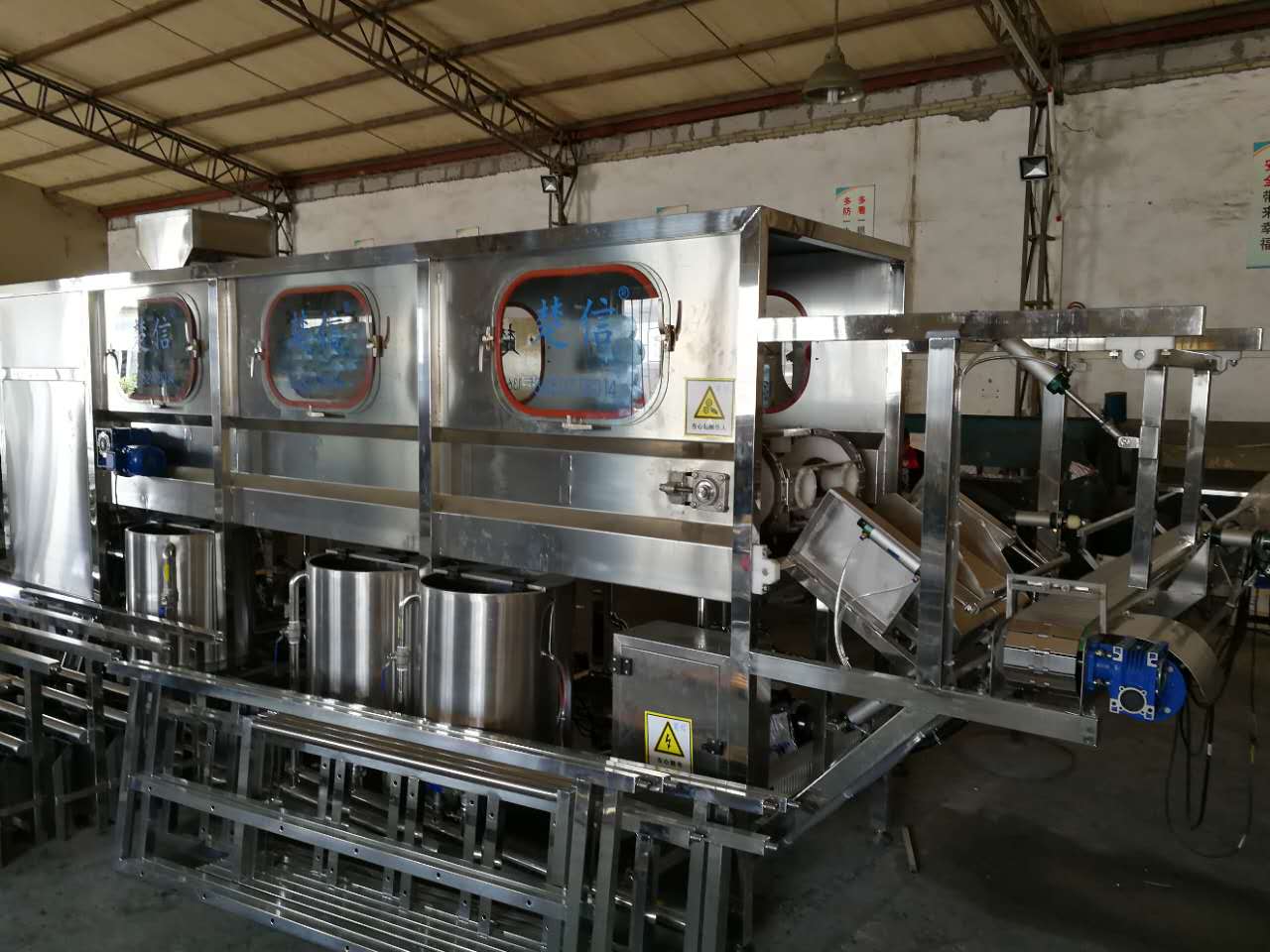
Crucially, the integrated bottle washing-filling-capping unit is engineered as a single synchronized module. This reduces bottle handling interfaces, minimizes recontamination risk, and ensures filling accuracy ≤ ±2 mL with a capping pass rate ≥99.6%—but only when aligned with correct bottle geometry and cap type.
️ Boundary note: The line assumes non-carbonated, ambient-temperature spring water in standard PET or PC containers. Hot-fill, flavored, or carbonated products require different valve designs and pressure controls—outside this system’s scope.
Phase 3: Acceptance – Validating Performance Under Real Conditions
Factory acceptance tests (FAT) are useful, but site acceptance testing (SAT) under actual operating conditions is essential. Key validation points include:
- Stable output over 8+ hours at target capacity
- Consistent liquid level across all filling heads
- No cross-contamination during bottle transfer
- PLC-based control system responsiveness (including alarms and batch records)
- Operator ability to perform basic changeovers and cleaning
Training is embedded in this phase: operators learn not just “how to start the machine,” but how to interpret HMI diagnostics, respond to torque deviations, and execute CIP protocols.
Phase 4: Maintenance – Ensuring Long-Term Stability and Maintainability
A spring water line’s value isn’t measured on day one—it’s proven over years of uptime. Chuxin Mingwei emphasizes long-term maintainability through:
- Modular design for easy membrane or pump replacement
- Remote-ready PLC interfaces for troubleshooting support
- Clear service boundaries: we provide after-sales support for the integrated system, including water treatment, filling, and clean air components
However, performance depends on routine upkeep: filter changes, seal inspections, and calibration per your internal SOPs. We recommend quarterly preventive maintenance reviews, especially in regions with hard or variable source water.
Next Steps: Start with Your Water, Not Just the Machine
If you’re evaluating a bottled spring water production line, begin by sharing your source water quality report, target bottle specifications, and facility layout sketch. This enables a technically grounded proposal—not a generic catalog quote.
For teams comparing options, also consider reviewing bottled water production line cost factors beyond upfront price, such as energy use, water recovery rate, and service response time.
Chuxin Mingwei engineers solutions for real plants—not idealized showrooms. Let’s build a system that works where you operate.
---
Based in Huizhou, Guangdong, China, Chuxin Mingwei serves beverage, food, pharmaceutical, and industrial clients worldwide with custom-engineered water treatment and filling systems.