
How to choose industrial greywater reuse syste: selection, rollout and support checklist
Who Needs an Industrial Greywater Reuse System?
Facilities that generate large volumes of lightly contaminated wastewater—such as beverage plants, food processing units, pharmaceutical cleanrooms, and electronics manufacturing sites—are primary candidates for greywater recycling. Unlike blackwater (sewage containing human waste), industrial greywater typically originates from equipment rinsing, cooling tower blowdown, floor washing, and reverse osmosis reject streams. These sources carry suspended solids, residual organics, trace chemicals, or elevated mineral content, but remain treatable to reusable standards with the right process configuration.
For procurement managers and operations leads evaluating water recycling, the core question is not whether greywater can be reused, but whether the treatment cost, footprint, and maintenance burden justify the water savings at your specific scale and discharge context.
---
Stage 1: Source Segregation and Collection
The process flow begins well before any treatment equipment. Effective greywater reuse depends on separating lightly contaminated streams from heavily polluted or hazardous wastewater at the source.
Operating logic: Dedicated piping networks route greywater from designated collection points—such as bottle washing stations, CIP (clean-in-place) return lines, or cooling system overflow—into a centralized equalization tank. This tank buffers flow variations and homogenizes water quality before downstream processing.
Equipment configuration:
- Segregated drainage piping (typically HDPE or stainless steel depending on chemical compatibility)
- Flow meters and conductivity sensors at key junctions
- Equalization tank with level control and coarse screening (1–3 mm mesh) to remove large particulates
Boundary condition: If your facility cannot physically separate greywater from high-COD or hazardous streams due to shared drainage infrastructure, the influent quality may exceed what a standard greywater system can handle. In such cases, a full wastewater treatment plant—rather than a greywater reuse system—is the appropriate investment.
---
Stage 2: Primary Physical Treatment
Once collected, greywater enters primary treatment to remove suspended solids, oils, and coarse contaminants that would foul downstream membranes or biological units.
Operating logic: Physical separation relies on gravity settling, dissolved air flotation (DAF), or media filtration. The choice depends on the dominant contaminant profile. For beverage and food processing greywater, where fats, oils, and fine particulates are common, DAF combined with coagulant dosing achieves higher removal efficiency than simple sedimentation.
Equipment configuration:
- Coagulant and flocculant dosing system (PAC, PAM, or site-specific chemistry)
- Dissolved air flotation unit or lamella clarifier
- Sand filter or multi-media filter as a polishing step before secondary treatment
Key parameter: Turbidity after primary treatment should typically fall below 5 NTU to protect downstream membrane systems. If raw greywater turbidity consistently exceeds 200 NTU, a two-stage clarification approach may be necessary.
---
Stage 3: Secondary Biological or Chemical Treatment
This stage targets dissolved organic matter and, where required, ammonia or specific chemical residues.
Operating logic: For greywater with moderate BOD (50–300 mg/L), a biological process such as a membrane bioreactor (MBR) or moving bed biofilm reactor (MBBR) breaks down organics efficiently. Where organic load is low but disinfection is critical—such as water destined for cleanroom humidification or equipment rinsing—chemical oxidation (ozone or UV at 254 nm) may replace biological treatment entirely.
Equipment configuration:
- MBR or MBBR unit with aeration and biomass management
- Alternatively: ozone generator with contact tank, or UV sterilization module
- Intermediate buffer tank with ORP (oxidation-reduction potential) monitoring
Boundary condition: Biological systems require stable influent conditions. If your greywater contains biocidal chemicals (e.g., high-concentration sanitizers from CIP cycles), these must be neutralized or diluted before entering a bioreactor, or the biomass will be inhibited.
---
Stage 4: Advanced Purification and Disinfection
The final treatment stage ensures recycled water meets the quality standard required for its intended reuse application.
Operating logic: For non-contact applications like floor washing or cooling tower makeup, sand filtration plus chlorination may suffice. For higher-purity reuse—such as boiler feed, process rinsing in pharmaceutical or electronics facilities, or integration with a bottled water production line—reverse osmosis (RO) or ultrafiltration (UF) membranes provide the necessary barrier against dissolved salts, bacteria, and endotoxins.
Equipment configuration:
- Ultrafiltration (UF) or dual-stage RO system, selected based on target TDS and microbial limits
- Post-treatment mineralization or pH adjustment if the recycled water contacts product or packaging
- Terminal disinfection: UV (254 nm) and/or ozone, consistent with sterilization approaches used in purified water filling lines
Practical note: Facilities already operating RO-based purified water systems can often integrate greywater-derived permeate into non-product water loops, reducing fresh water intake without compromising product-quality water circuits.
---
Stage 5: Storage, Distribution, and Monitoring
Treated greywater requires dedicated storage and distribution infrastructure to prevent cross-contamination with potable or process water systems.
Operating logic: A separate treated-water tank with continuous recirculation prevents stagnation and biofilm growth. Distribution piping must be clearly labeled and physically isolated from drinking water lines. Online monitoring of conductivity, pH, residual chlorine (or ORP), and turbidity provides real-time assurance that recycled water remains within specification.
Equipment configuration:
- Treated water storage tank with recirculation pump and level control
- Dedicated distribution pump set with variable frequency drive (VFD)
- Online water quality analyzers with PLC integration and alarm thresholds
- Backflow prevention devices at every interface with municipal or process water systems
---
Implementation Boundaries and Risk Factors
Before committing to a greywater reuse system, consider these practical constraints:
| Factor | Consideration |
|---|---|
| Influent variability | Batch-process facilities (e.g., beverage plants with seasonal product changes) experience wider greywater quality swings than continuous-process sites. Equalization capacity must account for worst-case scenarios. |
| Regulatory compliance | Local discharge and reuse regulations vary. Some jurisdictions restrict greywater reuse to non-contact applications regardless of treatment level. |
| Footprint and integration | A complete greywater system—from equalization to RO—requires significant floor space. Facilities with constrained layouts should evaluate whether a compact MBR + UF configuration can replace larger multi-stage setups. |
| Maintenance burden | Membrane systems require regular CIP and periodic replacement. Biological systems need sludge management. Factor these into total cost of ownership, not just capital expenditure. |
| Economic threshold | Greywater reuse typically becomes cost-effective when fresh water costs exceed a meaningful threshold or when discharge surcharges are high. For small facilities with low water tariffs, the ROI period may extend beyond acceptable limits. |
---
Connecting Greywater Reuse to Your Broader Water Infrastructure
For facilities that already operate water treatment and filling systems—such as bottled spring water or purified water production lines—greywater reuse integrates most effectively when designed as a complementary loop rather than a standalone project. The RO reject stream from a purified water system, for example, is a high-quality greywater source suitable for cooling tower makeup or floor washing with minimal additional treatment.
Chuxin Mingwei engineers water treatment and filling systems with this integration logic in mind. Whether your project involves a new bottled water production line or a retrofit of existing water infrastructure, the design process accounts for source water quality, target standards, production capacity, and facility constraints—ensuring that every subsystem, from purification to packaging, operates within a coherent water management strategy.
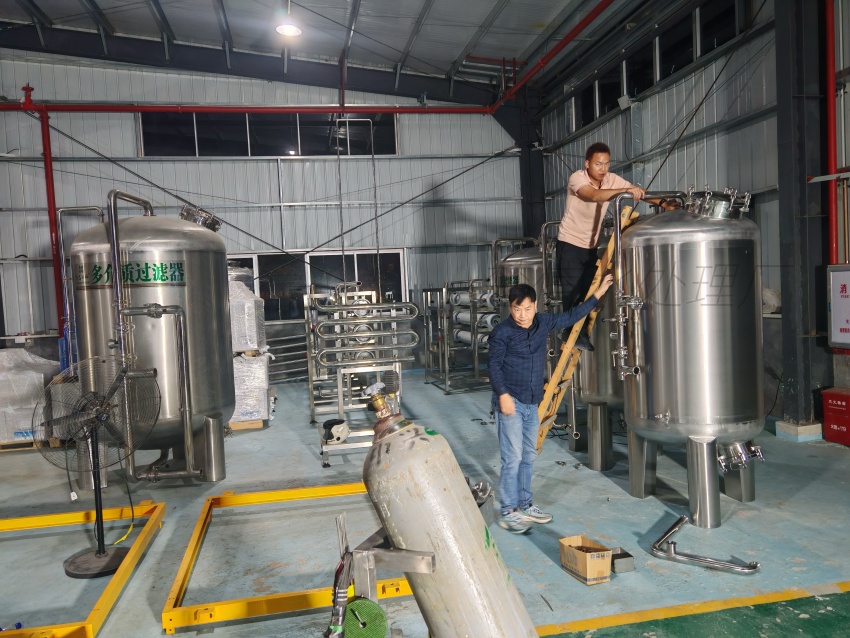
For teams evaluating the feasibility of greywater reuse alongside new production equipment, understanding the full scope of water plant equipment installation and commissioning is essential to accurate budgeting and timeline planning.
---
Next Steps for Procurement and Operations Teams
- Audit your water streams. Map all wastewater sources, estimate flow rates, and characterize contaminant profiles. Identify which streams qualify as greywater.
- Define reuse targets. Specify which applications will receive recycled water and the quality standards each requires.
- Request a site-specific process design. Generic greywater system catalogs cannot account for your influent variability, spatial constraints, or integration requirements. A custom engineering assessment is the appropriate next step.
- Clarify delivery scope. Ensure your supplier's proposal covers design, equipment manufacturing, installation, commissioning, operator training, and post-installation support—not just equipment supply.
If your team is evaluating an industrial greywater reuse system or integrating water recycling into a new or existing production facility, Chuxin Mingwei provides end-to-end engineering services tailored to your actual water quality, capacity requirements, and site conditions.