
How Industrial Pure Water Systems Work: Process Flow, Core Equipment & Operational Boundaries for Bottled Water Lines
Who This Guide Is For
This article is written for procurement managers, operations leads, and project engineers evaluating or specifying an industrial pure water system for a new bottled water line or an upgrade. It focuses on the process flow — the sequence of stages, the equipment involved, and the operational logic that determines whether a system will deliver stable, compliant water at the required capacity.
Before Adoption: Planning the Right Process Flow
Every industrial pure water system begins with source water characterization. The process flow is not a fixed template; it is engineered based on:
- Raw water quality
- (TDS, hardness, turbidity, microbial load, iron, manganese, silica)
- Target water standard
- (e.g., GB 19298 for packaged drinking water, or pharmacopoeia grades for pharma)
- Production capacity
- (bottles per hour, total daily volume)
- Packaging format
- (18.9 L bottles, 5 L, 11.3 L, etc.)
- Facility layout
- (available footprint, ceiling height, drain access)
At this stage, the system designer must map the source water to the appropriate purification process. For example, spring water with low TDS and stable mineral content may use a combination of nanofiltration (NF) + ultrafiltration (UF) to retain beneficial minerals while removing pathogens. In contrast, high-TDS or contaminated water sources typically require a two-stage reverse osmosis (RO) deep purification process.
During Adoption: Key Stages of the Industrial Pure Water System Process Flow
1. Raw Water Pretreatment
Before water enters the membrane or disinfection stages, suspended solids, chlorine, and large particles must be removed. A typical pretreatment train includes:
- Multi-media filter
- (sand, anthracite, garnet) — removes sediment and turbidity
- Activated carbon filter
- — removes chlorine, organic matter, and improves taste/odor
- Water softener
- (ion exchange) — reduces hardness to prevent scaling on membranes
- Cartridge filter (5–10 µm)
- — final particulate removal before membranes
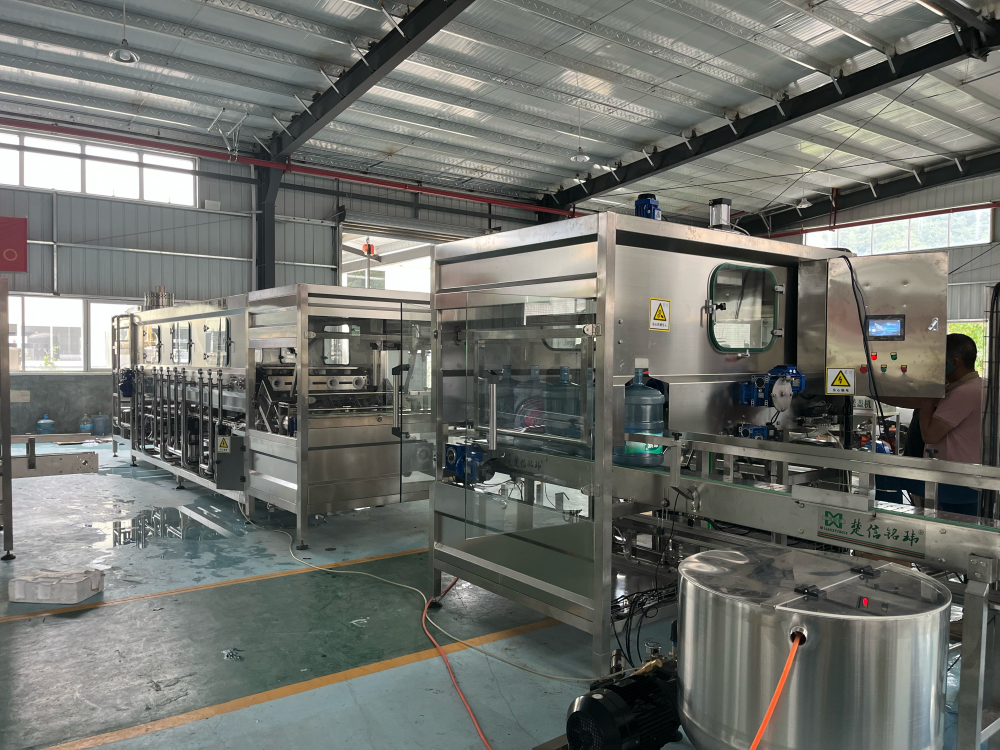
Evidence from our products: Chuxin Mingwei’s bottled purified water filling line integrates multi-media + activated carbon + precision filtration as standard pretreatment, designed to protect downstream RO membranes and extend their service life.
2. Primary Purification: RO or NF / UF
This is the core separation stage. The selection depends on the target water specification:
- Two-stage RO (reverse osmosis):*
- For purified water (e.g., GB 19298-2014 purified water category). Removes 95–99% of dissolved salts, bacteria, viruses, and organic compounds. Typical operating pressure: 8–15 bar. The system includes a high-pressure pump, RO membrane vessels, and automated flush/cleaning circuits.
- NF + UF (nanofiltration + ultrafiltration):*
- For spring water or natural mineral water where partial mineral retention is desired. NF removes divalent ions and pathogens while allowing some monovalent ions (e.g., sodium, potassium) to pass. UF (0.01 µm pore size) ensures microbial safety.
Operational logic: The system monitors feed water conductivity, pressure differential across membranes, and permeate flow rate. If conductivity exceeds a setpoint, the system triggers automatic flush or alerts for chemical cleaning. This prevents membrane fouling and ensures consistent water quality.
3. Disinfection and Final Polish
Even after membrane filtration, the water must be disinfected to prevent microbial regrowth in storage and distribution. Common methods:
- UV (254 nm) sterilizer
- — inactivates bacteria, viruses, and protozoa without chemical residues
- Ozone injection
- — provides residual disinfection in the water storage tank and during filling; ozone decomposes back to oxygen over time
- Membrane degasifier
- (optional) — removes dissolved gases (H₂S, CO₂) that affect taste
Evidence from our products: Chuxin Mingwei’s purified water filling line uses dual-stage RO combined with ozone and UV (254 nm) dual sterilization, providing a barrier against biological contamination.
4. Storage and Distribution
Treated water is stored in a closed, UV-sterilized or ozone-maintained buffer tank before being fed to the filling machine. The storage tank is typically made of stainless steel (304L or 316L) with a conical bottom for drainage. A distribution pump with variable frequency drive maintains constant pressure to the filling valve.
5. Integration with Filling Line
The pure water system is not a standalone unit; its output must match the flow rate and pressure demands of the filling machine. For example, a fully automatic bottled water filling line rated at 200–2,500 bottles/hour requires a continuous water supply at a specific pressure (typically 1–3 bar). The system’s PLC communicates with the filling line’s PLC to synchronize start/stop sequences and prevent overflow or dry running.
Additional integration: If the filling environment requires ISO Class 8 (100,000) cleanroom conditions, a clean air purification system (with H13 HEPA filters) is installed above the filling area. Chuxin Mingwei offers custom-engineered clean air systems that integrate with the water treatment and filling line controls, ensuring airborne particle counts stay within specification.
After Adoption: Operational Boundaries and Support
Once the system is installed and commissioned, the procurement team and operators need to understand:
Maintenance Regime
- Daily:*
- Check pressure gauges, flow meters, conductivity readings; record data
- Weekly:*
- Inspect pre-filters, flush membranes if TDS spike observed
- Monthly:*
- Sanitize storage tank, replace UV lamps (if lamp life < 9,000 hours)
- Quarterly:*
- Chemical clean RO membranes (CIP) based on manufacturer’s protocol
- Annually:*
- Replace cartridge filters, service pumps, calibrate sensors
Common Failure Modes and Boundaries
- Membrane fouling:*
- Occurs if pretreatment is inadequate (e.g., high silt density index, or chlorine breakthrough damaging thin-film composite RO membranes). Solution: regular SDI monitoring and timely replacement of carbon filters.
- Ozone over-injection:*
- Residual ozone >0.4 ppm in filling water can corrode stainless steel and affect taste. Use an ORP controller and ozone destruct unit.
- Flow rate mismatch:*
- If the pure water system is undersized, the filling line will starve; if oversized, water stagnates in the tank. The system must be designed with a buffer capacity of at least 1.5× the filling line peak demand.
Support Boundaries
Chuxin Mingwei provides end-to-end engineering services including design, manufacturing, installation, commissioning, operator training, and after-sales support. However, the following are typically outside the scope unless specified in the contract:
- Civil works (foundation, wall openings, drainage)
- Raw water intake piping beyond the first flange
- Electrical supply from the main panel to the system
- Continuous on-site operation (the client’s staff are trained to operate)
Conclusion
Understanding the industrial pure water system process flow is essential for making informed procurement decisions. The correct sequence of pretreatment, membrane purification, disinfection, and integration with filling equipment ensures stable operation, consistent water quality, and minimal downtime. Because every source water and production scenario is unique, a one-size-fits-all approach does not work.
Next step: Request a site-specific process flow diagram and equipment proposal from Chuxin Mingwei. Share your source water analysis report, target water standard, daily production volume, and facility layout — our engineers will design a system that matches your exact requirements.