
Juice Hot-Fill Line Engineering: From Blending and Sterilization to Cooling – The Role of Water Treatment, Clean Air, an
Juice hot-fill lines are thermal processes first, but their day-to-day reliability depends on three subsystems that are rarely discussed together: water treatment, cleanroom air quality, and packaging integration. A filler and sterilizer are only as good as the water going into the blend and the air surrounding the bottle. This article explains the engineering logic behind each stage, where common misconceptions cause problems, and how Chuxin Mingwei’s water treatment, clean air units, and packaging integration services help beverage producers build a production backbone that lasts.
1. Blending Water Quality: Why the Raw Water Report Matters
Juice formulation begins with water — whether reconstituting concentrate or adjusting NFC juice. The water used for blending directly affects taste, stability, and shelf life. A generic “drinking water” spec is not enough.
The raw water report is the starting point
Before selecting any treatment equipment, you must know the source water’s true profile. As water treatment engineering practice shows, factors such as suspended solids, residual chlorine, hardness, iron, manganese, TDS, and microbiological risks vary dramatically between groundwater, municipal, and surface sources. The original water report determines whether a simple carbon filter is sufficient or a multi-stage reverse osmosis (RO) system is required.
- Groundwater may contain high iron, manganese, or hardness that alters flavor and accelerates scale formation in heat exchangers.
- Municipal water can carry residual chlorine that reacts with juice components, producing off-flavors.
- Surface water demands rigorous microbiological control beyond typical filtration.
Target water quality for blending
For premium juice with extended shelf life, blending water should typically achieve conductivity below 50 µS/cm and TDS under 30 ppm — targets achievable with a properly designed RO system. RO is a pressure-driven membrane separation unit that sits after pretreatment. The exact configuration (single-pass, double-pass, or RO + EDI) depends on the raw water report and the final product specification.
Common misconception: “We have a softener, so our water is fine.”
Sodium-ion exchange softening reduces calcium and magnesium hardness to control scaling, but it does not remove dissolved salts, chlorides, or microbial contaminants. Softened water may still contain high dissolved solids and cannot be considered equivalent to RO permeate. Using softened water for blending can lead to off-flavors, precipitation with juice acids, and failure to meet shelf-life stability requirements. This is a frequent mistake in juice factories that treat softening as purification.
2. Sterilization: UHT Logic and Its Interaction with Water Treatment
Hot-fill juice typically uses ultra-high temperature (UHT) sterilization — heating the product to 95–105°C for a few seconds. The sterilizer is an energy-intensive unit that is sensitive to scaling. Hardness in process water used for CIP or pre-heating can foul heat exchanger plates, leading to more frequent cleaning cycles and lost production time.
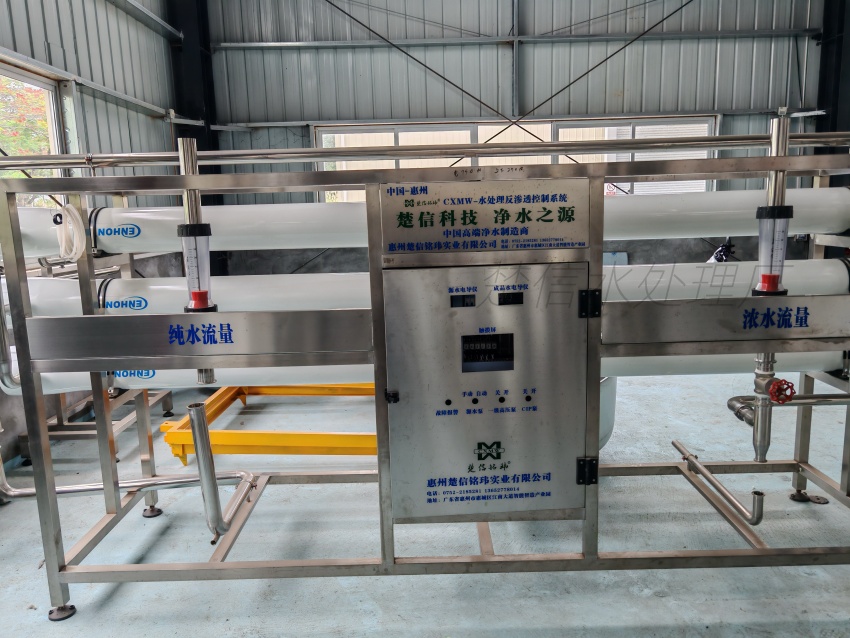
A dedicated RO system that supplies both blending water and CIP tank refill water — with low hardness and low TDS — reduces sterilizer maintenance frequency and extends run time between CIP cycles. When sizing the RO unit, peak demand must be considered, not just the hourly average. The RO system must be sized for blending, CIP, and any cooling water demand simultaneously, and the pretreatment sequence must match the specific raw water profile.
3. Filling and Capping: Clean Air as a Critical Component
After UHT sterilization, juice is filled at elevated temperature (typically 85–88°C) into PET bottles. The filling zone must maintain a controlled environment to prevent recontamination. Even a few airborne yeast or mold spores can cause spoilage in non-carbonated, low-acid juice blends.
ISO Class 8 cleanroom is the practical minimum
Chuxin Mingwei’s Clean Air Purification Systems deliver ISO Class 8 (100,000) or better, engineered to the specific filling room layout. H13 HEPA filtration, combined with project-specific airflow design (1,500–20,000 m³/h), creates a positive-pressure zone around the filler. The design includes duct routing, return air placement, and pressure differentials between the filling room and adjacent areas to avoid turbulence that pulls unfiltered air into the critical zone.
- Why it matters: The brief period between bottle rinsing and capping is a contamination window. A properly designed cleanroom with HEPA filtration and positive pressure control significantly reduces the microbial load around the filler.
- Engineering logic: Airflow is not just about filter rating. The entire air handling system must be engineered to maintain ISO 14644-1 Class 8 compliance under production conditions.
Common misconception: “The filler is enclosed, so we don’t need a cleanroom.”
Enclosures reduce but do not eliminate airborne contamination. Without a properly designed air handling system, positive pressure control is lost, and the enclosure can become a dead zone with unpredictable particle counts. For shelf-stable juice, a cleanroom is a production necessity, not an optional upgrade.
4. Cooling, Conveying, and Packaging Integration
After capping, bottles pass through a cooling tunnel where water temperature and residence time are controlled to bring the product down without thermal shock. The cooling water must be treated to avoid biofilm growth — another reason a site-wide water treatment plan is preferable to isolated unit operations.
Once cooled, bottles move to labeling, case packing, and palletizing. The packaging line must be synchronized with the filler’s output.
Line speed matching and buffer accumulation
The filler is the heartbeat of the line. Labelers, cartoners, and case packers should be selected with a 10–15% overhead above the filler’s nominal speed to absorb micro-stops. Between filling and packaging, accumulation tables prevent one machine’s stoppage from bringing down the entire line. The buffer capacity should be at least 2–3 minutes of filler output.
Integration logic
A monobloc filler-capper that integrates rinsing, filling, and capping reduces transfer interfaces and risk of contamination. However, the front-end water treatment and back-end packaging must be matched to the line’s actual capacity. If the water treatment system cannot supply enough quality water during peak demand, or if the downstream packaging equipment runs slower than the filler, the line will operate at the speed of its slowest, most unreliable section.
5. Common Misconceptions That Derail Juice Hot-Fill Projects
| Misconception | Reality |
|---|---|
| “We can start with the filler and add water treatment later.” | The water system defines product quality from day one. Retrofitting often leads to layout compromises and higher cost. |
| “Any RO system will work for juice.” | The RO system must be sized for blending, CIP, and cooling water demand simultaneously, and pretreatment must match the specific raw water profile. |
| “Softened water is pure enough for blending.” | Softening does not remove dissolved salts or microbes. It is not a substitute for RO. |
| “Cleanroom is an optional upgrade.” | For shelf-stable juice, it is a production necessity. |
| “Packaging equipment can be bought separately and matched later.” | Conveyor speeds, interface signals, and accumulation logic must be designed as a system. |
6. How Chuxin Mingwei Supports Juice Hot-Fill Projects
While Chuxin Mingwei’s core filling equipment is optimized for water and beverage applications, the company’s water treatment systems (RO, NF, UF), clean air purification systems, and packaging integration engineering are directly applicable to juice hot-fill lines.
- We start with the raw water analysis and target product specification to design the right water treatment train — not just a generic RO unit.
- Our cleanroom team designs the filling room air system to ISO 14644-1 Class 8, with upgrade paths to Class 7 if needed.
- For packaging, we provide integrated conveying, labeling, and case packing solutions that synchronize with the filler’s actual output profile.
This “subsystem-first” approach ensures that the critical support systems are not afterthoughts but are engineered in parallel with the thermal process line.
7. Next Steps for Your Project
If you are planning a new juice hot-fill line or upgrading an existing one, we recommend:
- Share your raw water quality report — this is the single most important document for sizing water treatment and predicting operating costs.
- Define your target product specifications — including Brix, pH, bottle size, fill temperature, and desired shelf life.
- Layout your filling room constraints — available space, existing HVAC, and cleanroom classification goals.
With this information, Chuxin Mingwei can propose a water treatment, clean air, and packaging configuration that supports the thermal process — not just individual pieces of equipment.
Contact our engineering team to discuss how our water treatment and packaging integration services can strengthen your juice hot-fill project from the ground up.