
Should Small-Bottle Water Lines Use Monoblock or Modular Filling Equipment? Configuration Comparison & Technical Agreeme
For procurement managers and operations leads in the beverage and water sectors, configuring a small-bottle water production line requires a definitive structural choice: a monoblock (3-in-1) system or a modular filling line. This decision directly impacts factory layout, capital expenditure, and long-term maintainability. Rather than relying on generic industry assumptions, technical teams must map equipment capabilities to real-world operational contexts.
Before Adoption: Prerequisites and Scenario Matching
The selection process begins long before evaluating machine dimensions. It requires a clear understanding of your source water characteristics and production targets.
Water Quality Alignment
The filling configuration must align seamlessly with the front-end water treatment system. Whether your facility utilizes a dual-stage RO reverse osmosis process for purified water or a dual-membrane NF+UF process to retain minerals in spring water, the treated water's microbiological safety dictates the hygiene requirements of the filling zone. The filling environment must protect the water quality achieved by the purification system.
Monoblock Suitability
Monoblock systems are engineered for high-speed, standardized production. They are typically applied to purified water, mineral water, and other non-carbonated drinking water packaged in standard PET round or square bottles. By integrating multiple functions into a single enclosed unit, monoblock machines minimize the factory footprint and significantly reduce the risk of secondary contamination between transfer points.
Modular Suitability
Modular lines, comprising standalone rinsers, fillers, and cappers, are better suited for facilities requiring high operational flexibility. If your production involves diverse bottle geometries, specialized caps, or a phased capacity expansion plan, modular equipment allows for individual machine maintenance without halting the entire line. However, this configuration demands more floor space and complex conveyor synchronization.
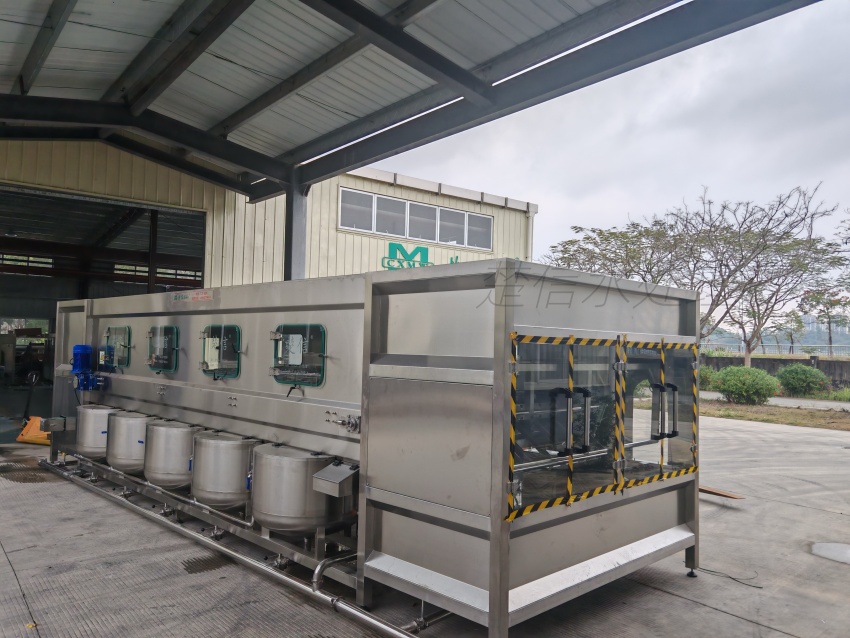
During Adoption: Implementation and Configuration Comparison
Once the configuration is selected, the focus shifts to execution and defining precise technical boundaries.
Core Process Execution
In a monoblock setup, the core workflow—empty bottle conveying, bottle rinsing, quantitative or level filling, cap sorting and feeding, capping, and finished product output—occurs within a unified chassis. The front-end typically connects to water treatment and bottle unscrambling or blow-molding systems, while the back-end integrates with light inspection, inkjet coding, labeling, and packaging equipment.
Critical Technical Agreement Points
To ensure the equipment meets actual production demands, technical procurement teams must define specific quality control parameters in the contract. Key agreement points include:
- Rinse Water Parameters:*
- Defining the required rinse water quality and pressure to ensure effective internal bottle cleaning without damaging the PET structure.
- Contamination Control:*
- Establishing strict protocols for secondary contamination control at the bottle mouth during the transfer from rinsing to filling.
- Filling Precision:*
- Specifying liquid level consistency tolerances to minimize product giveaway and ensure regulatory compliance.
- Automation Logic:*
- Mandating sensors for "no-bottle-no-fill" operations and missing cap detection to reduce waste.
- Capping Integrity:*
- Defining precise capping torque specifications to guarantee seal integrity without deforming the closure.
- Operational Agility:*
- Documenting estimated changeover times for different bottle formats and identifying potential cleaning blind spots within the fluid paths to streamline sanitation procedures.
After Adoption: Operational Boundaries and Support
Transitioning from installation to stable, continuous production requires rigorous validation and sustained support.
Commissioning and Validation
Proper water plant equipment installation and commissioning is critical to ensure that theoretical specifications are achieved in real-world conditions. For instance, validating that the integrated bottle washing-filling-capping unit consistently maintains a filling accuracy of ≤ ±2 mL and a capping pass rate of ≥99.6% requires precise calibration of the PLC-based intelligent control system under actual production speeds.
Maintenance Realities
Operators must be trained on the specific maintenance boundaries of the chosen configuration. For monoblock systems, accessing internal components for deep cleaning requires structured protocols to avoid disrupting the synchronized mechanical timing. Conversely, modular lines require ongoing calibration of conveyor transfer points to prevent bottle jams or scuffing.
Conclusion
The choice between monoblock and modular filling equipment is not about which technology is universally superior. It is about which configuration aligns with your specific production capacity, packaging format, facility constraints, and target water standards. Prioritizing stability, applicability, and long-term maintainability ensures a higher return on investment.
Evaluate your source water quality and target output with our engineering team. Contact Chuxin Mingwei to discuss site-specific water treatment and filling solutions engineered for your exact operational context.
ical agreement points. These points must encompass comprehensive selection criteria, including preform and bottle shape, bottle capacity, target capacity, material temperature and carbonation state, cap type, blowing mold cavities, filling valve type, clean environment requirements, compressed air, cooling water, energy consumption, and changeover time. The core operational sequence should cover empty bottle conveying, bottle rinsing, volumetric or level filling, cap sorting and feeding, capping, and finished product output. Crucially, key quality metrics such as rinse water quality and pressure, secondary contamination control at the bottle mouth, and liquid level consistency must be strictly defined. Furthermore, this mechanical configuration must align with the front-end water treatment strategy, as different raw water sources present varying levels of suspended solids, residual chlorine, hardness, iron and manganese, TDS, conductivity, and microbial risks, which ultimately dictate the necessary pretreatment and membrane configurations.