
NF vs. RO for Spring Water Filling: How to Match Purification to Source Characteristics
Why the Purification Choice Defines Your Spring Water Line
For procurement managers and operations leads commissioning a bottled spring water production line, the purification stage is not a generic add-on—it sets the baseline for product positioning, regulatory compliance, and daily maintenance. Spring water differs from purified water in that it must retain characteristic minerals while meeting safety standards. Selecting between nanofiltration (NF) and two-stage reverse osmosis (RO) requires matching the process to actual source water quality, target output standards, and packaging format.
Technical Comparison: NF vs. Two-Stage RO
| Decision Factor | NF Spring Water Equipment | Two-Stage RO Purified Water Line |
|---|---|---|
| Core Objective | Balance purification with mineral retention | Remove dissolved solids to near-zero levels |
| Typical Process | Dual-membrane NF + UF | Multi-media + activated carbon + dual-stage RO |
| Sterilization | Integrated with filling hygiene control | Ozone + UV (254 nm) dual sterilization |
| Filling Accuracy | ≤ ±2 mL per bottle | Customizable per bottle type |
| Capping Pass Rate | ≥99.5% | Project-dependent |
| Best For | Natural spring water with stable mineral profile | Municipal or variable source requiring deep demineralization |
Chuxin Mingwei's NF spring water equipment is engineered specifically for sources where mineral retention is a product requirement. The dual-membrane NF + UF process removes particulates and microorganisms while preserving beneficial ions. In contrast, the two-stage RO process used in purified water lines strips nearly all dissolved solids, making it suitable for municipal or highly variable source water but unsuitable for spring water that must maintain its natural composition.
Selection Criteria for First-Time Buyers
1. Source Water Report Is Non-Negotiable
Before specifying equipment, obtain a comprehensive water quality analysis covering TDS, hardness, heavy metals, microbial load, and seasonal variation. NF performs optimally when source TDS is moderate and mineral composition is stable. RO becomes necessary when source water exceeds safe limits for direct consumption or shows high variability.
2. Packaging Format Drives Line Configuration
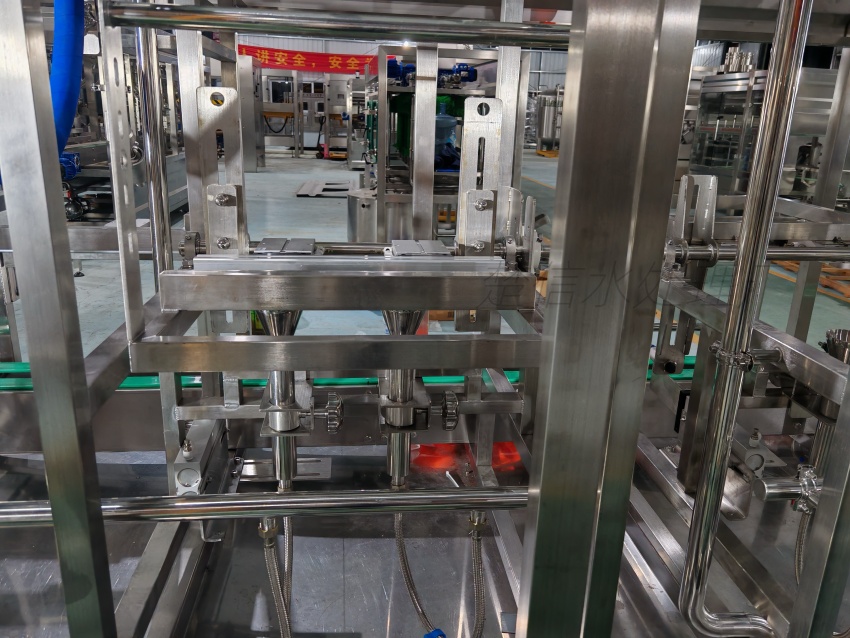
The bottled spring water filling line must align with your target container sizes. Chuxin Mingwei's systems support 18.9 L, 11.3 L, 5 L, and other standard drinking water bottles, with rated output capacity ranging from 200 to 1,800 bottles/hour based on 18.9 L bottles. If your operation requires smaller PET bottles or different cap types, the washing-filling-capping unit and conveyor interfaces must be adjusted accordingly.
3. Clean Air Integration Is Part of the System
Spring water filling requires controlled environments to prevent post-treatment contamination. Clean air purification systems designed to ISO Class 8 (100,000) standards—upgradable to Class 7 (10,000)—should be integrated with the filling line. Airflow, duct routing, and pressure zoning must be engineered based on facility layout, not added as an afterthought.
Implementation Boundaries and Risk Mitigation
- Delivery Scope Clarification: A complete line includes water treatment, bottle handling, filling, capping, inspection, and clean air support. Ensure your quotation explicitly states which components are included, especially regarding installation, commissioning, operator training, and after-sales support.
- Capacity Claims Must Be Contextual: Rated output (e.g., 200–1,800 bottles/hour) assumes standard 18.9 L bottles, consistent source water quality, and proper facility utilities. Actual throughput depends on bottle changeover frequency, maintenance schedules, and operator proficiency.
- Post-Installation Support: Long-term maintainability depends on accessible service points, clear SOPs, and responsive technical support. Verify that the supplier provides documented training, spare parts lists, and remote diagnostics capability.
Next Steps for Procurement Teams
- Request a source water analysis template from your equipment supplier to ensure all critical parameters are captured.
- Define your target water standard (e.g., national drinking water standard, internal brand specification) before finalizing the purification process.
- Confirm facility constraints including floor space, utility connections, drainage, and cleanroom zoning before layout approval.
- Review the delivery workflow from design to commissioning, ensuring operator training and after-sales support are contractually defined.
Chuxin Mingwei delivers end-to-end engineering services for spring water filling equipment, starting from actual source water quality, target standards, production capacity, and facility constraints. If you are evaluating a new line or upgrading an existing one, share your water report and production targets to receive a site-specific configuration proposal.