Pre-treatment Equipment for Tea Beverage Production Lines: From Raw Water to Seamless Integration
Pre-treatment Equipment for Tea Beverage Production Lines: From Raw Water to Seamless Integration
For procurement managers and operations leads in the beverage industry, the pre-treatment stage is often the most underestimated part of a tea beverage production line. Unlike standard purified water projects, tea production introduces specific variables: organic load from extraction, sensitivity to chlorine (which alters flavor profiles), and the rigorous demands of hot-fill processes.
At Chuxin Mingwei, we engineer pre-treatment systems not as generic off-the-shelf units, but as the critical foundation that protects your downstream blending, sterilization, and filling assets. This guide outlines the selection logic, key components, and integration boundaries you must evaluate before purchasing.
Why Standard Water Treatment Configurations Fail for Tea Lines
A common mistake in project planning is assuming a standard reverse osmosis (RO) pre-treatment train is sufficient for tea beverages. While the core hardware may look similar, the operational parameters differ significantly.
Tea extraction water often requires specific mineral balances to optimize flavor release, whereas pure RO water might strip essential taste notes. More critically, tea polyphenols are highly reactive. If residual chlorine from municipal water sources is not completely removed by activated carbon filtration, it can oxidize tea compounds, leading to off-flavors and color degradation. Furthermore, tea lines often operate with higher suspended solids loads during the extraction phase, requiring robust multi-media filtration to prevent rapid fouling of downstream membranes.
Our approach prioritizes product-scenario matching. We analyze your raw water report alongside your target tea formulation to determine whether a standard sand-carbon-softener train is adequate or if specialized oxidation or ultrafiltration steps are required.
Core Components of a Tea Line Pre-treatment System
A reliable pre-treatment system for tea beverages typically consists of four critical stages. Each stage serves a distinct protective function for the subsequent process.
1. Multi-Media Filtration
The first line of defense against suspended solids, turbidity, and sediment. For tea lines handling leaf extraction or concentrate reconstitution, this unit must be sized to handle peak flow rates without excessive pressure drop.
- Function:*
- Removes sand, silt, and large particulates.
- Tea-Specific Consideration:*
- If using well water with high iron or manganese, an aeration or oxidation step may be integrated here to prevent membrane staining later in the line.
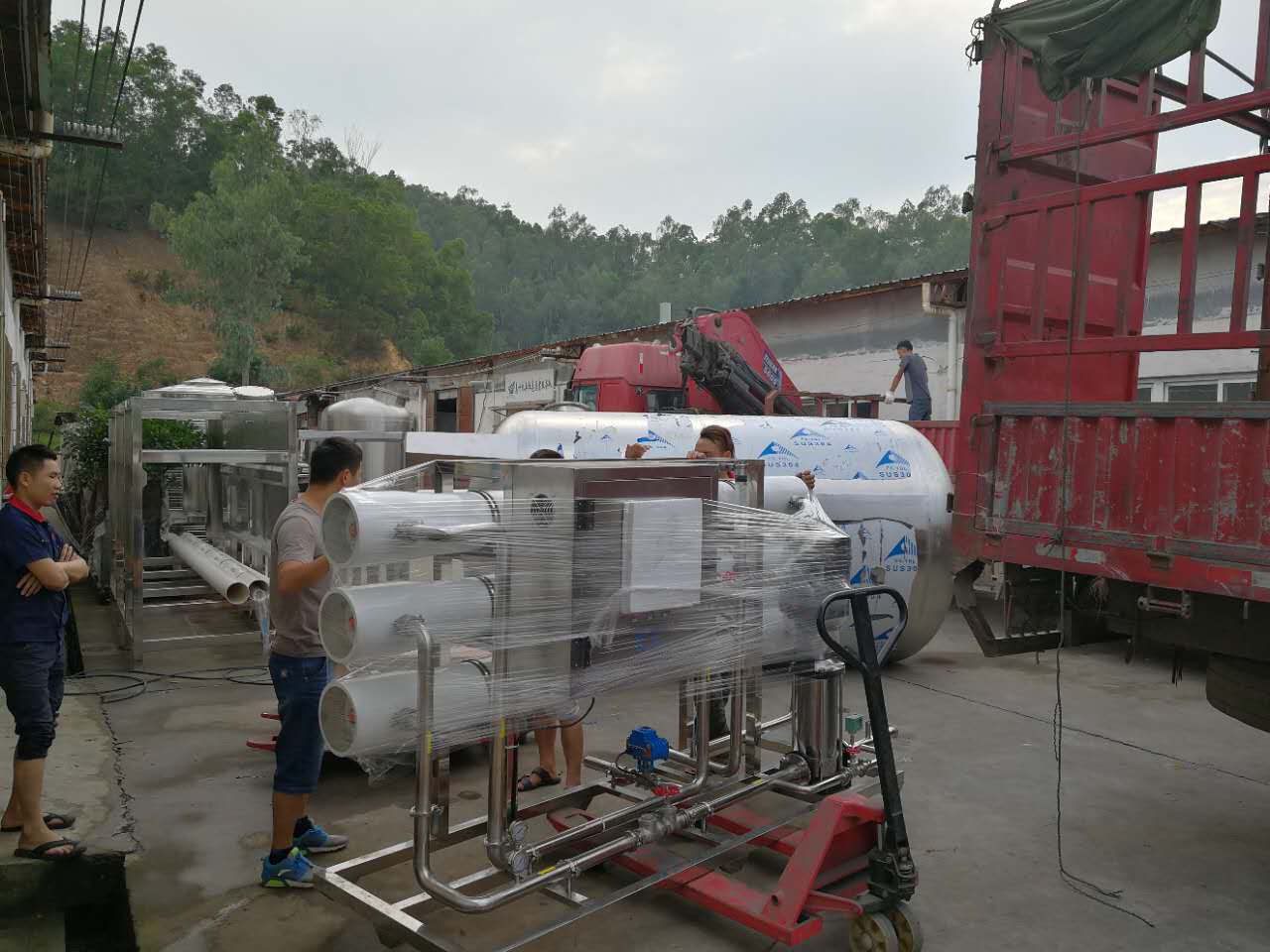
2. Activated Carbon Filtration
This is arguably the most critical stage for flavor integrity.
- Function:*
- Adsorbs residual chlorine, organic compounds, and odors.
- Selection Criterion:*
- Ensure the carbon media has sufficient contact time (empty bed contact time) to reduce chlorine to non-detectable levels (<0.1 ppm). Failure here directly impacts the sensory quality of the final tea product.
3. Water Softening (Ion Exchange)
Hardness ions (calcium and magnesium) can cause scaling in heat exchangers and pasteurizers, which are ubiquitous in hot-fill tea lines.
- Function:*
- Exchanges calcium and magnesium ions with sodium to prevent scale formation.
- Operational Note:*
- As noted in industry best practices, continuous production lines often require a dual-tank softening system (one operating, one regenerating) to ensure uninterrupted water supply during shift changes. Single-tank systems risk downtime during regeneration cycles.
4. Precision Security Filtration
Located immediately before the high-pressure pumps and RO membranes (if used) or directly before the blending tank.
- Function:*
- Captures fine particulates (typically 5-micron or 1-micron) that bypass earlier stages.
- Protection Role:*
- This acts as the final safeguard for high-value equipment. In tea lines, this filter also catches any carbon fines or resin beads that might escape previous vessels, preventing damage to high-pressure pumps and filling valves.
Integration Boundaries and Risk Factors
When evaluating suppliers, it is vital to understand where the pre-treatment scope ends and the process equipment begins. Ambiguity here leads to project delays and performance gaps.
The "Black Box" of Raw Water Variability
No pre-treatment system can be finalized without a comprehensive raw water analysis. Parameters like pH, conductivity, total hardness, iron, manganese, and microbial load dictate the entire configuration.
- Risk:*
- Purchasing equipment based on "typical" municipal water data when your facility uses well water or surface water can lead to immediate membrane fouling or insufficient chlorine removal.
- Mitigation:*
- Insist on a solution design that includes a site survey and water testing phase before manufacturing begins.
Downstream Compatibility
The pre-treatment output must align with the specific needs of your blending and filling sections.
- Hot-Fill Constraints:*
- If your line utilizes a hot-fill process (common for tea to ensure shelf stability), the pre-treated water must be free of organics that could caramelize or foul heat exchangers at elevated temperatures.
- Clean Air Support:*
- While often overlooked, the integrity of the water system is supported by the facility's air quality. In high-care zones, clean air purification systems meeting ISO Class 8 standards are essential to prevent airborne contamination of open tanks or filling zones, ensuring the water quality achieved by pre-treatment is maintained until sealing.
Maintenance and Lifecycle Costs
Equipment selection is not just about CapEx. Consider the operational complexity:
- Regeneration Cycles:*
- Does the softener have automatic controls? Is there a brine tank sizing appropriate for your shift pattern?
- Cleaning Protocols:*
- Can the multi-media and carbon filters be backwashed efficiently without disrupting production?
- Spare Parts:*
- Are filter housings and media standard sizes, or proprietary?
Selection Checklist for Procurement Teams
Before requesting a formal quote, prepare the following data points to ensure an accurate proposal:
- Raw Water Source: Municipal, well, or surface water? (Provide a recent lab report).
- Target Capacity: Required flow rate in m³/hour, accounting for peak extraction demands.
- Product Specifics: Type of tea (green, black, oolong), extraction method, and target Brix/pH.
- Downstream Process: Will the water go directly to blending, or through an RO/EDI system first? Is hot-fill involved?
- Site Constraints: Available floor space, ceiling height, and drainage capabilities.
- Automation Level: Do you require PLC-based control with remote diagnostics, or manual operation?
Next Steps: From Assessment to Implementation
Selecting the right pre-treatment equipment is a balance of chemical engineering, mechanical reliability, and operational pragmatism. At Chuxin Mingwei, we do not offer generic catalogs. Since 2008, we have delivered custom-engineered solutions that map equipment capabilities to real-world operational contexts.
Our process begins with a Requirement Confirmation phase, where we validate your water quality data and production goals. We then move to Solution Design, creating a process route that balances purification efficiency with your specific tea formulation needs. Finally, our Manufacturing & Delivery and Commissioning teams ensure the system integrates seamlessly with your existing or new filling lines.
If you are planning a new tea beverage line or upgrading an existing one, avoid the risk of mismatched equipment. Share your raw water report and capacity requirements with us. We will provide a tailored technical proposal that clarifies the scope, delivery workflow, and long-term support boundaries.
Ready to optimize your water pre-treatment strategy?
Request a Solution Consultation to discuss your specific tea production requirements with our engineering team.