
Pressure-Sensitive vs. Shrink Sleeve Labeling: How Bottle Shape Drives Your Choice
Who This Decision Affects
For procurement managers and operations leads running bottled water, juice, or tea beverage lines, the labeling system is not an isolated purchase. It must synchronize with upstream filling and capping, downstream case packing, and the physical reality of your container. The choice between pressure-sensitive (PS) labels and shrink sleeve labels is primarily driven by bottle shape, but the final decision also hinges on line speed, changeover frequency, and the utilities available in your facility.
Core Principles: How Each Technology Works
Pressure-Sensitive Labeling
Pressure-sensitive labels are pre-cut adhesive labels applied to the container using a wipe-on or blow-on mechanism. The label conforms to the surface it touches, but it cannot wrap around complex curves, deep recesses, or sharp transitions without wrinkling or lifting.
Operating logic: A label web is advanced, peeled from its liner, and pressed onto the bottle as it passes on a conveyor. Registration is controlled by photoelectric sensors reading eye-marks on the web.
Best-fit geometry: Cylindrical or slightly tapered bottles with a flat, continuous labeling panel. Standard round PET water bottles (50–100 mm diameter, as commonly seen in small-bottle drinking water filling lines) are ideal candidates.
Shrink Sleeve Labeling
Shrink sleeves are tubular films dropped over the container and then passed through a heat tunnel (steam or electric). The film shrinks uniformly, conforming to virtually any contour—including hourglass shapes, square-to-round transitions, and full-body coverage.
Operating logic: A flat sleeve is cut from a roll, opened, and dropped over the bottle. The container then enters a shrink tunnel where controlled heat causes the film to contract tightly against the surface.
Best-fit geometry: Contoured, tapered, square, or complex bottles where a PS label would bridge gaps or fail to adhere. Also preferred when 360° coverage or tamper-evident neck bands are required.
Decision Matrix: Matching Label Type to Bottle Shape
| Bottle Characteristic | Pressure-Sensitive | Shrink Sleeve |
|---|---|---|
| Round, straight-wall PET | Excellent | Good (often over-specified) |
| Slight taper (< 5°) | Good with adjusted applicator | Excellent |
| Square or rectangular | Limited to flat panels | Excellent (full-body wrap) |
| Hourglass / deep contour | Not recommended | Excellent |
| Full-body + neck coverage | Not possible | Excellent |
| Tamper-evident band | Separate cap seal required | Integrated into sleeve |
Process Positioning on the Filling Line
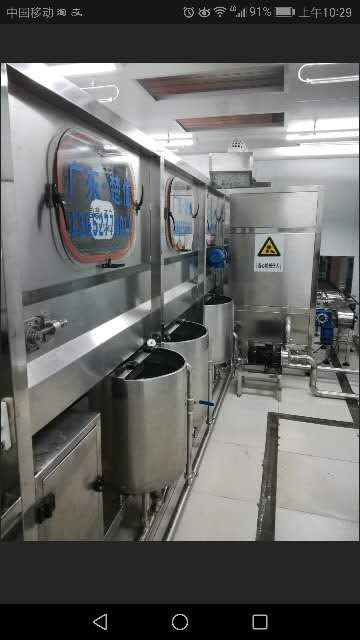
In a typical small-bottle water or beverage production line, the labeling station sits after the wash-fill-cap monoblock and before lamp inspection, inkjet coding, and case packing. The exact position matters:
- Pressure-sensitive applicators require a stable, dry bottle surface. If the line uses a warm-fill process or the bottles exit a rinse station with residual moisture, an air knife or drying tunnel must precede the labeler.
- Shrink sleeve systems are more tolerant of minor surface moisture before the tunnel, but the tunnel itself demands a reliable steam or high-capacity electric heat source. This adds a utility requirement—steam boiler capacity or significant electrical load—that must be confirmed during line planning.
For barrelled water lines (18.9 L / 5-gallon), labeling is often replaced by barrel-wrap packaging using PE or PP film, which is a different equipment category altogether. The principles discussed here apply primarily to single-serve bottles in the 300–2,000 mL range.
On-Site Control Points and Boundaries
Changeover Time and SKU Flexibility
If your facility runs multiple bottle shapes across different SKUs, changeover speed becomes critical. PS labelers generally require mechanical adjustment of guide rails, sensor repositioning, and web threading for each label format. Shrink sleeve systems require sleeve roll changes and tunnel temperature profiling, but the applicator head itself is less geometry-sensitive.
Boundary: If you run more than four distinct bottle shapes per shift, the cumulative changeover time on a PS system may erode your effective capacity. Verify the manufacturer's stated changeover procedure against your actual SKU list before committing.
Line Speed Synchronization
Both labeling technologies must match the output rate of your filling monoblock. A small-bottle water filling machine running at higher capacities requires a labeler with proportional throughput. Mismatched speeds create bottle accumulation on conveyors, which risks tip-overs, label damage, and micro-stoppages.
Boundary: Always calculate line capacity based on the slowest unit. If your filler runs at a given bottles-per-hour rate, your labeler must sustain at least that rate plus a buffer for transient stops and restarts.
Facility Utility Constraints
- Steam tunnels (for shrink sleeves) require a boiler, water treatment for boiler feed, condensate drainage, and ventilation. If your facility lacks steam infrastructure, an electric tunnel is an alternative, but it draws substantial power and may have a slower heat recovery profile.
- PS labelers have a smaller utility footprint—primarily compressed air for blow-on applicators and standard electrical supply. This makes them easier to integrate into facilities with limited utility expansion capacity.
Material and Cost Considerations
Shrink sleeve films (typically PETG or PVC) are generally more expensive per label than PS paper or film labels. However, sleeves eliminate the need for separate tamper-evident cap bands and can replace secondary packaging decoration, which may offset the unit cost in specific product strategies.
When to Involve Your Equipment Supplier Early
Labeling is frequently treated as a downstream afterthought, but it should be part of the initial line layout discussion. Share the following with your equipment manufacturer during the solution design phase:
- Bottle drawings (dimensional profiles, not just volume).
- Label artwork zone (where the label sits, wrap extent, and any neck or shoulder coverage).
- Target line speed and the rated capacity of your filling monoblock.
- Available utilities at the labeling station (compressed air pressure, electrical capacity, steam availability).
- SKU list with changeover frequency expectations.
This data allows the manufacturer to position the labeling station correctly within the conveyor layout, specify the right applicator type, and confirm that the system will synchronize with your wash-fill-cap unit and downstream packaging equipment.
Next Steps
If you are evaluating labeling integration for a new or upgraded water or beverage filling line, start by documenting your bottle geometries and utility conditions. These two inputs will narrow the technology choice faster than any other factor. For a tailored assessment that maps your specific container profile to a labeling solution within your line layout, share your project details with our engineering team.