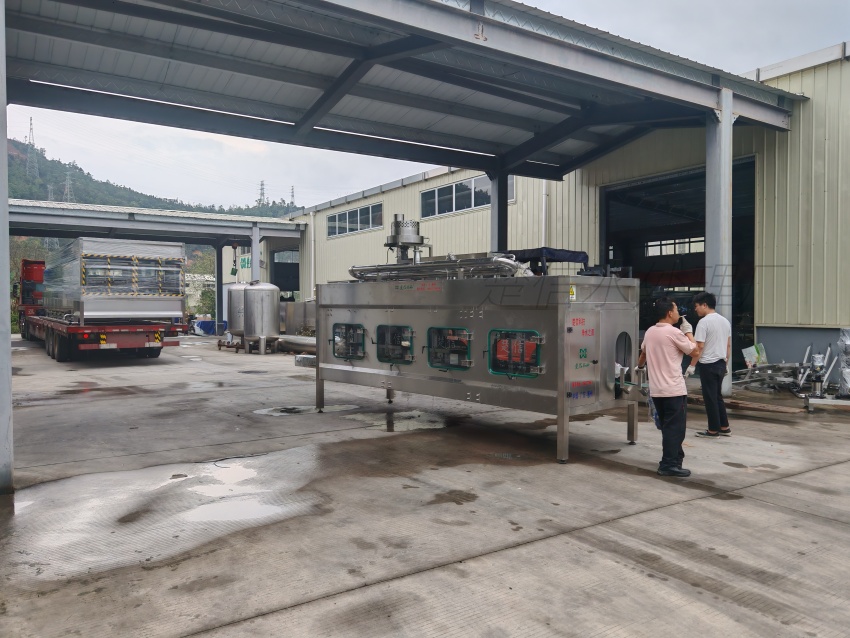
Typical Process Flow for RO + EDI Ultrapure Water Systems: Design Logic and Operational Boundaries for Industrial Client
Chuxin Mingwei designs custom RO + EDI ultrapure water systems for clients in the beverage, pharmaceutical, and electronics sectors who require consistent water resistivity above 1 MΩ·cm — a standard unattainable by single-stage RO alone. These systems are not pre-packaged units; each is engineered from actual source water data, facility layout, and end-use purity targets.
The process begins with comprehensive pre-treatment. Raw water first passes through multimedia filtration to remove suspended solids, followed by activated carbon adsorption to eliminate chlorine and organic contaminants. Sodium ion exchange softening is then applied to reduce hardness, a step critical to protecting downstream membranes. As documented in our technical references, softening does not equate to full demineralization — it only controls scaling potential, not conductivity or microbial risk. Without this step, EDI modules suffer rapid fouling and irreversible damage.
Following pre-treatment, water enters a dual-stage reverse osmosis (RO) system. The first stage reduces total dissolved solids (TDS) by 95–99%, while the second stage further lowers conductivity to below 10 µS/cm. This two-stage configuration is selected not because it is "better," but because it responds to specific feedwater conditions. As our engineering guidelines state, whether to use one or two RO stages depends on original water conductivity, target resistivity, recovery rate, and energy constraints — not on arbitrary capacity labels like 5 T/H or 25 T/H. In one case, a beverage producer in Guangdong experienced declining resistivity during dry season due to rising well water TDS; the solution required adding a second RO stage, not upgrading the EDI module.
The permeate from dual-stage RO then feeds into the electrodionization (EDI) unit. EDI combines ion-exchange resins, selective membranes, and an electric field to remove residual ions without chemical regeneration. This continuous process is ideal for facilities requiring uninterrupted supply, such as pharmaceutical rinse lines or electronics wafer cleaning. However, EDI has strict inlet requirements: conductivity must remain below 40 µS/cm, hardness below 1 ppm (as CaCO₃), and free chlorine must be fully removed. High carbon dioxide levels can also compromise final resistivity, often requiring degassing or pH adjustment upstream. Temperature must be maintained between 5°C and 35°C for optimal ion migration.
These parameters are not theoretical benchmarks — they are operational boundaries observed in field installations. A client in the electronics sector failed to reach 18.2 MΩ·cm because their RO system was sized for average TDS, not peak seasonal levels. The fix required adding CO₂ removal and tightening pre-treatment controls — changes only possible when design starts with actual water analysis.
Chuxin Mingwei does not sell standard RO + EDI packages. Every system is mapped to the client’s unique combination of source water quality, production volume, facility power and drainage, and hygiene requirements. We provide end-to-end engineering services: from collecting and analyzing source water reports, designing the process flow, manufacturing components, to on-site installation, commissioning, and operator training.
For procurement and operations teams evaluating ultrapure water solutions, the decisive question is not: "What resistivity does the system claim?" but: "What is the variability in our source water, and how will the system respond?" If your water comes from groundwater with seasonal TDS spikes, municipal supply with fluctuating chlorine, or surface water with high silica, a generic RO + EDI unit will underperform — regardless of its marketing specs.
Start with a detailed water analysis. Engage an engineer who can match system design to your actual conditions — not a sales catalog.