
Scaling a Bottled Spring Water Filling Line: Operational Boundaries and Maintenance Checkpoints for Procurement Teams
The Real Bottleneck in Spring Water Line Expansion
When beverage producers scale bottled spring water output, the most frequent point of failure is not the filling machine's rated speed—it is the mismatch between raw water variability, purification selectivity, and downstream packaging rhythm. Unlike purified water, spring water must retain its natural mineral profile while meeting microbiological safety standards. This creates a narrow processing window that standard reverse osmosis lines cannot accommodate.
Procurement managers and operations leads evaluating a fully automatic bottled spring water filling line must look beyond catalog capacity figures. The critical task is to examine how the integrated system handles seasonal source water fluctuations, multi-format changeovers, and the hygiene boundaries of the washing-filling-capping monoblock during sustained daily operation.
Scenario: Expanding a Regional Spring Water Facility
Consider a mid-sized beverage operation supplying 18.9L returnable barrels and 5L disposable bottles to local distributors. The existing semi-automatic line faces three constraints during scale-up:
- Mineral stripping during purification: Conventional single-stage filtration removes too much calcium and magnesium during high-turbidity rainy seasons, altering the product's taste profile.
- Format changeover downtime: Switching between 5L and 18.9L formats requires extended manual adjustment, creating scheduling bottlenecks during peak demand.
- Capping inconsistency: Manual or semi-automatic capping introduces leak-test rejections, wasting both product and packaging materials.
The objective is not simply higher bottles-per-hour output, but a stable, validated line that preserves the spring's mineral signature across formats while reducing manual intervention.
Goals, Constraints, and Non-Negotiables
Before issuing a request for quotation, the project team should define the following parameters:
Target Water Standard
Which minerals must be retained, and at what minimum concentration? This determination drives the purification technology selection. Spring water processing requires selecting a purification train that balances safety treatment with source characteristic retention—typically coarse filtration, fine filtration, ultrafiltration, disinfection, and filling hygiene control. Dual-membrane configurations (such as nanofiltration combined with ultrafiltration) balance purification efficiency with selective mineral retention, unlike reverse osmosis which strips nearly all dissolved solids.
Format Flexibility
Can the filling monoblock handle multiple bottle sizes on the same conveyor path without major mechanical reconfiguration? The selection criteria must account for bottle preform and shape, bottle capacity, target output, material temperature and carbonation state, cap type, blowing mold cavity count, filling valve type, clean environment requirements, compressed air, cooling water, energy consumption, and changeover time. Exact changeover durations and tooling requirements must be confirmed during factory acceptance testing.
Hygiene Boundary
The washing-filling-capping unit must operate within a controlled environment. For spring water—which is not sterile-filtered like purified water—the cleanroom air system becomes a critical interface. If the existing facility lacks proper air zoning, the filling line upgrade must include clean air purification system integration.
Capacity Buffer
Rated output assumes ideal conditions. Real-world planning must account for CIP cleaning cycles, bottle supply interruptions, and seasonal raw water quality dips. Calculating actual production capacity requires more than converting bottles-per-hour into finished water volume. Teams must factor in rinse water consumption, CIP cleaning, equipment flushing, blending losses, peak buffering, and planned runtime. The standard approach is to calculate finished output per shift first, then overlay process water and safety margins, verifying that raw water and finished water tanks can buffer short-term fluctuations.
Equipment Scope: What the Monoblock Actually Covers
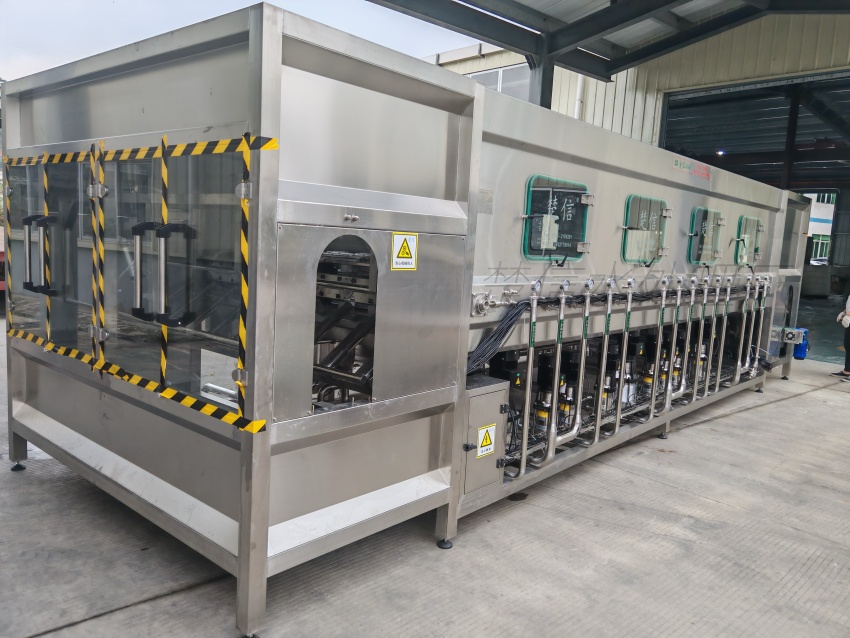
The washing-filling-capping monoblock integrates three processes on a continuous conveyor path to reduce transfer points and bottle mouth exposure, and to synchronize line rhythm and control. However, it does not replace upstream water treatment, bottle supply, or downstream labeling and packaging.
| Process Stage | Function | Critical Checkpoint |
|---|---|---|
| Bottle Washing | Internal rinse with treated water or disinfectant | Rinse water quality and pressure; nozzle alignment for barrel necks |
| Filling | Gravity or low-vacuum filling to precise volume | Fill level consistency; no-bottle-no-fill logic |
| Capping | Cap sorting, placement, and torque-controlled tightening | Cap presence detection; capping torque verification |
The monoblock does not include:
- Raw water intake and storage
- Pretreatment (multimedia filtration, activated carbon, softening)
- Membrane purification systems (NF/UF/RO)
- Ozone or UV sterilization
- Downstream labeling, coding, shrink-wrapping, or palletizing
These upstream and downstream systems must be engineered as a coordinated line. A common procurement error is sourcing the filling monoblock separately from the water treatment system, then discovering that treated water storage cannot buffer the monoblock's peak demand.
Implementation Boundaries: Where Projects Stall
Three boundaries frequently cause deployment delays in spring water line scale-up projects:
Source Water Data Gaps
Spring water facilities must provide a full-year water quality report covering turbidity, total dissolved solids, mineral ions, and microbiological baselines. Without this data, the membrane configuration is speculative. Engineering teams require this information before finalizing the purification train. Facilities unable to supply historical data should budget for an extended monitoring period before equipment specification.
Facility Layout Constraints
An 18.9L barrel line requires significant floor space for empty barrel storage, washing stations, and finished product staging. If the existing building cannot accommodate a linear flow from barrel washing through filling to palletizing, the project may require structural modifications. This is a civil engineering issue, not an equipment issue, but it directly impacts the filling line's effective capacity.
Operator Training and SOP Handover
Fully automatic does not mean unattended. The PLC and HMI control system requires trained operators for recipe management, CIP initiation, and alarm response. The delivery scope should explicitly include operator training sessions and a site-specific standard operating procedure manual—not just a generic equipment manual.
Acceptance Criteria: What to Verify Before Sign-Off
Before issuing the final payment milestone, the procurement and operations team should validate the following:
- Continuous run test: The line must sustain rated capacity for consecutive shifts, with documented downtime events and rejection rates.
- Mineral retention verification: Treated water samples taken at the filling nozzle must be lab-tested against the target mineral profile. This verification should be repeated after membrane cleaning cycles.
- Changeover time measurement: Format switching must be timed and documented, with tooling requirements listed.
- Capping torque audit: A statistical sample of capped bottles must pass torque and leak tests at specified thresholds.
The washing-filling-capping monoblock must be validated for rinse water pressure, bottle neck contamination control, fill level consistency, no-bottle-no-fill logic, cap presence detection, capping torque, changeover time, and cleaning dead zones. These criteria should be written into the purchase contract as binding acceptance conditions.
Next Steps for Procurement and Operations Teams
If your team is evaluating a spring water line scale-up:
- Compile raw water quality data covering a minimum of six months, ideally twelve months of seasonal variation.
- Define target bottle formats and realistic daily output, including buffer for CIP and maintenance.
- Request a site-specific engineering proposal that maps the water treatment system, filling monoblock, and clean air system as an integrated line—not as separate equipment quotes.
- Insist on factory acceptance testing with your actual bottle and cap samples before shipment.
Chuxin Mingwei engineers spring water filling lines from source water data and facility constraints, not from catalog templates. If your project requires validation of mineral retention, multi-format flexibility, or cleanroom integration, the next step is a technical scoping discussion with your water quality report and layout drawings.