
Transitioning from manual to automatic de-capping: Hidden facility requirements
Preparation: Space, Utilities, and Layout Alignment
Before committing to a replacement upgrade or expansion, verify that your existing facility can support the mechanical, electrical, and hydraulic demands of automated de-capping and integrated filling systems.
- Footprint and floor load verification: Automated de-cappers and rotary transfer units require precise spacing and stable flooring. Confirm concrete thickness, vibration tolerance, and drainage gradients to handle high-pressure wash cycles and potential water pooling.
- Power and compressed air readiness: PLC-controlled lines demand stable voltage and dry, oil-free compressed air. Map current electrical panels against the new machine’s startup surge and continuous draw. Ensure pneumatic regulators match the torque requirements for servo-driven capping heads.
- Conveyor synchronization and alignment: Manual lines often rely on simple roller belts. Automatic systems require synchronized speed control, photoelectric sensors, and star-wheel transfers to prevent bottle stacking or jamming during cap removal and forward movement.
Implementation: Process Integration and Boundary Management
Automation upgrades succeed when scope boundaries are clearly defined and utility balances are calculated before installation begins.
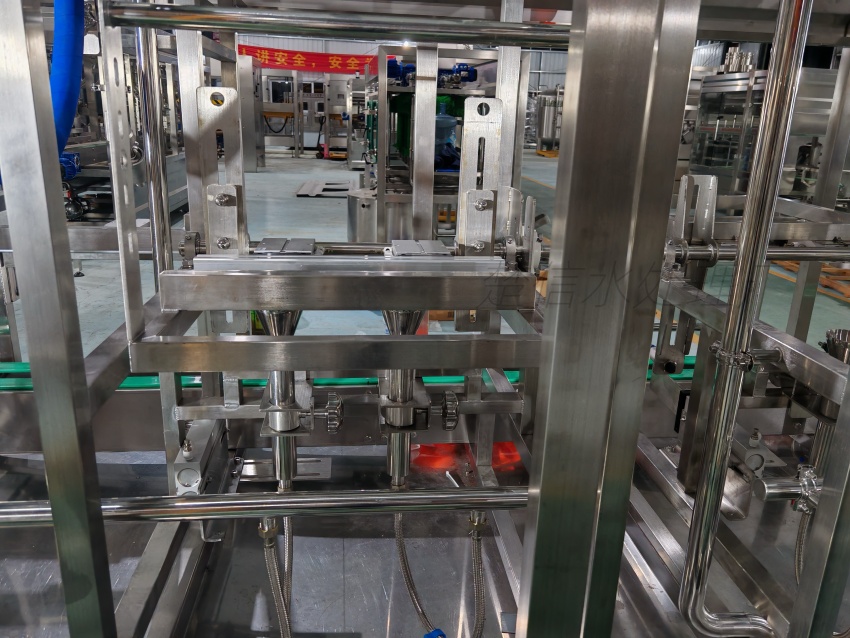
- Define the turnkey scope boundary: An integrated three-in-one unit consolidates rinsing, filling, and capping into a single continuous path, minimizing bottle mouth exposure and transfer points. However, it does not replace front-end water purification or back-end labeling and shrink-wrapping stages. Clearly document what is included in the delivery package versus what remains under your existing infrastructure.
- Balance hydraulic and pneumatic loads: Rated output (e.g., 200–1,800 bottles/hour for 18.9 L bottles) must be matched with actual plant water recovery rates and CIP cycle times. Account for rinse water consumption, tank buffering capacity, and peak operational shifts. Final calculations should be confirmed through a project-specific material balance rather than theoretical throughput alone.
- Control system configuration: Ensure PLC/HMI interfaces are programmed for your specific bottle formats (e.g., 5 L, 11.3 L, 18.9 L). Verify that sensor calibration aligns with your existing quality inspection protocols and that remote-ready diagnostics are accessible for your technical team.
Acceptance: Performance Verification and Compliance
Acceptance testing should validate real-world stability, not just idle machine function. Use this checklist to sign off on critical performance metrics.
- Validate filling accuracy and capping integrity: Target metrics typically include filling tolerance within ±2 mL and capping pass rates exceeding 99.6%. Run continuous trials under full load to confirm consistency across different batch runs and temperature conditions.
- Verify hygiene and cross-contamination controls: Confirm that the de-capping mechanism prevents cap debris from entering the fill zone. Test flush-water pressure and final rinse sterility against your target water standard, whether using dual-stage RO deep purification or NF+UF mineral retention processes.
- Document OEE baseline: Record actual throughput versus theoretical capacity. Factor in changeover time, planned downtime, and minor stops to establish a realistic performance benchmark before final commissioning approval.
Maintenance: Long-Term Operability and Support
Sustained uptime depends on structured preventive maintenance and clear after-sales boundaries.
- Establish preventive maintenance schedules: Automated conveyors, rotary valves, and servo-driven capping heads require regular lubrication, belt tension checks, and seal inspections. Align spare parts inventory with the manufacturer’s recommended replacement intervals to avoid unplanned stoppages.
- Train operations and technical staff: Move beyond basic HMI navigation. Ensure your team understands error code resolution, safe lockout/tagout procedures for high-speed mechanical zones, and routine sanitation protocols that comply with food-grade or pharmaceutical standards.
- Clarify after-sales boundaries: Confirm response times, remote diagnostic access, and on-site visit policies. Verify whether operator training, initial commissioning support, and long-term maintenance contracts are explicitly outlined in your agreement.
Upgrading to automatic de-capping and filling is a facility-wide transformation, not a single-machine swap. By mapping space, power, conveyor alignment, and service boundaries upfront, operations and procurement teams can reduce commissioning delays and secure predictable long-term performance.