
Two-Stage Reverse Osmosis Process Flow: How It Works, When It’s Required, and What Chuxin Mingwei Engineers Into Real Pr
Who This Guide Is For
Procurement managers, plant engineers, and project leads evaluating two-stage reverse osmosis systems for stable, low-conductivity purified water — especially in beverage bottling (e.g., 5-gallon purified water lines), food processing, electronics rinse water, or pharmaceutical process water applications. This reflects the actual process flow embedded in Chuxin Mingwei’s Fully Automatic Bottled Purified Water Filling Production Line (Product ID #59) and Fully Automatic Barrelled Purified Water Production Line (Product ID #54).
Why Two Stages? It’s About Stability — Not Just Lower Conductivity
Two-stage RO is not merely ‘more membranes’. It is a purpose-built response to three real-world constraints:
- Feed water TDS > 500 ppm (e.g., groundwater, brackish municipal supply),
- Requirement for final permeate conductivity < 5 µS/cm (critical for ozone stability, sterile storage, or high-purity rinsing),
- Need to maintain long-term membrane performance under variable hardness or silica levels.
Unlike single-stage RO, the two-stage architecture separates bulk desalination (Stage 1) from precision polishing (Stage 2). Stage 1 handles fouling-prone feed and delivers intermediate-quality water; Stage 2 operates on pre-stabilized permeate — enabling tighter rejection control and predictable lifespan.
The Six-Stage Process Flow — With Equipment Logic & Boundaries
1. Pre-Treatment System
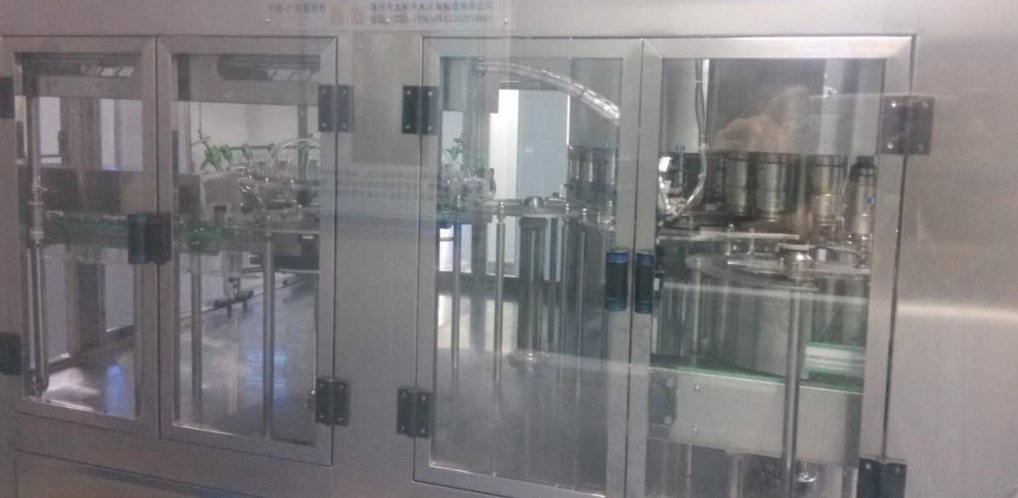
- Purpose: Remove suspended solids, chlorine, organic matter, and hardness before
- RO — preventing irreversible membrane scaling or oxidation.
- Standard Chuxin Mingwei configuration: Multi-media filter → activated carbon filter → softener (if hardness > 150 mg/L CaCO₃) → 5 µm precision filter.
- Critical boundary: As stated in , “pre-treatment is selected based on original water test reports — never standardized.” Groundwater with iron/manganese triggers optional oxidation + filtration; municipal water mandates full carbon adsorption to protect RO membranes.
2. First-Stage RO Unit
- Function: Primary salt removal (95–98% rejection); produces permeate at ~10–50 µS/cm.
- Core components: High-pressure pump, membrane housings (BW30 or equivalent), flow/pressure sensors, auto-flush valve, and CIP interface — per ’s specification that “RO host typically consists of high-pressure pump, membrane housings, membrane elements, flow/pressure instruments, control system, and cleaning interface.”
- Design dependency: Recovery rate is set between 50–75%, balancing flux, concentrate disposal, and fouling risk — not maximized arbitrarily.
3. Intermediate Storage & pH Adjustment
- Why required: First-stage permeate contains dissolved CO₂, resulting in low pH (~5.5–6.0). Unadjusted, this accelerates stainless steel corrosion and reduces second-stage membrane rejection efficiency.
- Chuxin Mingwei practice: Sodium hydroxide dosing or degasification is standard — not optional — to raise pH to 6.5–7.5 before Stage 2 feed.
4. Second-Stage RO Unit
- Function: Polishing to <5 µS/cm; targets residual silica, boron, and trace ions.
- Configuration: Uses tighter-tolerance, low-energy membranes (e.g., ESPA2); lower flux, higher crossflow velocity.
- Key boundary: Second-stage recovery is deliberately capped at ≤50% — a deliberate trade-off to ensure stable rejection and extend membrane life. This contrasts with generic marketing claims of “high-recovery dual RO.”
5. Post-Treatment Sterilization
- Integrated system: UV (254 nm) + ozone generator + sterile storage tank — matching ’s specification: “ozone generator, ozone mixing device; UV sterilizer; sterile water tank, finished water tank, circulation pipeline.”
- Rationale: RO removes ions and microbes but does not sterilize. In Product ID #59, this stage is validated for ≥4-log pathogen reduction — essential for bottled water compliance.
6. Distribution & Monitoring
- Non-negotiable controls: Conductivity meter (with alarm), flow/pressure logging, and automated CIP scheduling — all integrated into PLC-HMI control per Product ID #59’s documented specifications.
- Implementation note: Real-time diagnostics and remote support readiness are built-in — not retrofitted.
When Two-Stage RO Is Not the Right Choice
- Feed water TDS < 300 ppm with consistent low hardness (single-stage RO suffices),
- Projects without committed pre-treatment maintenance or scheduled membrane cleaning,
- Facilities lacking space for intermediate tanks or pH adjustment skids.
Your Next Step Starts With Verified Data
As states: “Collect source water, raw water test report, target use, and target water quality.” Two-stage RO performance hinges on three inputs:
- Full raw water test report (TDS, hardness, alkalinity, iron, manganese, SDI),
- Confirmed hourly/peak demand and daily operating hours,
- Facility constraints (power voltage, floor load capacity, drainage slope).
Without these, equipment selection remains theoretical. Chuxin Mingwei’s engineering workflow begins here — with requirement confirmation, not catalog browsing. Our deliverables include validated process flow diagrams, equipment layout plans, and a clear scope boundary: what’s included (factory-tested skids, commissioning support), and what requires client-side coordination (civil foundations, utility tie-ins, local regulatory sign-off).
If your project demands stable, low-conductivity purified water — and you have source water data — we’ll provide a validated two-stage RO process flow diagram, equipment list, and implementation timeline within 5 working days.