Ultrapure Water Equipment Working Principle Explained: Core Components, Treatment Logic, and Applicable Scenarios
Why Ultrapure Water Systems Fail to Meet Expectations
A common issue in industrial water projects is specifying "ultrapure water equipment" without defining the actual water quality target, production capacity, or end-use scenario. When the system is delivered, operators often find that conductivity, microbial levels, or particle counts do not match expectations. This usually happens because ultrapure water is not produced by a single machine; it is the result of a coordinated process chain that must be matched to source water characteristics, facility constraints, and final application requirements.
This guide explains the working principle of ultrapure water equipment, outlines the core components and treatment logic, and clarifies applicable scenarios and implementation boundaries for procurement and engineering teams.
Core Components and Treatment Logic
Ultrapure water equipment is engineered as a multi-stage purification system. The working principle relies on sequential removal of suspended solids, dissolved ions, organic matter, and microorganisms, followed by controlled storage and distribution to prevent recontamination.
1. Pre-Treatment Stage
The first step protects downstream membranes and ion-exchange units. Typical components include:
- Multi-media filtration
- to reduce turbidity and remove larger suspended particles.
- Activated carbon filtration
- to adsorb chlorine, organic compounds, and odors.
- Water softening or anti-scalant dosing
- to prevent membrane fouling from hardness ions.
- Precision filtration
- (usually 5 μm or 1 μm cartridge filters) as a final safeguard before high-pressure stages.
Pre-treatment is not optional. Without it, RO membranes and polishing units degrade quickly, leading to unstable water quality and frequent maintenance.
2. Primary Purification: Reverse Osmosis (RO)
RO is the core deionization step. Water is pressurized through semi-permeable membranes that reject 95–99% of dissolved salts, organics, and microorganisms. In many ultrapure water systems, a two-stage RO configuration is used to achieve lower conductivity and higher stability. Online monitoring of pressure, flow, and conductivity ensures consistent performance and early detection of membrane fouling.
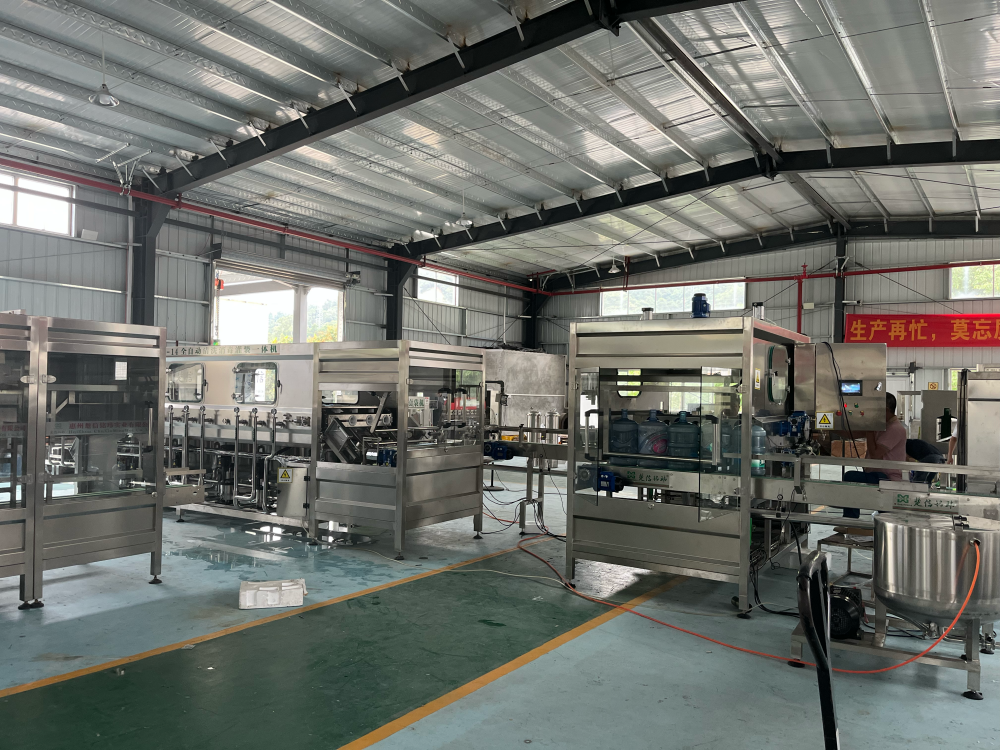
3. Polishing and Final Treatment
After RO, additional polishing steps bring water to ultrapure standards:
- Mixed-bed ion exchange or electrodeionization (EDI)
- removes residual ions to achieve resistivity targets.
- UV sterilization (254 nm)
- and ozone disinfection control microbial load. Ozone is effective for bulk water and container sanitation but requires careful control of dosage, contact time, and off-gas management. UV provides physical disinfection but does not leave a residual effect; its performance depends on water clarity, flow rate, and lamp maintenance.
- Sterile storage tanks and recirculation loops
- prevent stagnation and secondary contamination. Continuous circulation with periodic sanitization (CIP) maintains water quality between production cycles.
4. Distribution and Monitoring
Ultrapure water quality is maintained through closed-loop piping, sanitary fittings, and real-time monitoring of conductivity, TOC, and microbial indicators. Pumps, valves, and instrumentation are selected for compatibility with high-purity water and ease of maintenance.
Applicable Scenarios and Selection Criteria
Ultrapure water equipment is not a one-size-fits-all solution. It is typically deployed in:
- Pharmaceutical and biotech manufacturing, where water must meet pharmacopeia standards for injectables and formulation.
- Electronics and semiconductor production, where low ionic content and particle control are critical for wafer cleaning and process rinsing.
- High-end beverage and food processing, where consistent water quality affects product taste, shelf life, and regulatory compliance.
- Laboratory and analytical facilities, requiring stable resistivity and low organic load for sensitive testing.
When specifying ultrapure water systems, procurement teams should clarify:
- Source water quality
- (municipal, well, or surface water) and seasonal variations.
- Target water standards
- (resistivity, conductivity, TOC, microbial limits) based on end-use requirements.
- Production capacity
- and peak demand patterns.
- Facility layout, including space for pre-treatment, RO skids, storage tanks, and distribution piping.
- Automation level
- and integration with existing PLC/SCADA systems.
Implementation Boundaries and Risk Management
Ultrapure water systems require disciplined operation and maintenance. Key boundaries include:
- RO is not a standalone solution.*
- It must be supported by proper pre-treatment and post-treatment to achieve stable ultrapure output.
- Disinfection methods have limits.*
- Ozone requires controlled dosing and off-gas handling; UV effectiveness declines with lamp aging and sleeve fouling. Neither replaces proper system hygiene and CIP protocols.
- Storage and distribution are critical.*
- Stagnant water, dead legs, or non-sanitary fittings will degrade water quality regardless of upstream purification performance.
- Maintenance must be data-driven.*
- Replacement of membranes, filters, UV lamps, and resin should be based on operating data (pressure drop, flow, conductivity, cleaning history) rather than fixed schedules.
Next Steps for Project Planning
If your facility requires ultrapure water for production, the first step is a technical assessment of source water, target quality, and process integration. Chuxin Mingwei engineers custom water treatment and filling systems based on actual site conditions, production capacity, and packaging formats. We provide end-to-end services including design, manufacturing, installation, commissioning, operator training, and after-sales support.
For procurement and engineering teams, we recommend:
- Collect source water analysis reports and define target water specifications.
- Map production capacity and layout constraints to determine equipment footprint and automation needs.
- Request a technical proposal with process flow, component specifications, and service boundaries.
- Plan for long-term maintenance by establishing monitoring protocols and spare parts inventory.
Contact our engineering team to discuss your ultrapure water requirements and receive a site-specific system design.