
Utility Engineering Checklist for Water Treatment and Filling Equipment Installation
Who Needs This Checklist?
This utility engineering checklist is designed for facility engineers, plant managers, and project coordinators overseeing the first-time installation of custom water treatment and filling systems — especially those deploying:
- Fully automatic bottled spring water filling lines (e.g., 18.9 L systems with nanofiltration and ultrafiltration)
- Bottled purified water production lines with reverse osmosis and sterilization
- Clean air purification systems integrated with bottling or barrelled water filling operations
It applies to new greenfield projects and brownfield upgrades across beverage, food, pharmaceutical, and electronics manufacturing sites in China — where utility infrastructure often predates modern automation requirements.
Why Utility Readiness Matters — Not Just for Commissioning
Chuxin Mingwei delivers end-to-end engineered solutions: design, manufacturing, installation, commissioning, operator training, and after-sales support. But successful commissioning depends on your site’s utility foundation. A mismatch between equipment specifications and on-site utility supply is the most common cause of delayed handover, unplanned rework, or compromised long-term stability — especially for non-standard, site-specific systems.
Unlike off-the-shelf machines, our solutions are engineered from your actual source water quality, target standards, production capacity, packaging format (PET, HDPE, aluminum caps), and physical constraints (ceiling height, floor load, duct routing). That means utility interfaces must be verified before equipment arrives — not during installation.
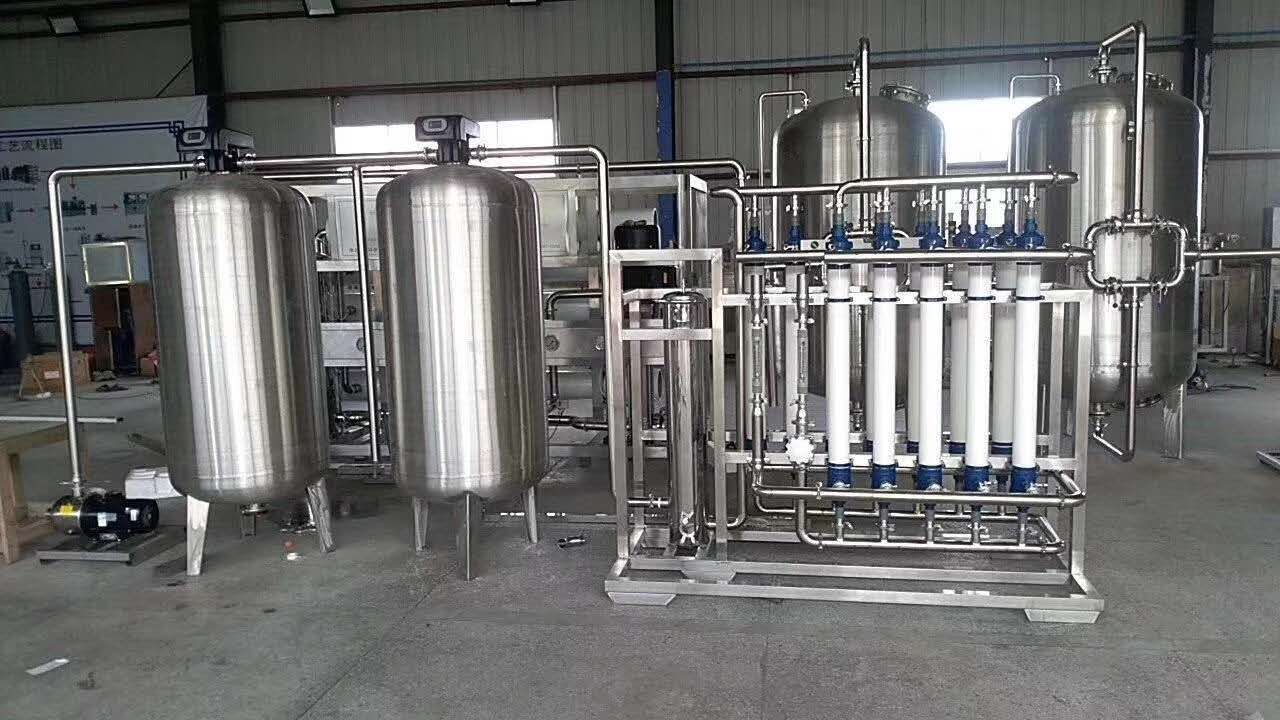
Key Utility Requirements — Verified Against Real Product Specifications
1. Electrical Supply
- Voltage & Phase: 380 V, 3-phase, 50 Hz (standard for PLC-based control systems)
- Power Capacity: Minimum 30–120 kVA depending on line configuration (e.g., 18.9 L spring water line with washing-filling-capping unit requires ≥65 kVA)
- Critical Note: Voltage fluctuation beyond ±10% or unbalanced phase loading may trigger control system faults. Dedicated circuit breakers with surge protection are required.
2. Compressed Air
- Pressure: Stable pressure within 0.6–0.8 MPa range, oil-free, with dew point low enough to prevent condensation in pneumatic components
- Flow Rate: ≥1.2 m³/min for 18.9 L filling lines; ≥2.0 m³/min when integrating clean air systems
- Note: Air used for capping, bottle handling, and filter actuation must be free of oil and moisture — contamination directly affects mechanical reliability and sealing performance.
3. Cooling Water (for high-pressure pumps, UV lamps, and heat exchangers)
- Inlet Temperature: ≤30°C; flow sufficient to maintain thermal stability during continuous operation
- Water Quality: Non-corrosive, low hardness, no residual chlorine (to protect stainless steel components)
4. Drainage & Wastewater Handling
- Floor drains with adequate diameter and slope required near rinsing stations, cleaning-in-place (CIP) skids, and membrane housings
- Wastewater from concentrate streams, bottle rinsing, and CIP must be routed to dedicated pretreatment — not general plant sewer
5. Cleanroom Integration (for clean air systems)
- Structural ceiling load capacity sufficient to support suspended filtration modules (H13 grade, airflow up to 20,000 m³/h)
- Return air pathways and pressure zoning required to maintain separation between clean and adjacent zones
- Duct routing must avoid conflict with overhead utilities (electrical trays, fire sprinklers, piping)
What’s Not Covered — Clear Boundaries
Chuxin Mingwei provides:
- Full electrical termination points (cable entry glands, busbar connections)
- Pneumatic quick-connect fittings and isolation valves
- Interface drawings for cooling water inlet/outlet and drain connections
- Cleanroom airflow modeling reports and pressure mapping protocols
We do not provide:
- On-site utility upgrades (transformer replacement, compressor retrofit, pipe rerouting)
- Civil works (floor reinforcement, trenching, duct penetration sealing)
- Third-party utility certification or testing
All such scope must be confirmed and completed by your facility team prior to scheduled installation start date.
Next Steps: From Checklist to Commissioning
- Download & Complete: Use our Utility Readiness Form (PDF, bilingual) to document your site’s current utility status against each item above.
- Share Early: Submit the completed form at least 30 days before planned delivery. Our engineering team will flag gaps and propose technical workarounds — e.g., buffer tanks for unstable water pressure, local air dryers if central system falls short.
- Joint Walkthrough: Schedule an on-site utility verification visit 10–14 days pre-installation. We’ll validate measurements, inspect termination points, and confirm interface alignment.
- Proceed Confidently: Once verified, commissioning proceeds per agreed schedule — with full operator training and documented SOP handover.
For immediate support, contact your Chuxin Mingwei project engineer or request a bottled water production line quotation with utility review included.
Important Context for Decision-Making
- These requirements reflect real product configurations: e.g., 18.9 L filling lines require ≥65 kVA; H13 HEPA systems require structural ceiling load capacity matching airflow volume; capping reliability depends on consistent, dry, oil-free air.
- Requirements scale with system complexity — adding clean air integration or dual-stage purification increases utility demand.
- All values are derived from operational experience across beverage, food, and pharma installations in China — not generic benchmarks.
- Final utility sizing must be confirmed through joint engineering review, as site-specific conditions (e.g., ambient temperature, pipe length, elevation) affect performance.