
Water Treatment Production Line Process Flow: From Raw Water to Filled Bottles — Stages, Equipment Logic & Operational B
Who This Guide Is For
Procurement managers, plant engineers, and operations leads in beverage, food, pharmaceutical, electronics, and industrial manufacturing — especially those evaluating or specifying a new water treatment and filling line. This is not a generic overview. It reflects how Chuxin Mingwei designs, builds, and commissions non-standard systems — starting from actual source water quality and ending with stable, compliant output.
The Core Principle: Process Flow Is Not Fixed — It’s Engineered
Unlike off-the-shelf units, a water treatment production line’s process flow is determined before equipment selection — based on three non-negotiable inputs: (1) your raw water test report (TDS, hardness, iron/manganese, turbidity, microbiology), (2) your target water standard (e.g., GB 19298 for packaged drinking water, USP Purified Water, or ISO 3696 Class 3), and (3) your physical constraints (facility layout, power supply, drainage, and ceiling height). As stated in our engineering protocol: “No detection → no reliable configuration” .
Stage-by-Stage Process Flow & Equipment Logic
1. Pre-Treatment (Raw Water Conditioning)
Purpose: Protect downstream membranes and ensure consistent feed quality.
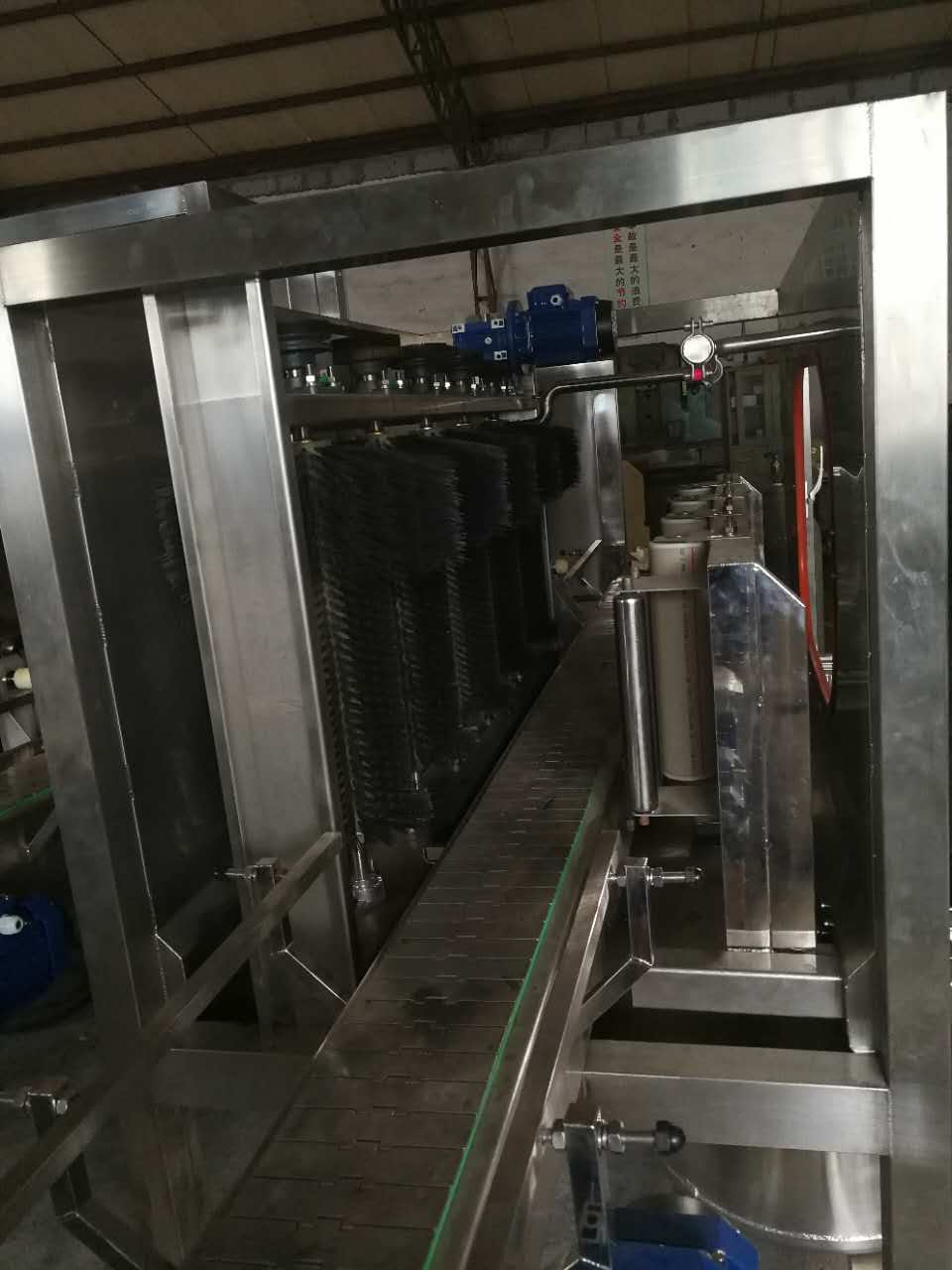
- Includes: multi-media filter (reduces turbidity and suspended solids), activated carbon filter (removes chlorine and organics), softener (prevents RO membrane scaling), and precision cartridge filter (5–10 μm, final barrier before RO/UF).
- Optional add-ons: coagulant dosing (for high-turbidity surface water), pH adjustment, or antiscalant injection — selected only after lab analysis .
2. Primary Purification
Choice depends entirely on source and target:
- For purified water: Dual-stage RO system — first pass reduces TDS by ~98%, second pass achieves ≤5 μS/cm conductivity. Used in our Fully Automatic Bottled Purified Water Filling Production Line (ID: 59).
- For spring/mineral water: NF + UF combination — nanofiltration retains beneficial minerals while removing pathogens; ultrafiltration polishes particulates and bacteria. Applied in our [Bottled Spring Water Filling Production Line] (ID: 60).
- For high-purity applications
- (electronics, pharma): EDI or mixed-bed polishing follows RO — but only when resistivity >1 MΩ·cm is required .
3. Disinfection & Storage
- Ozone generator + contact tank (for residual microbial control), followed by UV sterilizer (254 nm) as final barrier.
- Stainless steel finished water tank (304 or 316L), CIP cleaning loop, and constant recirculation to prevent biofilm formation .
4. Filling & Packaging Integration
The water treatment line does not operate in isolation. Its output must match the hydraulic and sanitary requirements of the filling line:
- For bottled lines: Finished water is fed under pressure to a 3-in-1 rinsing-filling-capping machine. Filling accuracy is maintained at ≤±2 mL per bottle (ID: 60); flow rate must align with line speed (200–1,800 bottles/hour for 18.9 L).
- For barrelled lines: Water enters a sterile buffer tank before feeding into a wash-fill-seal unit. Triple-layer disinfection (internal wash + ozone + UV) ensures compliance for PC/ABS barrels (ID: 57, ID: 55).
- Clean air support is mandatory: Our ISO Class 8 (100,000) cleanroom systems integrate airflow zoning, H13 HEPA filtration, and PLC-controlled pressure cascades — engineered specifically for bottling environments (ID: 58).
Key Operational Boundaries — What Determines Success
- Capacity mismatch risk: A 2,500-bph RO system feeding a 500-bph filling line creates unnecessary energy waste and maintenance burden. We size all components to match peak hourly demand, not theoretical max .
- Water quality drift: Without ongoing monitoring (TDS, pH, ORP, UV intensity), performance degrades silently. Our systems include online sensors and remote-ready HMI interfaces (ID: 58, ID: 59).
- Facility readiness: Pre-installation site survey is mandatory — including floor load capacity, electrical grounding, compressed air dew point, and drain slope. Skipping this step causes 70% of commissioning delays .
Next Step: Get a Site-Specific Flow Diagram
Share your raw water report, target standard, hourly capacity, and facility dimensions. Within 3 working days, we’ll deliver a validated process flow diagram — with equipment list, pipe sizing notes, and interface specifications for your civil and electrical contractors.
Chuxin Mingwei has delivered 100+ turnkey water treatment and filling lines since 2008 — all engineered to perform reliably under real operating conditions, not just lab specs.