
10L Bottled Water Production Line Process Flow: Failure Points, Equipment Logic & Corrective Actions
Where 10L Bottled Water Lines Actually Fail
Procurement managers and operations leads often assume that a 10L bottled water production line lives or dies at the filling station. In practice, the most costly failures — microbial contamination, inconsistent fill volumes, cap seal leaks, and off-taste complaints — originate upstream. They stem from mismatches between raw water quality and pretreatment design, inadequate container decontamination, or uncontrolled airflow in the filling environment.
This article walks through the 10L bottled water production line process flow stage by stage, not as a generic overview, but as a diagnostic map. Each section identifies a common failure mode, explains the engineering principle that should prevent it, and outlines the corrective action. The focus is on 10L formats — large-format bottles that sit between small PET bottles and 18.9L returnable barrels — because their unique handling, filling, and sealing requirements introduce failure points that standard line designs often overlook.
---
Stage 1: Raw Water Intake & Pretreatment — The Foundation Most Lines Skip
Common Failure: Membrane Fouling Within Weeks of Commissioning
When a 10L line experiences rapid pressure drop across RO or UF membranes, the root cause is almost never the membrane itself. It is undersized or incorrectly configured pretreatment. Raw water sources — municipal supply, borehole, spring, or surface water — carry suspended solids, organic matter, hardness ions, and residual chlorine that must be managed before water reaches precision filtration.
The Engineering Logic
A properly sequenced pretreatment chain for a 10L bottled water line typically follows this order:
- Multi-media filtration
- removes larger suspended particles and reduces turbidity, protecting downstream units.
- Activated carbon filtration
- adsorbs organic compounds and residual chlorine that would otherwise oxidize and degrade RO membranes.
- Water softening
- (ion exchange) reduces calcium and magnesium to prevent scaling on membrane surfaces.
- Precision filtration
- (typically 5 μm cartridge filters) acts as the final guard before RO or UF modules.
The specific configuration depends entirely on the source water report. A spring water source with low turbidity but high mineral content requires a different pretreatment strategy than a municipal supply with chlorine residual and seasonal turbidity spikes.
Corrective Action
Before specifying any 10L filling line, obtain a full raw water analysis covering at minimum: turbidity, TDS, hardness, iron, manganese, free chlorine, and microbial counts. Match pretreatment equipment to these parameters — not to a standard catalog configuration. Chuxin Mingwei engineers each water treatment system from actual source water quality and target water standards, rather than applying a fixed template.
---
Stage 2: Core Purification — RO vs. UF and the Mineral Retention Question
Common Failure: Product Water Does Not Meet Label Claims
For purified water, the standard is two-stage RO reverse osmosis, which reduces TDS to single-digit levels. For spring water or mineral water, the goal is different: remove pathogens and particulates while retaining naturally occurring minerals. Applying RO to a spring water source strips the minerals that define the product.
The Engineering Logic
- Two-stage RO
- is the standard for bottled purified water. The first stage removes the bulk of dissolved solids; the second stage polishes the permeate. Ozone and UV (254 nm) dual sterilization provide redundant microbial control.
- Dual-membrane NF + UF
- is the appropriate process for spring water. Nanofiltration reduces hardness and certain contaminants while allowing monovalent minerals to pass. Ultrafiltration provides a physical barrier against bacteria and particulates without altering mineral composition.
The choice between these paths is not a preference — it is determined by the product standard you must meet and the source water composition you start with.
Corrective Action
Define your target water standard before selecting purification equipment. If your product is labeled "purified water," plan for dual-stage RO with integrated ozone and UV sterilization. If your product is "spring water" or "natural mineral water," specify NF + UF and validate mineral retention against your source water profile. Chuxin Mingwei's bottled spring water filling production line uses a dual-membrane NF + UF process specifically to balance purification efficiency with mineral retention.
---
Stage 3: Container Handling — The 10L Format's Hidden Complexity
Common Failure: Contamination Introduced After Purification
Water may leave the treatment system at specification, but if the 10L bottle is not properly cleaned, rinsed, and handled in a controlled environment, the final product will fail microbial testing. This is especially critical for 10L bottles because their large internal volume and narrow neck make thorough internal rinsing more difficult than with smaller formats.
The Engineering Logic
The 10L bottle format occupies a distinct position in the packaging spectrum. Unlike 330 mL to 5L bottles that run on standard rotary washing-filling-capping monoblocks, and unlike 18.9L returnable barrels that require multi-stage external and internal brushing, 10L bottles may be either single-use or returnable — and the handling logic changes entirely depending on which.
For single-use 10L bottles, the process typically involves:
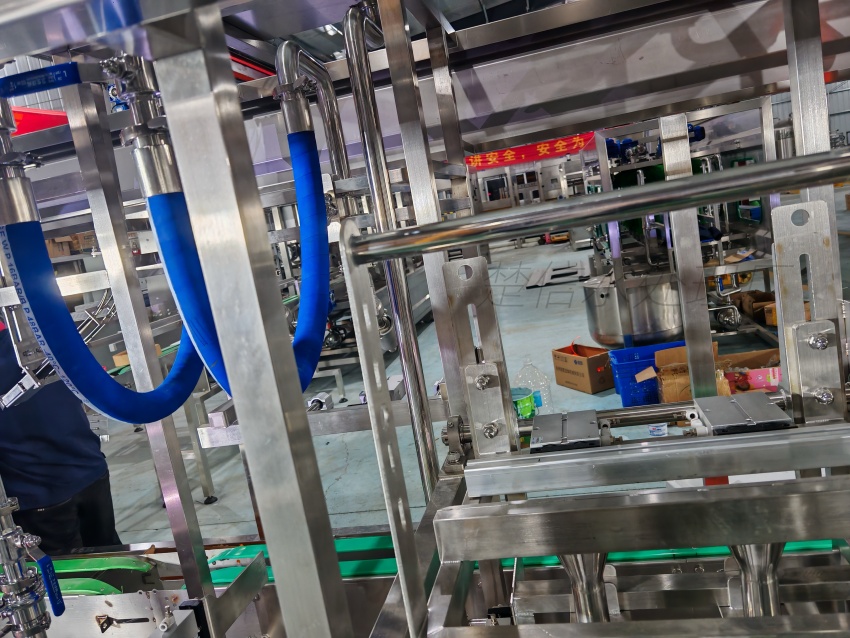
- Empty bottle unscrambling and conveying
- Inverted high-pressure rinsing with purified water
- Immediate transfer to the filling station in a controlled environment
For returnable 10L bottles, additional stages are required:
- Visual inspection and sorting for damage or contamination
- External brushing
- Internal brushing with detergent solution
- Multi-stage rinsing with disinfectant and final purified water rinse
The washing-filling-capping integration matters here. Chuxin Mingwei's integrated bottle washing-filling-capping units are designed to minimize the time and exposure between rinsing and filling, reducing the window for airborne recontamination.
Corrective Action
Specify your container type — single-use or returnable — at the project scoping stage, not after equipment procurement. Ensure the rinsing system delivers adequate pressure and contact time for the 10L internal geometry. If running returnable containers, include inspection and brushing stages that smaller-format lines typically omit.
---
Stage 4: Filling & Capping — Precision at Scale
Common Failure: Fill Volume Drift and Cap Seal Failures
At production rates of 200 to 1,800 bottles per hour (based on large-format bottles), even small inconsistencies in fill volume or cap torque compound into significant product loss, regulatory non-compliance, or customer complaints.
The Engineering Logic
Modern 10L filling lines use PLC-based intelligent control systems to synchronize bottle positioning, fill valve timing, and capping torque. Key performance benchmarks include:
- Filling accuracy: ≤ ±2 mL deviation per bottle
- Capping pass rate: ≥99.6% first-pass seal integrity
These figures are achievable only when the filling environment is controlled, the bottle is properly presented to the fill nozzle, and the cap is oriented and applied with consistent force. Any upstream disruption — a misaligned bottle, a warped cap, a pressure fluctuation in the product water supply — will manifest as a filling or capping defect.
Corrective Action
Validate that the filling monoblock is rated for your specific bottle dimensions and neck finish. Confirm that the PLC control system includes real-time fill volume monitoring and automatic reject diversion. Ensure cap sorting and orientation equipment is matched to your cap specification. Chuxin Mingwei's filling systems integrate these controls as standard, with filling accuracy and capping pass rates verified during commissioning.
---
Stage 5: Clean Air & Filling Environment — The Invisible Variable
Common Failure: Intermittent Microbial Contamination Without an Obvious Source
When water treatment is correct, containers are clean, and equipment is sanitized — yet microbial counts still spike — the cause is frequently the filling environment itself. Airborne particulates and microorganisms settle into open bottles during the brief window between rinsing and capping.
The Engineering Logic
A 10L filling line requires a controlled cleanroom environment around the washing-filling-capping zone. The applicable standard is typically ISO 14644-1 Class 8 (equivalent to the legacy Class 100,000), with the option to upgrade to Class 7 (Class 10,000) for higher-risk products or stricter regulatory environments.
Key design parameters include:
- HEPA filtration
- (H13 grade) on supply air
- Positive pressure zoning
- to prevent infiltration from adjacent unclassified areas
- Airflow rates
- engineered to the specific room volume and personnel count (ranging from 1,500 to 20,000 m³/h depending on project scope)
- PLC + HMI control
- with real-time differential pressure monitoring and diagnostics
Chuxin Mingwei's clean air purification systems are site-specifically engineered for airflow, duct routing, and pressure zoning based on the actual filling room layout — not selected from a standard catalog.
Corrective Action
Treat the filling environment as part of the production line, not as a facility afterthought. Specify cleanroom class based on your product risk profile and regulatory requirements. Ensure the air handling system is integrated with the filling line's PLC for coordinated start-stop and alarm management.
---
Stage 6: Post-Filling — Inspection, Packaging & Traceability
Common Failure: Shipping Defective Product That Passed the Filler
A bottle that leaves the capping station with a micro-leak, a low fill level, or a misapplied label will reach the customer unless downstream inspection catches it.
The Engineering Logic
Post-filling stages for a 10L line typically include:
- Light inspection
- (visual or automated) for particulates, fill level, and cap alignment
- Leak detection
- for seal integrity
- Labeling or sleeve application
- with position verification
- Date coding
- (inkjet or laser) for batch traceability
- Secondary packaging
- — shrink wrapping, carton packing, or handle application
- Conveying to palletizing
- and warehouse staging
Each of these stages must be synchronized with the line speed. A bottleneck at the labeler or palletizer will force the filler to slow down or stop, reducing overall equipment effectiveness.
Corrective Action
Design the post-filling chain with the same rigor as the water treatment and filling stages. Include automated reject mechanisms at inspection points. Ensure secondary packaging equipment is rated for the weight and dimensions of filled 10L bottles — which are significantly heavier than standard PET formats and require different handling logic.
---
Operational Boundaries: What a 10L Line Cannot Do
It is equally important to understand the limits of a 10L bottled water production line:
- Format flexibility has limits.*
- A line configured for 10L bottles can often accommodate adjacent sizes (5L, 11.3L), but changeover requires mechanical adjustment and PLC recipe changes. It is not a universal platform for all bottle sizes from 330 mL to 18.9L.
- Capacity is finite.*
- Rated outputs of 200–1,800 bottles per hour are based on specific bottle sizes and cannot be arbitrarily increased without adding parallel filling stations.
- Water treatment is not optional.*
- Even if municipal water meets drinking standards, it must still be treated to meet bottled water product standards and to protect filling equipment from scaling and biofilm.
- Maintenance is condition-based.*
- Consumables such as RO membranes, UF cartridges, UV lamps, and ozone generator components should be replaced based on operational data — inlet/outlet pressure, differential pressure, flow rate, conductivity, water temperature, and cleaning history — not on a fixed calendar schedule.
---
Next Steps for Procurement & Project Teams
If you are evaluating a 10L bottled water production line, the following sequence will reduce project risk:
- Obtain a comprehensive raw water analysis and define your target product water standard.
- Confirm your container specification — single-use or returnable, exact dimensions, neck finish, and cap type.
- Define your required output in bottles per hour, accounting for shift patterns and future expansion.
- Assess your facility constraints — floor space, ceiling height, cleanroom zoning, utility connections (water, power, drainage, compressed air).
- Request a site-specific process design that maps equipment capabilities to your actual operational context, rather than selecting from a standard catalog.
Chuxin Mingwei provides end-to-end engineering services for 10L bottled water lines — from source water assessment and process design through manufacturing, water plant equipment installation and commissioning, operator training, and sustained post-installation support. Every system is engineered from your water quality, production capacity, packaging format, and facility constraints.
For 10L bottled water lines, the complete process chain extends well beyond pretreatment and filling. After precision filtration, the system typically incorporates single-pass or double-pass RO, membrane pre-dosing, online monitoring, and concentrate management. Disinfection relies on ozone generators with mixing devices and UV sterilizers, followed by sterile water tanks, circulation piping, and CIP cleaning systems. On the packaging side, 10L formats — whether returnable or single-use — require dedicated handling: empty bottle inspection and sorting, cap removal, external and internal brushing, multi-stage washing and disinfection, final rinsing with finished water, filling, cap application and pressing, light inspection, labeling or shrink sleeving, inkjet coding, bagging, and palletizing. Line selection must account for bottle type and capacity, mouth specifications, cleanliness of returnable containers, hourly output, shift patterns, future expansion plans, number of washing stations, disinfection methods, automation level, cleanroom zoning, and utility conditions. Unlike smaller PET bottles processed on integrated rinse-fill-cap monoblocks, 10L lines demand careful coordination between container decontamination stages and the filling environment to prevent secondary contamination from residual cleaning agents, final rinse water quality, cap hygiene, and uncontrolled airflow.