
Assessing Maintenance and Support for Spring Water Filling Equipment: Myths vs. Field Realities
Who This Guide Is For
When procuring a fully automatic bottled spring water production line, especially for cross-regional or international facility deployments, evaluating the vendor's maintenance and support framework is just as critical as assessing the hardware. Spring water presents unique operational variables—such as seasonal source fluctuations and mineral retention requirements—that directly impact equipment wear and service frequency.
This guide uses a myth-versus-fact framework to help procurement managers, operations leads, and digital project teams separate generic vendor promises from actionable, site-specific support realities. By understanding these boundaries, teams can accurately evaluate the total lifecycle cost of their 18.9L bottled water equipment and smaller format lines.
Myth 1: "Spring Water and Purified Water Lines Share the Same Maintenance Schedule"
The Claim
Vendors often provide a standardized preventive maintenance calendar, assuming all water filling lines require identical service intervals regardless of the water source or purification method.
The Operational Fact
Spring water requires a delicate balance between safe treatment and retaining natural source characteristics, meaning the purification and filling processes differ significantly from standard reverse osmosis (RO) purified water lines. Selecting processes that balance safe treatment with retaining source water characteristics dictates the actual maintenance burden.
Conditions and exceptions:
- Seasonal variation: If your source water experiences high seasonal turbidity or mineral shifts, the pre-treatment and ultrafiltration (UF) membranes will require more frequent chemical cleaning than a stable municipal RO system.
- Exception: If the spring source is exceptionally stable year-round and microbial risks are consistently low, maintenance intervals may align closer to standard purified water lines. However, this must be verified via a comprehensive 12-month water quality report, not assumed.
What to verify: Does the vendor’s support proposal adjust membrane cleaning and sanitization frequencies based on your specific seasonal water analysis, rather than a fixed calendar?
Myth 2: "Line Capacity (Bottles/Hour) Directly Equals Consumable Usage"
The Claim
Calculating spare parts and consumable usage is simply a matter of multiplying the rated bottles-per-hour capacity by the planned operating hours.
The Operational Fact
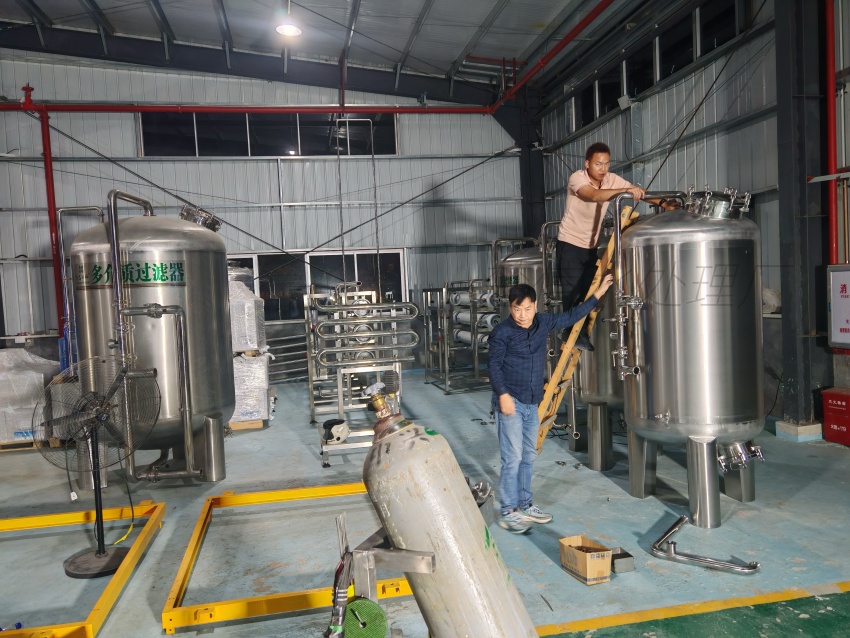
You cannot simply convert the filling line's bottles-per-hour rate into finished water volume or consumable wear; you must also factor in bottle washing water, CIP cleaning, equipment flushing, blending losses, peak buffering, and planned runtime.
Conditions and exceptions:
- Returnable formats: For 18.9L bottled water equipment handling returnable barrels, the multi-stage washing process (including external brushing, internal brushing, and disinfection) consumes significant water and causes mechanical wear on brushes and nozzles, independent of the actual filling speed.
- Exception: If the line runs exclusively single-use PET bottles with a simple rinse, the gap between rated capacity and actual resource consumption narrows, but CIP cycles and equipment flushing still dictate chemical and filter usage rates.
What to verify: Has the vendor provided a mass balance calculation that includes CIP cycles, washing water, and flushing volumes to accurately project consumable lifespans and utility requirements?
Myth 3: "Integrated 3-in-1 Machines Eliminate the Need for Environmental Monitoring"
The Claim
Using a monoblock washing-filling-capping machine completely isolates the product from the external environment, negating the need for strict cleanroom maintenance and internal sanitation protocols.
The Operational Fact
While a 3-in-1 machine concentrates processes in a continuous conveying path to reduce transfer exposure and unify control, it does not replace the need for frontend water treatment, bottle supply hygiene, or backend packaging controls. Furthermore, internal machine hygiene remains a critical variable.
Conditions and exceptions:
- Internal quality control: Key quality control points include rinse water quality and pressure, secondary pollution control at the bottle mouth, liquid level consistency, no-bottle-no-fill logic, missing cap detection, capping torque, changeover time, and cleaning dead zones. These require rigorous daily verification.
- Exception: If the facility operates in a highly controlled ISO Class 8 environment with positive pressure, the risk of external contamination drops significantly. However, internal machine dead zones and capping torque drift remain critical maintenance focuses that environmental controls cannot fix.
What to verify: Does the maintenance manual explicitly detail the disassembly and sanitization procedures for internal cleaning dead zones and bottle mouth secondary pollution prevention?
Myth 4: "Remote PLC Support Resolves Cross-Regional Downtime"
The Claim
For cross-regional or overseas projects, remote PLC diagnostics are sufficient to minimize downtime, drastically reducing the need for on-site technician dispatches.
The Operational Fact
Remote support is highly effective for logic faults, parameter adjustments, and alarm resets, but it cannot fix mechanical degradation or physical misalignments on the production floor.
Conditions and exceptions:
- Mechanical realities: Issues such as capping torque drift, liquid level consistency deviations, or missing cap detection sensor misalignments require physical calibration and mechanical intervention.
- Exception: If the local operations team is highly trained and the vendor provides comprehensive video-guided mechanical calibration protocols, some physical adjustments can be handled locally without flying in a technician. This requires a higher initial investment in operator training.
What to verify: What is the vendor’s guaranteed response time and logistical framework for dispatching a mechanical engineer to your specific region when remote troubleshooting fails?
Decision Checklist for Evaluating Support Proposals
Use this checklist when comparing vendor proposals for a bottled spring water production line:
| Evaluation Point | What to Ask the Vendor | Red Flag |
|---|---|---|
| Source Water Alignment | Is the maintenance schedule adjusted for my seasonal water analysis? | Generic schedule identical across all product lines. |
| Consumable Projection | Can I see a mass balance including CIP, washing, and flushing? | Consumables calculated purely on bottles-per-hour output. |
| Internal Sanitation | How are internal cleaning dead zones and bottle mouth pollution addressed? | Over-reliance on the "closed" nature of the 3-in-1 machine. |
| Cross-Regional Dispatch | What is the guaranteed on-site response time for mechanical faults? | Claiming remote support can resolve all physical calibration issues. |
| Cleanroom Integration | Does support cover the air purification system or only filling equipment? | Unclear scope boundaries between water, filling, and air systems. |
Implementation Boundaries and Next Steps
Every conclusion in this guide carries a boundary: maintenance and support requirements for a bottled spring water filling line cannot be fully determined until your source water quality, target production capacity, bottle format mix, and facility layout are defined. Chuxin Mingwei's engineering approach prioritizes this site-specific mapping before proposing equipment configurations or support commitments.
Understanding the water plant cleanroom process flow is essential when evaluating how maintenance responsibilities are divided between water treatment, filling, and air system components. Furthermore, for teams in the budgeting phase, reviewing the bottled water production line cost structure—including long-term maintenance and support costs—provides a more accurate total cost of ownership than equipment pricing alone.
Recommended next steps:
- Compile your source water report: Include seasonal variation data to establish a baseline for membrane and filter maintenance.
- Define your format mix: Specify which bottle sizes (18.9L, 11.3L, 5L, or smaller PET) you will run to calculate accurate mechanical wear and changeover times.
- Request a site-specific proposal: Ask Chuxin Mingwei's engineering team to map maintenance intervals and support response commitments to your actual project parameters.