
How to Match Barrel Cleaning Intensity to Actual Contamination: A Technical Comparison for First-Time Buyers
Why Barrel Cleaning Intensity Must Be Scenario-Driven
When installing a new barrelled water filling line — especially for 18.9 L (5-gallon) or similar sizes — many buyers assume that higher wash pressure or longer cycle time always improves hygiene. In practice, mismatched cleaning intensity can cause three common issues:
- Over-cleaning: Excessive mechanical scrubbing or chemical exposure damages barrel integrity, especially in reused polycarbonate barrels with repeated sterilization cycles.
- Under-cleaning: Insufficient pre-rinse or internal brushing fails to remove biofilm in high-humidity environments, increasing microbial risk between batches.
- Operational inefficiency: Fixed high-intensity cycles increase water, energy, and maintenance costs without proportional quality gains.
The root cause is rarely equipment capability — it’s the assumption that all barrels enter the line with identical contamination levels.
Two Realistic Scenarios: Recycled vs. New Barrels
Chuxin Mingwei’s engineering documentation distinguishes two distinct cleaning workflows based on barrel origin — a detail often omitted in generic equipment brochures but critical for first-time buyers.
Scenario A: Recycling Existing Barrels (Most Common in Domestic CN Market)
Recycled barrels — especially those sourced from food or beverage refill stations — typically carry:
- External contamination: Dust, labels, adhesives, and surface microbes from transport and storage.
- Internal contamination: Residual liquid, mineral scale, or biofilm in valves and seams, depending on prior use and cleaning history.
For such cases, the cleaning line must include:
- Pre-rinse at 3–5 bar
- to remove loose debris before mechanical brushing
- Internal brushing with programmable torque and dwell time, calibrated to avoid barrel deformation
- Final rinse with purified water
- (not raw source water) to prevent recontamination
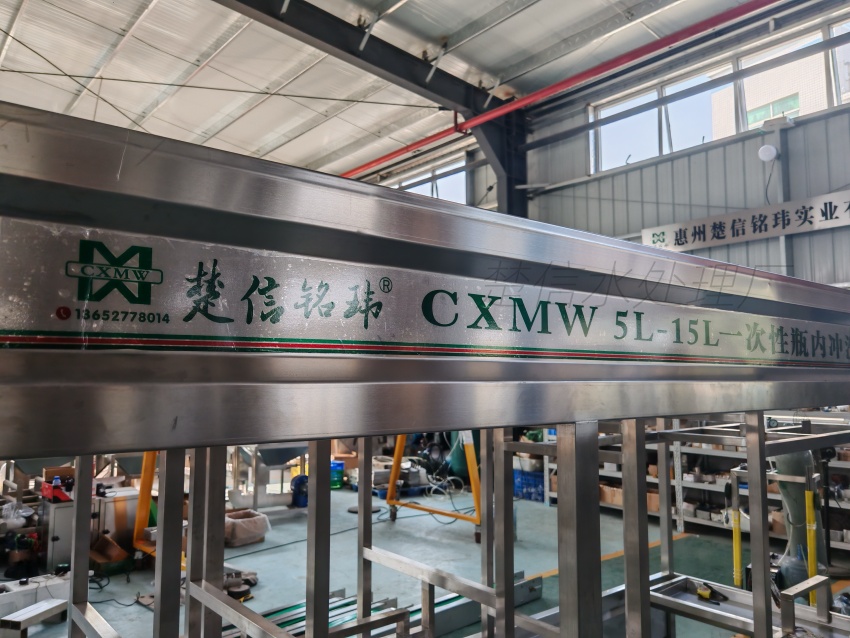
This sequence reflects Chuxin Mingwei’s barrel cleaning workflow: recycled barrel inspection, Cap Removal, external brushing, internal brushing, multi-stage cleaning, disinfection, and final rinse — as documented in their engineering reference for 3–18.9 L barrel lines.
Scenario B: Using New, Single-Use Barrels
New barrels — especially those meeting food-grade standards — often enter the line with minimal contamination:
- Surface dust only, from packaging and handling
- No internal residue or biofilm, assuming proper storage
In such cases, over-aggressive brushing or extended chemical soak may:
- Generate unnecessary micro-scratches that trap contaminants later
- Increase chemical residue risk if CIP rinsing is not perfectly timed
- Reduce throughput due to extended cycle times
For new barrels, Chuxin Mingwei’s standard configuration includes:
- Lower-pressure external wash
- (1.5–2.5 bar)
- Short-duration internal rinse
- (no brushing unless specified)
- Targeted ozone or UV disinfection
- in the final rinse stage
This reduces wear on the barrel and system components while maintaining microbial safety.
How to Estimate Contamination Level Without Lab Testing
While full contamination profiling requires swab testing and microbial analysis, procurement and operations teams can use these practical indicators:
| Indicator | Likely Contamination Level | Recommended Wash Intensity |
|---|---|---|
| Barrels arrive sealed, labeled, and stored indoors | Low | Minimal brushing, short internal rinse |
| Barrels show visible residue, labels, or outdoor exposure | Medium | Pre-rinse + moderate internal brushing |
| Barrels previously used for non-food liquids or stored outdoors | High | Full pre-wash, high-torque brushing, extended CIP |
These thresholds are derived from field observations across multiple beverage and water bottling facilities in southern China — where humidity and seasonal dust significantly affect barrel cleanliness.
Implementation Boundaries and Common Missteps
Even with correct intensity settings, implementation success depends on:
- Barrel feeding consistency: Irregular feeding disrupts timing of brushing cycles and rinse intervals
- Water quality for final rinse: Using unfiltered source water negates prior cleaning steps
- Maintenance of brushes and nozzles: Worn brushes reduce mechanical action; clogged nozzles cause uneven spray
A frequent misstep among first-time buyers is assuming that more cleaning = better hygiene. In practice, Chuxin Mingwei’s technical team observes that a majority of post-installation cleaning failures stem from mismatched intensity — not equipment failure.
Next Steps for Technical Evaluators
If you’re evaluating a new barrelled water filling line and want to ensure cleaning intensity aligns with your actual barrel contamination profile:
- Audit your barrel source: Are they recycled, new, or mixed? What’s their prior use and storage?
- Request a contamination-based wash configuration plan from your supplier — not just a standard spec sheet.
- Ask for adjustable parameters: Pre-rinse pressure, brush torque, dwell time, and CIP cycle length should be user-configurable.
This approach ensures your cleaning stage is neither over-engineered nor under-specified — protecting both product safety and operational economics.
Conclusion
Matching barrel cleaning intensity to contamination level isn’t about choosing the most powerful system — it’s about selecting a flexible one, designed for your specific barrel type and operational context. Chuxin Mingwei’s barrel cleaning modules support this by offering configurable wash stages, not one-size-fits-all defaults — a distinction that matters most for first-time buyers entering the barrelled water market.
CTA
Ready to align your cleaning intensity with actual contamination? Contact our engineering team to request a contamination-based wash configuration checklist — tailored to your barrel source, capacity target, and facility constraints.