
How Ozone and UV Disinfection Systems Work in Bottled Water Production: Principles, Integration Points, and Process Boun
Why Disinfection Is a Critical Control Point in Bottled Water
Microbiological safety is non-negotiable in bottled water production. Even after multi-stage purification, the water can be re-contaminated during storage, transfer, or filling. Disinfection equipment — typically ozone generators and ultraviolet (UV) sterilizers — provides the final barrier against bacteria, viruses, and other pathogens before the bottle is sealed. For procurement and operations teams, understanding how these systems work, where they are placed, and their inherent limitations is essential to specifying equipment that consistently meets regulatory and brand standards.
Chuxin Mingwei integrates disinfection stages into its bottled purified water and spring water filling lines based on source water conditions, target microbial limits, and packaging format. The following technical breakdown focuses on the two dominant disinfection methods used in the industry.
Ozone Disinfection: Principle, Operation, and Control
How It Works
Ozone (O₃) is a powerful oxidant that destroys microorganisms by rupturing cell walls and oxidizing cellular components. An ozone generator produces the gas on-site from oxygen or dry air using corona discharge. The ozone is then injected into the product water through a venturi mixer or diffusion system, where it dissolves and begins reacting immediately.
Process Integration
In a typical bottled water line, ozone is dosed after the final purification step (e.g., reverse osmosis or ultrafiltration) and before the filling machine. A contact tank or pipeline provides sufficient reaction time — usually 4 to 10 minutes — to achieve the required log reduction. Residual ozone in the water also helps sanitize the bottle and cap during filling, offering a secondary barrier.
Critical Control Parameters
- Dosage:*
- Typically 0.2–0.5 mg/L for purified water, but must be validated against the target microorganism and water quality.
- Contact time:*
- Must be verified with tracer studies or CT (concentration × time) calculations.
- Off-gas destruction:*
- Unreacted ozone must be destroyed by thermal or catalytic destructors to prevent worker exposure and equipment corrosion.
- Byproduct management:*
- Bromate formation can be a concern in waters containing bromide; careful monitoring and control are required.
Operational Boundaries
Ozone is not a “set and forget” solution. Water temperature, pH, and organic load affect its decay rate and efficacy. Seasonal changes in source water can demand adjustment of dosing. Without proper off-gas handling and ambient monitoring, ozone can pose an occupational health risk. Moreover, ozone does not provide a lasting residual inside the sealed bottle — its half-life is short — so the disinfection benefit is primarily at the point of filling.
UV Disinfection: Principle, Operation, and Limitations
How It Works
Ultraviolet light at 254 nm penetrates microbial cells and disrupts DNA, preventing replication. UV sterilizers consist of a stainless steel chamber housing one or more mercury-vapor lamps. Water flows through the chamber surrounding the lamp, with the exposure dose determined by lamp intensity, flow rate, and water transmittance.
Process Integration
UV systems are typically installed as a final polishing step immediately before the filler, or as a secondary disinfection barrier after carbon filtration. In some configurations, UV is used in combination with ozone — UV ahead of the storage tank for continuous disinfection, and ozone dosed before filling.
Critical Control Parameters
- UV dose (mJ/cm²):*
- Bottled water applications commonly require ≥ 30 mJ/cm² for basic disinfection, but higher doses (≥ 40 mJ/cm²) may be needed for certain pathogens or regulatory standards.
- Water transmittance (UVT):*
- Impurities like iron, humic acids, or fine particles can reduce UVT, drastically lowering the effective dose. Pre-filtration to ≤ 5 µm absolute is recommended.
- Lamp aging and sleeve fouling:*
- Output declines over time; regular cleaning and periodic replacement (typically every 12 months or after 8,000–9,000 hours) are necessary.
- Flow rate:*
- Exceeding the design flow reduces exposure time, compromising kill efficiency.
Operational Boundaries
UV provides no residual disinfection — it only treats the water passing through the chamber at that moment. Any downstream contamination (e.g., in pipes, storage tanks, or filler components) goes unchecked. Therefore, UV must be coupled with a robust sanitation program for distribution piping and filling equipment. Performance also depends heavily on constant monitoring of UV intensity and automatic shut-off when intensity drops below a safe threshold.
Disinfection in Barrel/Bottled Water Lines: Extending Beyond Product Water
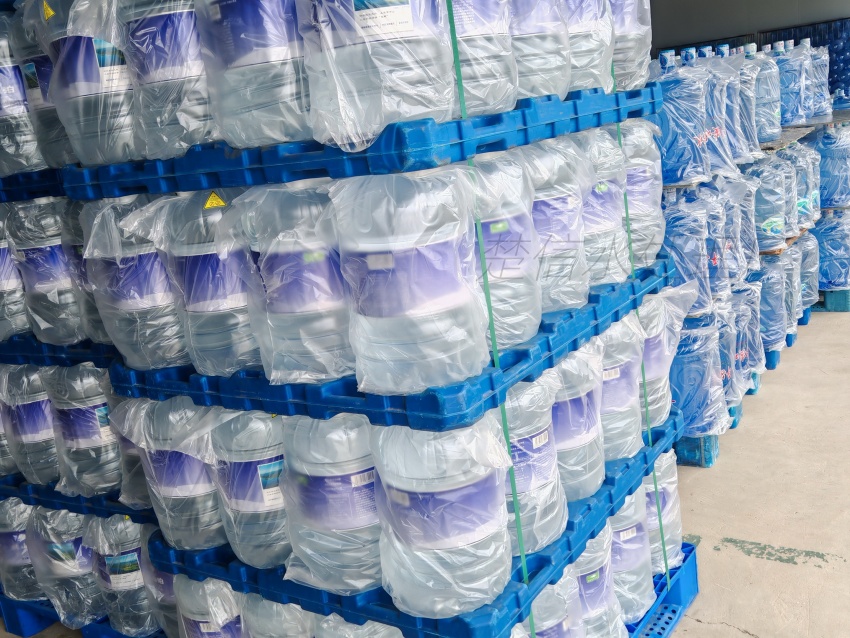
Disinfection is not limited to the product water itself. In barrel (5-gallon) water lines, the cleaning and sanitization of returnable bottles is equally critical. Chuxin Mingwei’s barrel water filling lines incorporate multi-stage washing stations that use hot water, sanitizing agents, and final sterile rinse to achieve acceptable microbial levels. Ozone or UV may also be applied to the rinse water or to the clean bottles just before filling. The same equipment principles apply: ozone’s oxidation power and UV’s physical inactivation are used to address different contamination risks.
Selecting the Right Disinfection Approach: A Framework for Buyers
When evaluating disinfection equipment for a bottled water project, procurement teams should consider:
- Source water characteristics: Bromide content, organic load, and seasonal variability influence ozone suitability.
- Target water standard: International, national, or custom customer specifications may dictate specific residual disinfectant requirements or pathogen log reductions.
- Line configuration: Where is the disinfection step integrated? Is there space for a contact tank? Can off-gas be safely vented?
- Packaging format: Single-use PET bottles, returnable polycarbonate barrels, and bag-in-box systems each have different hygiene demands.
- Regulatory requirements: Some jurisdictions mandate a detectable residual disinfectant (favoring ozone) or strictly limit disinfection byproducts (favoring UV).
Often, a combination of UV and ozone provides the most robust barrier — UV for continuous inline treatment and ozone for residual protection at the filler. The exact configuration must be engineered based on the specific project, not copied from a generic template.
Working with a Manufacturer That Understands the Whole Process
Disinfection equipment does not operate in isolation. It must be sized and positioned within the context of pre-treatment, purification, storage, and filling. An experienced water treatment equipment manufacturer can analyze the source water, define the disinfection stage, and ensure that ozone and UV systems are correctly integrated with the overall line controls. Chuxin Mingwei provides such engineering support — from initial water analysis to installation and after-sales service — helping industrial buyers avoid the common pitfalls of under-specified or over-compensated disinfection systems.
Conclusion
Ozone and UV are proven, reliable disinfection technologies for bottled water production, but their effectiveness depends on careful application and integration. Understanding the working principles, critical control points, and operational boundaries of each method helps procurement and operations teams specify equipment that will perform consistently under real-world conditions. When disinfection is engineered as part of a complete water treatment and filling line, the result is a safer product and a more predictable production process.
Next step: If you are planning a new bottled water line or upgrading an existing one, consult with our engineering team to assess which disinfection strategy fits your water quality, capacity, and regulatory requirements.