
How a Bottled Water Washer-Filler-Capper Integrated Machine Works: Core Components, Process Logic & Real-World Applicati
Who This Applies To
Procurement managers, plant engineers, and digital project leads in beverage, food, pharmaceutical, and electronics manufacturing — especially those evaluating or commissioning fully automatic bottled water filling lines where source water quality, packaging format (e.g., 18.9 L or 5 L bottles), facility layout, and long-term maintainability directly impact ROI.
What It Is — Not Just ‘Three Functions in One’
A washer-filler-capper (WFC) integrated machine is not a modular assembly of separate units. It is a synchronized, PLC-controlled system where bottle handling, purification-aligned filling, and capping operate as a single mechanical-electrical process chain. Chuxin Mingwei engineers this integration around actual operational constraints: raw water mineral profile, target finished water standards (e.g., GB 17323 for drinking water), rated output (200–1,800 bottles/hour for 18.9 L), and factory floor space.
Core Components & Their Functional Logic
- Bottle Handling & Pre-Cleaning Station
Empty PET bottles are fed via conveyor into a multi-stage wash module. Unlike generic rinsers, Chuxin Mingwei’s design includes adjustable nozzles calibrated to bottle geometry (e.g., 18.9 L neck diameter and base contour) and integrates pre-rinse with purified process water — sourced from the same dual-membrane NF + UF system used in spring water lines . This ensures residual contaminants are removed before entering the sterile zone.
- Filling Unit with Precision Control
Filling accuracy ≤ ±2 mL is achieved through servo-driven piston fillers or volumetric flow meters — selected based on water viscosity, CO₂ content (if applicable), and required fill speed. For purified water lines, the filler draws from a pressurized, ozone-treated sterile tank; for spring water lines, it interfaces directly with the NF+UF loop to preserve mineral balance .
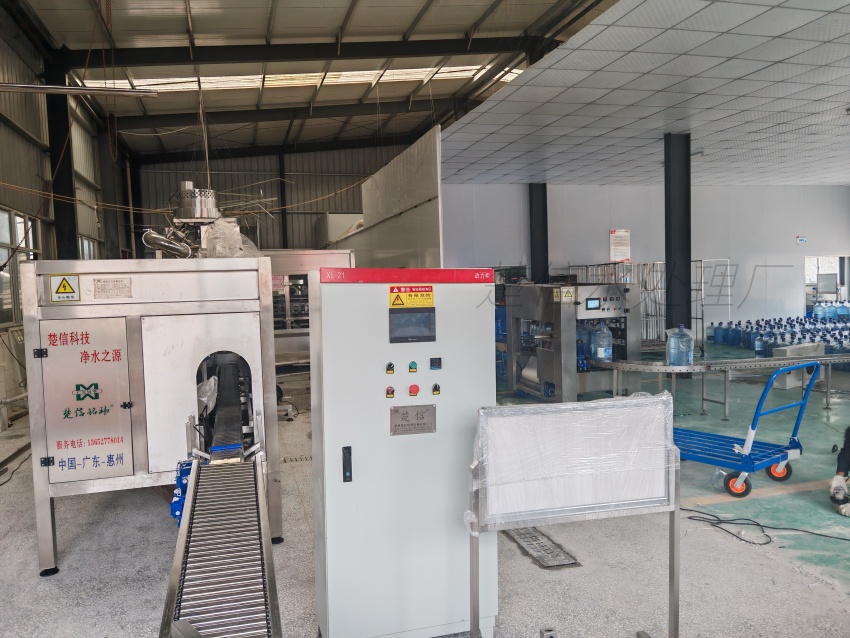
- Capping & Integrity Assurance
Capping torque, head alignment, and cap seal integrity are monitored in real time. The system achieves ≥99.6% capping pass rate by synchronizing cap feed timing with bottle indexing and applying adaptive torque control — avoiding over-tightening that damages PET threads or under-tightening that risks leakage .
- PLC + HMI Intelligence Layer
All subsystems run under a unified Siemens or Mitsubishi PLC platform. Operators access real-time diagnostics (e.g., bottle jam location, fill volume deviation, cap torque drift) via HMI interface — with remote-ready architecture supporting predictive maintenance planning (product ID 59, 60).
Where It Applies — And Where It Doesn’t
Valid Scenarios
- Natural spring water producers needing mineral retention without post-filtration re-mineralization.
- Purified water facilities requiring dual-stage RO + ozone/UV sterilization before filling .
- Facilities with ISO Class 8 cleanroom air support (product ID 58) — WFC operation must be enclosed within validated airflow zones.
️ Boundary Conditions
- Not suitable for non-standard bottle shapes (e.g., oval, asymmetrical) without custom mold/tooling redesign.
- Does not include blow-molding or label application — those are upstream/downstream systems .
- Requires stable electrical supply (±5% voltage fluctuation) and compressed air ≥0.6 MPa, dry and oil-free — verified during site survey.
Why Integration Matters Beyond Automation
Chuxin Mingwei’s WFC design prioritizes process continuity, not just labor reduction. By eliminating intermediate conveyors and manual transfers, it reduces microbial recontamination risk, minimizes bottle handling damage, and enables tighter batch traceability — critical for GMP-aligned food and pharma clients. This is reflected in delivery scope: full engineering, installation, commissioning, operator training, and after-sales support — not just equipment supply (business fact pack).
Next Step: Validate Against Your Reality
Before specifying a WFC line, confirm:
- Your raw water analysis report (TDS, hardness, iron/manganese, microbiology);
- Target bottle type, capacity, and hourly throughput;
- Available floor space, ceiling height, and utility points (water, air, power, drainage).
Chuxin Mingwei begins every project with a site-specific engineering review — not catalog selection.